they’re looking
p. 33 · Read in the full issue
trade winds
Leaping to where they’re looking
Leaping into the informa tion age is sometimes easier for a Third World country than one of the older, richer, powers. The emergent nation does not have millions of dollars invested in still operational, but obsolete, equipment of lesser efficiency.
Thus computer salesmen are finding eager customers in the Pacific and particularly in the bigger island countries like Fiji, and Papua New Guinea, both of which have thriving local computer firms and a relatively high level of computing facility in their business and admi nistrative communities.
All of this has been deve loping over several years but the latest little sprig on the tree has come in from New Zealand by way of Noumea in New Caledonia, carried in the arms of John Nixon, distributor of NCR equipment in the Pacific.
Imagine a scene in, say, Suva, where a Vanuatu businessman has turned up in a branch of his bank to cash a cheque. They don’t know him from Eparama and do not have a record of his signature which is in the bank records 1000 km away. What chance has he got of getting some money? Up to now he would have Buckley’s chance. Very soon, however, through a computer system cal led SIRRES, now spreading through the Pacific, the Suva bank will be able to call up the customer’s signature, on-line, from Port Vila and compare it with the presented cheque.
Other details, like cheque num bers, account balances and so forth will also be available.
SIRRES is already up and running locally in New Caledo nia, Tahiti. Banks in Fiji, Tonga and Solomon Islands are ex-
pected to sign on soon.
John Nixon’s dream of a SIRRES network linking all of the Pacific is still some distance away, but he considers he is getting there. It’s all a matter of educating the region’s bankers to the inherent advantages.
Many Pacific banks areas already heavily involved with computer systems. For exam ple, ANZ, Westpac and Bank of New Zealand in Fiji all offer on-line services throughout their branches in the country.
What Mr Nixon proposes is to extend these lines to form a Pacific network.
Nixon, who is president of Pacifique Technologic, of Noumea, and his associate, Gavin Black, recently saw in the United States an image digitis ing camera using an optically sensitive RAM (random access memory) device. The technolo gy is well-established and the hardware not expensive. In
deed similar “cameras” are to be found in computer stores in Sydney. Indeed, because the digitising camera and the recor ding programme operate through the very common 6502 microprocessor chip, the system can be run on an Apple lie microcomputer. To this is attached an Opto-RAM digitis ing camera, a Corvus 5 Mega byte Winchester disc drive, and an Epson FX-80 dot matrix printer. The software is con tained in EPROMs (program med microchips) on a plug-in card in the Apple so that setting up the system is simply a matter of switching on.
But it is the storage and handling of the digital informa tion which is the key to it all.
Nixon is offering a program especially designed for the is lands, called Pacific Banking System, which interfaces to NCR’s Decision Mate V perso nal computer used as a teller
terminal.
In operation each bank branch sends new-account cards to the SIRRES system each day for an operator to “photograph” the specimen signatures and key in account numbers, names and other de tails.
At the end of each day, or input period, signatures and data are listed for checking then sent into the bank’s host system.
From then on a teller simply uses the computer menu to call up a signature and account details as they are required.
Pacific Banking System allows such displays to be flagged for subsequent audit trail indica tion.
Original versions of the sys tem required about 4 kilobytes of memory for each signature but, through data compression, this has been reduced to one
Kbyte.
Garry Barker
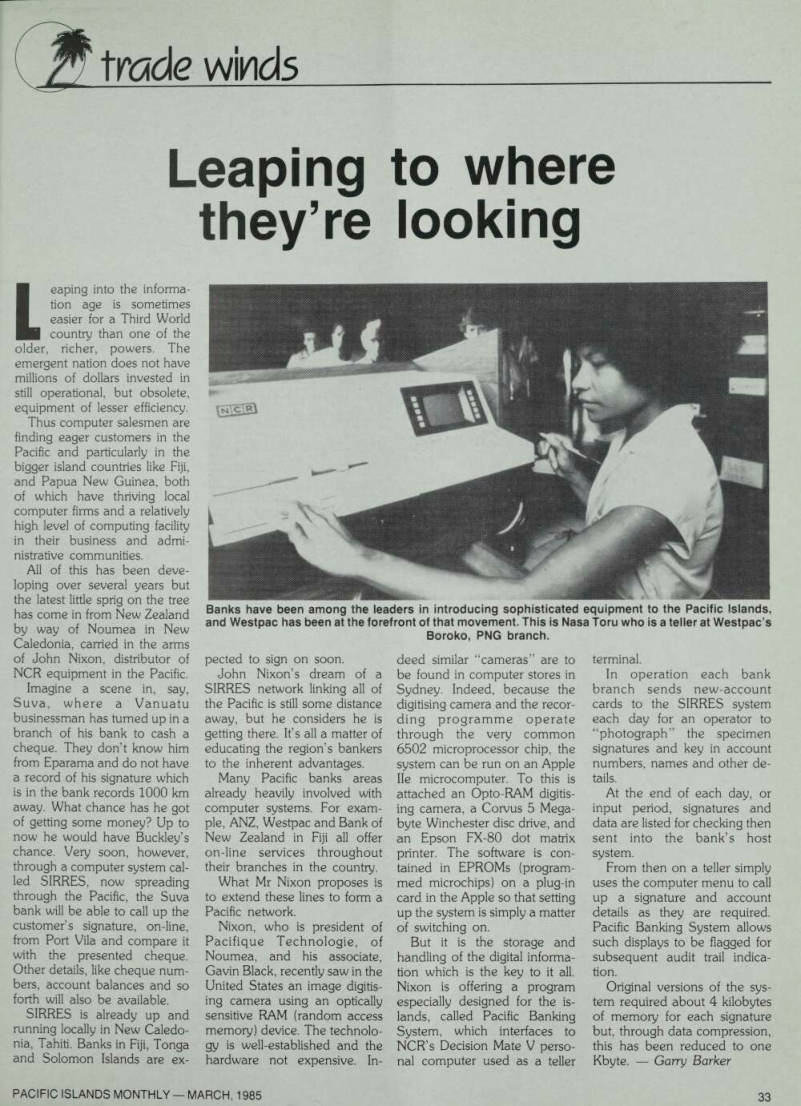
Banks have been among the leaders in introducing sophisticated equipment to the Pacific Islands, and Westpac has been at the forefront of that movement. This is Nasa Tom who is a teller at Westpac’s Boroko, PNG branch.