signifying little
pp. 30-32 · Read in the full issue
U.S. policies study
Plethora of paper signifying little
It was reported earlier in this column (PIM, December, 1983, pl 4), that U.S.Senator James A.McClure (Republican, Ida ho), had requested the U.S.General Accounting Office (GAO), to conduct a compre hensive study of federal policies for U.S. territories and insular possessions. Senator McClure chairs important congressional committees which review legislation pertaining to the ter ritories, and he felt that a major review of U.S. policy was ne cessary for future planning. The study was first requested by McClure in March, 1983, when he expressed the concern that present methods for handling territorial affairs inhibited ’’the ability of Congress to properly discharge its responsibilities.”
The GAO research was actually conducted from June, 1983, to April, 1984. It in volved a literature search on past and present territorial poli cy and interviews with a wide range of government officials in Washington, D.C., and U.S. territories in the Caribbean as well as the Pacific. The results, Issues Affecting U.S. Territory and Insular Policy were circu lated as a confidential ’’draft of a proposed report” in October of last year. The draft was for the purpose of obtaining feed back from officials with respon sibilities concerning the topics discussed in it. Presumably, these would include many of those who were interviewed by the GAO staff. In a December article, Guam’s Pacific Daily
A View from Honolulu
News quoted Governor Ricar do J.Bordallo to the effect that the draft contained no surprises and reflected much that he had told GAO interviewers. Revi sions may occur before the final version is released for public consumption, but as of early February, the document had not surfaced, at least in Honolu lu.
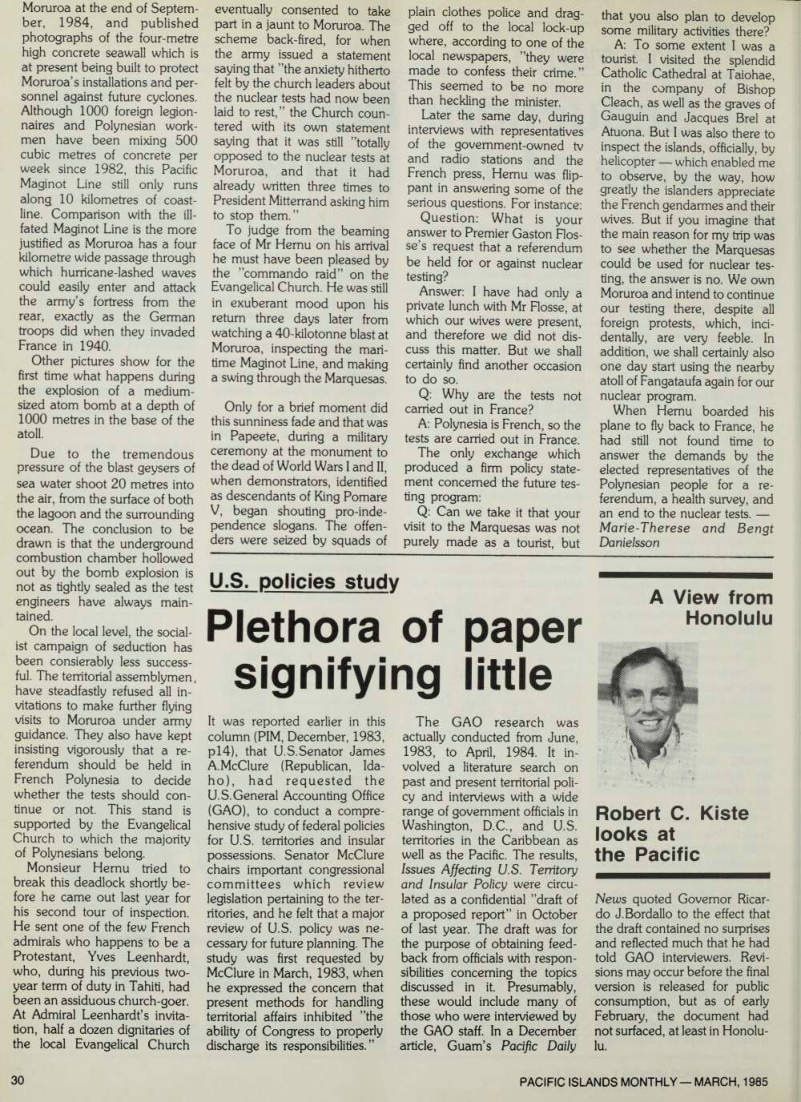
Robert C. Kiste looks at the Pacific
The circulated draft is overly long (97 pages, including sum mary digest and appendices) and quite repetitious. There is some inconsistejcy in the sub jects covered, and the history of pre-statehood Hawaii as a terri tory is entirely ignored. Even with this major omission,the document provides some in teresting history on past territo rial policy and a review of current problems, particularly as they are viewed by island officials. By intent, the GAO research team ’’did not attempt to determine what U.S. policy should be, nor did we make an in-depth analysis and evalua tion of all the issues and prob lems of the territories and insu lar areas. ” There are no recom mendations about anything, and all of this seems somewhat disappointing for a study so long in the making.
With regard to history, the Northwest Ordinance of 1787 was a congressional act provid ing for the incorporation of new states to be added to the original thirteen. Federal policy was clear. Contiguous territor ies were to be organised and administered until they were ready for statehood, and it was understood that the latter was the ultimate goal.
The results of the Spanish American war in 1898 changed all of that. The U.S. acquisition of the Philippines, Purto Rico, and Guam was new to the American experience, and at about the same time, the U.S. was in the process of acquiring Hawaii and the eastern tip of Samoa. Previous territories had been contiguous to the U.S. or located on the North American
continent. The GAO report notes that: ’’Cultural distinc tions further separated these islands from traditional acquisi tions.” Overlooked is the fact that the inhabitants of the is lands were racially different from mainland Americans, and as the history of Hawaii reveals, racial prejudice was one factor which delayed statehood.
With the acquisition of island territories, the U.S. had ac quired new possessions without any real notion as to what their legal or long term status would be. U.S. citizenship was not envisaged for the island people, and some members of congress felt that it was contrary to democratic principles to hold territories indefinitely as col onies.
The GAO report also makes it clear that because U.S. in terests in territorial acquisition at the turn of the century were largely strategic, the military dominated most early islands administrations. Puerto Rico was under military control for only two years. However, the navy administered the Virgin Islands for 14 years and Amer ican Samoa and Guam for slightly over half a century.
Navy administrators tended to focus on areas such as public works, sanitation, health and education. (The extent to which education was of any great concern to the navy could be questioned). As would be ex pected, little effort was made to foster local self-government under navy rule. Also, econo mic development received scant, if any, attention.
In the early 1950’5, the ad ministration of the island terri
tones was turned over to civi lian control under the Depart ment of Interior. Initially, direct rule was continued. The chief executive officers were appointed and government operations were managed through them.
Change occurred in the early 1960’s with the administration of President Kennedy, and in his own words ’’responsible self-rule throughout the world and particuarly in those territor ies under the jurisdiction of the United States” was to be en couraged. Subsequent adminis trations have reaffirmed this stance, and the GAO report places a great emphasis on the fact that more self-government has come to the territories. All now elect their governors and legislatures. American Samoa, Guam, Puerto Rico, and the Virgin Islands also elect non voting delegates to the U.S.
House of Representatives. (While those delegates do not vote on the floor of the House, they are members of, and have voting rights on, House com mittees).
Despite greater self-govern ment, island governors and other island officials are re ported to believe that the meaning of self-determination as a policy is unclear because it offers little specific guidance for attaining greater economic self reliance. Indeed, since the 1960’5, the territories have been made eligible for a wide variety of federal programs and subsidies, and all are ;painfully financially dependent on fede ral funding. For the year 1983, federal assistance accounted for
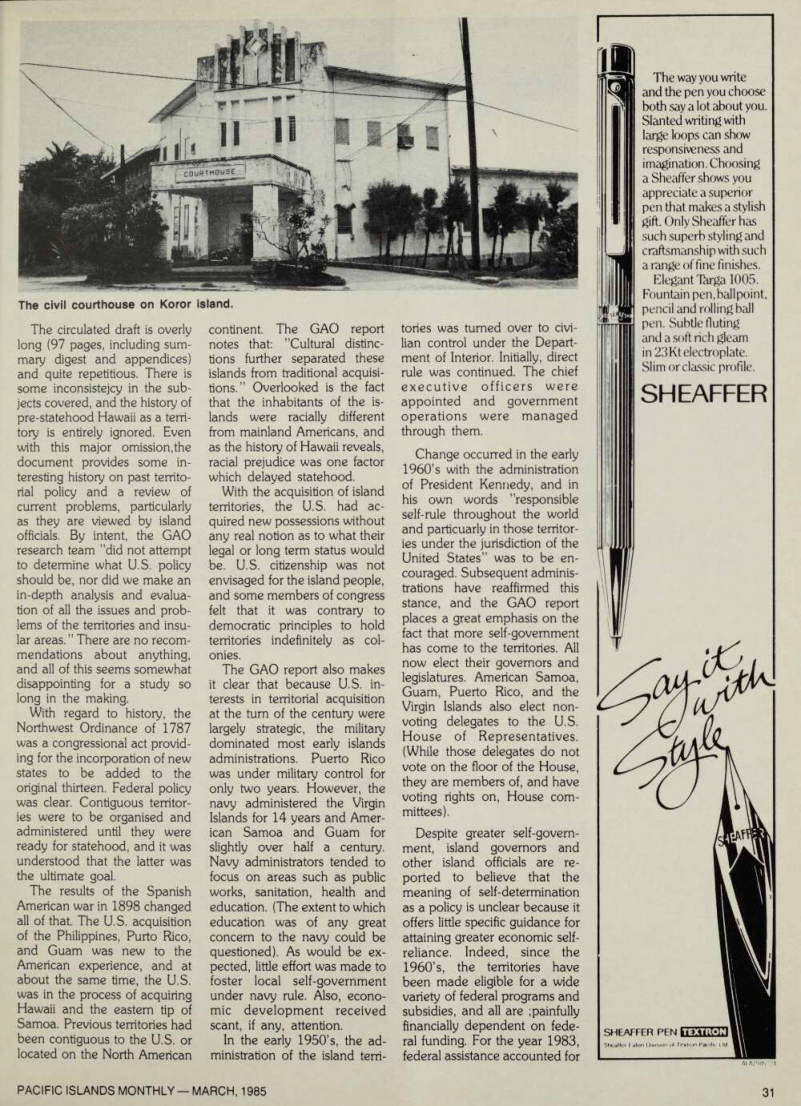
The civil courthouse on Koror island.
92 per cent, of American Samoa’s budget, 74 per cent of Guam’s, 85 per cent of the Commonwealth of the North ern Marianas, and 85 per cent of the Trust Territory’s. In the Caribbean, the figures for Puer to Rico and the Virgin Islands are in the same range.
The Department of the In terior has shifted from its role of direct administration to that of a facilitator to help the territorial governments in dealing with federal agencies. Territorial offi cials do not believe that Interior is effective in this new role.
Apparently they note that In terior’s main areas of interest land management, national for ests and parks, and minerals are not relevant for the territor ies. All territories want a greater voice at the national level, but there is no agreement as to how this should be done. Guam’s Bordalloi calls for a ’’Depart ment of Overseas Territories at a cabinet level with a secretary and everything.”
Island officials also report on
difficulties in dealing with va rious federal agencies and laws.
In 1983, at least 15 separate agencies provided direct finan cial assistance to the territories, and there was no coordination among those efforts.
There is also no overall policy to guide how territories should be treated in framing and enfor cing laws, and some laws apply to some territories, but not to others. As one example, Guam officials object to the Merchant Marine Act of 1920 (the Jones Act). It hampers Guam’s ability to develop a tuna transship ment industry because foreign vessels cannot be used to move cargo, in this case tuna, be tween two points in the U.S.
The Jones Act also prohibits the off-loading of tuna by foreign vessels. Guam officials believe the Act should not apply to Guam because of its great distance from the U.S. and because both American Samoa and the neighboring Common wealth of the Northern Marianas are exempt.
Perhaps one overall concern that comes through in the re port is that both island officials and some Washington obser vers feel keenly that there has been no comprehensive effort to establish a clear and consis tent policy for the territories.
Federal action is viewed as often haphazard. Greater eco nomic development is needed, and the ultimate status of terri tories other than the Trust Terri tory remains ambiguous.
That ambiguousness and de velopments in the Trust Terri tory are causing some reflection in the islands as to what future political status might be desir able for them. The people of Guam are comparing their own territorial status to the Com monwealth arrangement that the Northern Marianas have negotiated, and there is some sentiment that perhaps their northern neighbors struck a better deal with Uncle Sam.
As Belau, the Federated States of Micronesia, and the Marshalls move toward free
association, they will be able to handle a substantial amount of their own external relations, seek assistance from other na tions, establish their own im migration policies, and so on, and they will be receiving large financial subsidies from the U.S. For obvious reasons, the other island territories are close ly monitoring the unfolding of the new arrangement between the Micronesians and the U.S.
The GAO report clearly re flects that the prevailing opinion in the nation’s capital, as well as in the islands, is that the territor ies have not been administered well and that the lack of policy causes problems and discontent for those who would wish to do well. In a sense, the GAO effort is very American in character.
There is a sense that a problem exists, and the response is to spend a good deal of money to study it. Somehow there is faith that all of this will help resolve the problem but one cannot be hopeful in this case. Robert Kiste.