Seduction: New
pp. 29-30 · Read in the full issue
the month
Seduction: New name of the game
When the French minister for defence, Charles Hemu, visited French Polynesia for the first time in August, 1981, his main message was that President Mit terrand, in a remarkable turn about, was in favor of the Gaullist nuclear strike force that he had for years derided as ’’worthless from the military viewpoint and economically ruinous for a country like France. ”
Consequently, the nuclear testing at Moruroa, which Mit terrand had likewise conde mned as injurious and insulting to the Polynesian people, would continue (PIM, Oct ’Bl, p 32).
The only new twist in the socialist pro-nuclear program seemed to be Mr Hemu’s proc laimed determination to aban don the policy of aggrieved silence, consistently adopted by all previous conservative gov ernments when faced with criticism and protests concer ning the tests. ’The press must be informed about security problems,” said Monsieur Hemu on this occa sion. ’’Nothing must be hidden that affects the health of the population. ” He went so far as to add: ’’When New Zealand and Australia ask for informa tion about these problems, we shall supply it.”
Hernu’s second visit to French Polynesia at the end of 1984 therefore offered a most appropriate occasion to exam ine to what extent this promise has been kept during the three years between the two visits.
It must be admitted readily that Mitterrand’s government has indeed established numer ous contacts with governments in the Pacific region, with whom previous French administra tions were not on close terms.
This has been done not only through regular diplomatic
channels, but also and above all by despatching to New Zea land, Australia and the Pacific nations, a steady stream of French cabinet ministers, senat ors, deputies, high commission ers and presidential advisers, including Regis Debray. Pacific statesmen have been equally welcome in Paris and have been eloquently lectured on the important contribution France is making to the defence of the free world, and more particuar ly the Pacific.
What France has done, in fact, is to mount a campaign of seduction, which is not quite the same thing as the promised policy of the provision of frank and open information. For inst ance, nobody has yet been given any hard facts and figures about the problem that matters most: the heatlh hazards resul ting from the 106 atomic bombs so far exploded at Moruroa and Fangataufa. But there is no doubt that this propaganda drive has on the whole been quite adroit and successful. Except, in May, 1983, when New Zealand prime minister, Sir Robert Mul doon, possibly accustomed to the plainer and more down-to earth political vocabulary of his native land, made the apparent mistake of interpreting some of President Mitterrand’s state ments as a hint that the Pacific tests were soon to cease.
French officials on the ground were less equivocal, of course. The French comman der in Papeete, Admiral Mont pellier, in conversation with a variety of visitors, had usually advised that the tests would continue ”as long as is consi dered necessary,” leaving it to the listener to interpret that as he might.
As an integral part of the seduction campaign, the French socialist government
also adopted an ’’open house” policy at Moruroa, where ’’study groups” of scientists, politicians and journalists fol lowed each other in rapid suc cession. The danger that they might stumble upon a secret or two was non-existent consider ing the shortness of their visits and the severe restrictions on their movements and activities imposed by French military authorities.
This policy paid off most handsomely in the case of the five New Zealand, Australian and Papua New Guinean scien tists who spent four days at Moruroa in October, 1983. For, ever since, the French govern ment and media have proc laimed that the report produced by these distinguished foreign scientists ’’proved conclusively that the tests are harmless for the population.” The team did
Postmark Papeete
not include a single medical doctor, and the statistics on health reproduced in the report were supplied by the French army (PIM, Oct ’B4 p 29).
Some of these travellers occasionally (and often unwit tingly), brought back interesting pieces of information; as, for instance, the 20 French journal ists who spent two days at
Marie-Therese and Bengt Danielsson
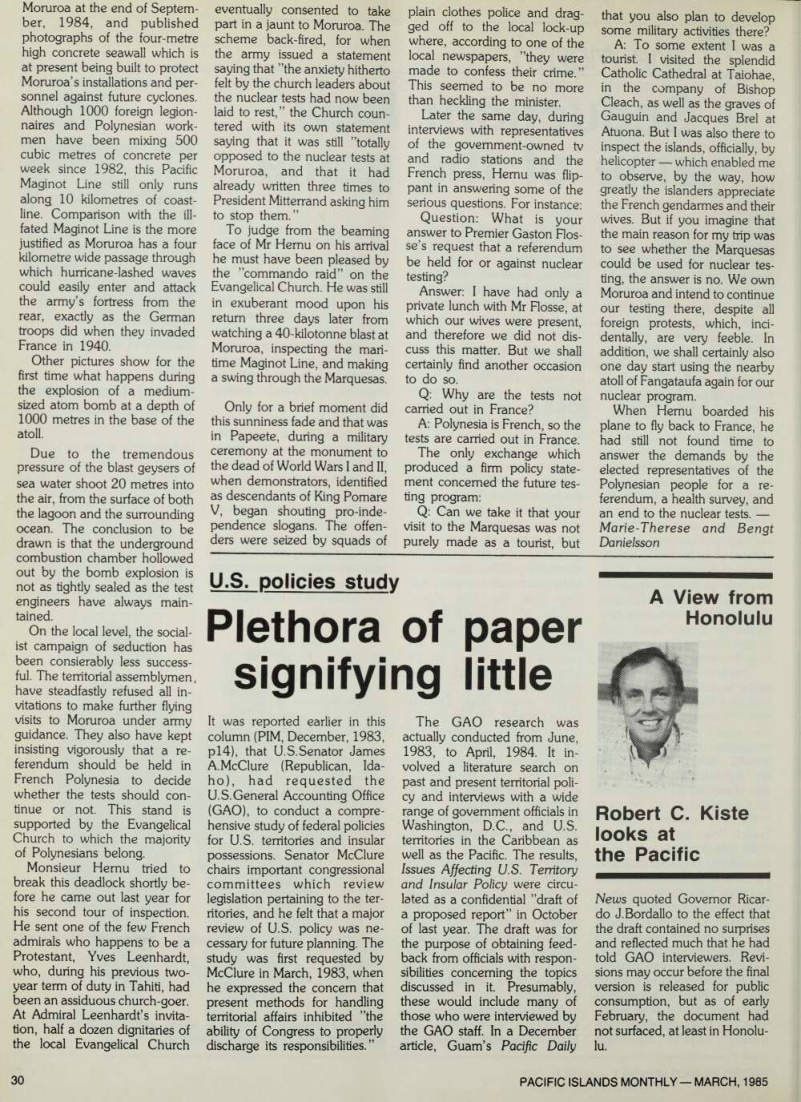
French caricature of Charles Hernu and President Francois Mitterrand from “Le Canard enchaine”.
Moruroa at the end of Septem ber, 1984, and published photographs of the four-metre high concrete seawall which is at present being built to protect Moruroa’s installations and per sonnel against future cyclones.
Although 1000 foreign legion naires and Polynesian work men have been mixing 500 cubic metres of concrete per week since 1982, this Pacific Maginot Line still only runs along 10 kilometres of coast line. Comparison with the ill fated Maginot Line is the more justified as Moruroa has a four kilometre wide passage through which hurricane-lashed waves could easily enter and attack the army’s fortress from the rear, exactly as the German troops did when they invaded France in 1940.
Other pictures show for the first time what happens during the explosion of a medium sized atom bomb at a depth of 1000 metres in the base of the atoll.
Due to the tremendous pressure of the blast geysers of sea water shoot 20 metres into the air, from the surface of both the lagoon and the surrounding ocean. The conclusion to be drawn is that the underground combustion chamber hollowed out by the bomb explosion is not as tightly sealed as the test engineers have always main tained.
On the local level, the social ist campaign of seduction has been consierably less success ful. The territorial assemblymen. have steadfastly refused all in vitations to make further flying visits to Moruroa under army guidance. They also have kept insisting vigorously that a re ferendum should be held in French Polynesia to decide whether the tests should con tinue or not. This stand is supported by the Evangelical Church to which the majority of Polynesians belong.
Monsieur Hernu tried to break this deadlock shortly be fore he came out last year for his second tour of inspection.
He sent one of the few French admirals who happens to be a Protestant, Yves Leenhardt, who, during his previous two year term of duty in Tahiti, had been an assiduous church-goer.
At Admiral Leenhardt’s invita tion, half a dozen dignitaries of the local Evangelical Church
eventually consented to take part in a jaunt to Moruroa. The scheme back-fired, for when the army issued a statement saying that ’’the anxiety hitherto felt by the church leaders about the nuclear tests had now been laid to rest,” the Church coun tered with its own statement saying that it was still ’’totally opposed to the nuclear tests at Moruroa, and that it had already written three times to President Mitterrand asking him to stop them.”
To judge from the beaming face of Mr Hemu on his arrival he must have been pleased by the ’’commando raid” on the Evangelical Church. He was still in exuberant mood upon his return three days later from watching a 40-kilotonne blast at Moruroa, inspecting the mari time Maginot Line, and making a swing through the Marquesas.
Only for a brief moment did this sunniness fade and that was in Papeete, during a military ceremony at the monument to the dead of World Wars I and 11, when demonstrators, identified as descendants of King Pomare V, began shouting pro-inde pendence slogans. The offen ders were seized by squads of
plain clothes police and drag ged off to the local lock-up where, according to one of the local newspapers, ’’they were made to confess their crime.”
This seemed to be no more than heckling the minister.
Later the same day, during interviews with representatives of the government-owned tv and radio stations and the French press, Hemu was flip pant in answering some of the serious questions. For instance: Question: What is your answer to Premier Gaston Flos se’s request that a referendum be held for or against nuclear testing?
Answer: I have had only a private lunch with Mr Flosse, at which our wives were present, and therefore we did not dis cuss this matter. But we shall certainly find another occasion to do so.
Q: Why are the tests not carried out in France?
A: Polynesia is French, so the tests are carried out in France.
The only exchange which produced a firm policy state ment concerned the future tes ting program: Q: Can we take it that your visit to the Marquesas was not purely made as a tourist, but
that you also plan to develop some military activities there?
A; To some extent I was a tourist. I visited the splendid Catholic Cathedral at Taiohae, in the company of Bishop Cleach, as well as the graves of Gauguin and Jacques Brel at Atuona. But I was also there to inspect the islands, officially, by helicopter which enabled me to observe, by the way, how greatly the islanders appreciate the French gendarmes and their wives. But if you imagine that the main reason for my trip was to see whether the Marquesas could be used for nuclear tes ting, the answer is no. We own Moruroa and intend to continue our testing there, despite all foreign protests, which, inci dentally, are very feeble. In addition, we shall certainly also one day start using the nearby atoll of Fangataufa again for our nuclear program.
When Hemu boarded his plane to fly back to France, he had still not found time to answer the demands by the elected representatives of the Polynesian people for a re ferendum, a health survey, and an end to the nuclear tests.
Marie-Therese and Bengt Danielsson