Twin Hurricanes flatter
pp. 14-19 · Read in the full issue

As the death toll rose to 29, the injured tended their wounds and the homeless queued in hopeless thousands for food rations and tents, it wasn’t only the worst pair of cyclones ever to hit Fiji that were getting the blame.
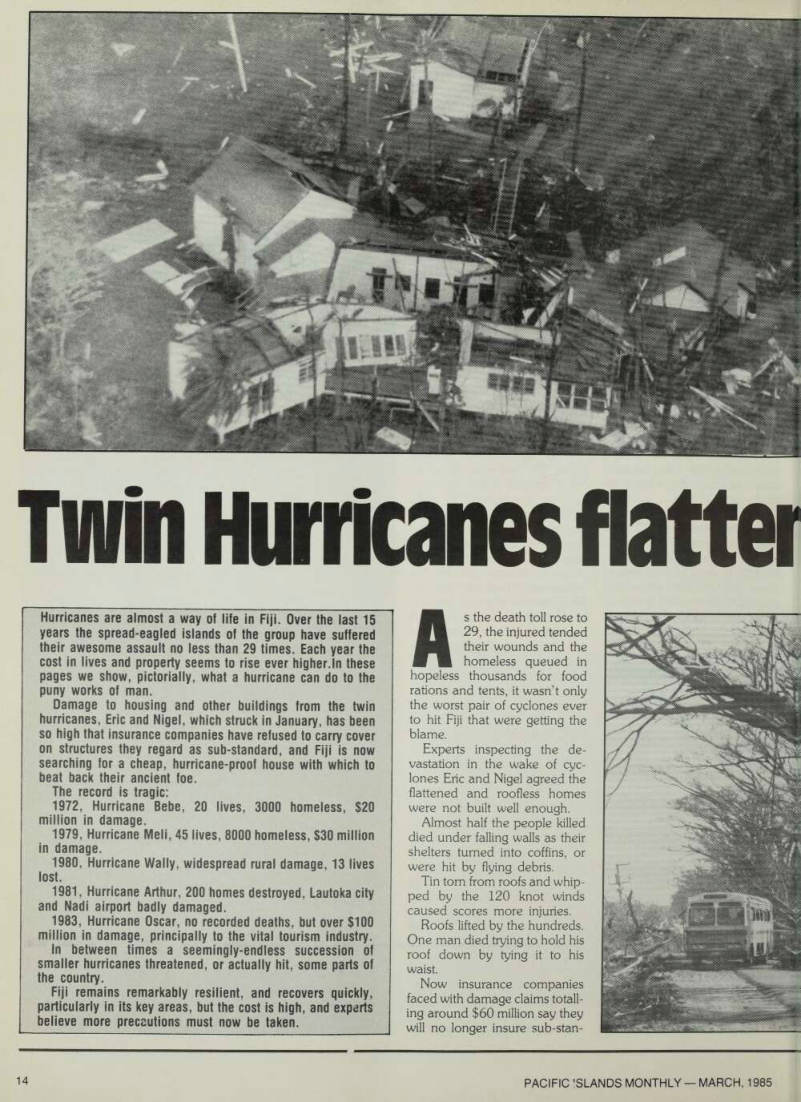
Experts inspecting the de vastation in the wake of cyc lones Eric and Nigel agreed the flattened and roofless homes were not built well enough.
Almost half the people killed died under falling walls as their shelters turned into coffins, or were hit by flying debris.
Tin tom from roofs and whip ped by the 120 knot winds caused scores more injuries.
Roofs lifted by the hundreds.
One man died trying to hold his roof down by tying it to his waist.
Now insurance companies faced with damage claims totall ing around $6O million say they will no longer insure sub-stan-
dard houses against cyclones and Fiji is now searching de sperately for a hurricane-proof house design that will shelter its people rather than kill them.
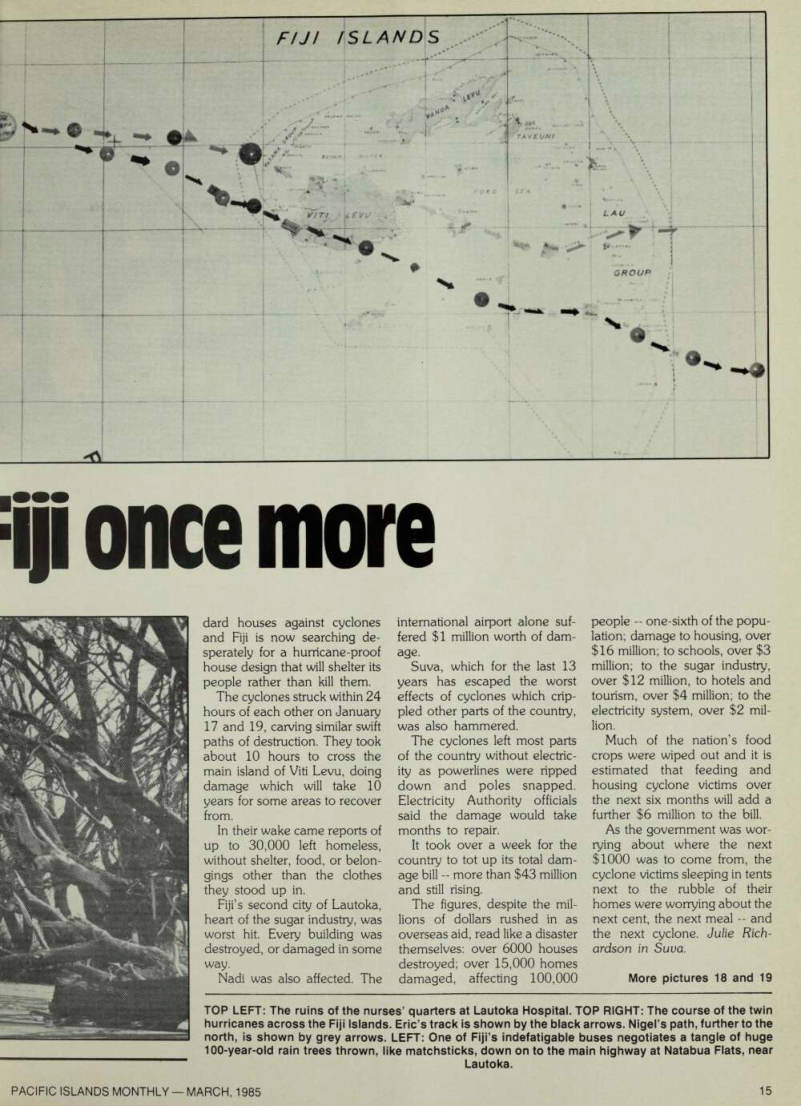
The cyclones struck within 24 hours of each other on January 17 and 19, carving similar swift paths of destruction. They took about 10 hours to cross the main island of Viti Levu, doing damage which will take 10 years for some areas to recover from.
In their wake came reports of up to 30,000 left homeless, without shelter, food, or belon gings other than the clothes they stood up in.
Fiji’s second city of Lautoka, heart of the sugar industry, was worst hit. Every building was destroyed, or damaged in some way.
Nadi was also affected. The
international airport alone suf fered $1 million worth of dam age.
Suva, which for the last 13 years has escaped the worst effects of cyclones which crip pled other parts of the country, was also hammered.
The cyclones left most parts of the country without electric ity as powerlines were ripped down and poles snapped.
Electricity Authority officials said the damage would take months to repair.
It took over a week for the country to tot up its total dam age bill more than $43 million and still rising.
The figures, despite the mil lions of dollars rushed in as overseas aid, read like a disaster themselves: over 6000 houses destroyed; over 15,000 homes damaged, affecting 100,000
people one-sixth of the popu lation; damage to housing, over $l6 million; to schools, over $3 million; to the sugar industry, over $l2 million, to hotels and tourism, over $4 million; to the electricity system, over $2 mil lion.
Much of the nation’s food crops were wiped out and it is estimated that feeding and housing cyclone victims over the next six months will add a further $6 million to the bill.
As the government was wor rying about where the next $lOOO was to come from, the cyclone victims sleeping in tents next to the rubble of their homes were worrying about the next cent, the next meal and the next cyclone. Julie Rich ardson in Suva.
More pictures 18 and 19
Fiji Islands
TOP LEFT: The ruins of the nurses’ quarters at Lautoka Hospital. TOP RIGHT: The course of the twin hurricanes across the Fiji Islands. Eric’s track is shown by the black arrows. Nigel’s path, further to the north, is shown by grey arrows. LEFT: One of Fiji’s indefatigable buses negotiates a tangle of huge 100-year-old rain trees thrown, like matchsticks, down on to the main highway at Natabua Flats, near Lautoka.
TOP LEFT: Smashed power poles and tangled wires at Kalal[?] industrial estate, Nasinu, near Suva. ABOVE: What was left of t[?] sports stadium at Ba. BOTTOM LEFT: Torrential rain flooded the[?] river and left this mess of debris on the highway bridge. BELOW Hangar ruined at Nadi airport.
[?]BOVE: The scene at Vunidawa hit yet again. TOP RIGHT: The rubble at [?]adi Travelodge which this time lost 55 rooms to Hurricane Eric.
BELOW: Women in the Yasawas survey the wreckage of their home and [?]ruin of their belongings; a scene repeated thousands of times in the wake of the twin hurricanes.