importance
pp. 20-22 · Read in the full issue
Nakasone Surveys “The Sphere”
A visit of great importance
The Nakasone odyssey was of immense im portance, particularly to Australia, for Japan is that country’s biggest customer, and biggest supplier. Also, if the trends of last year continue, Japan will be the biggest foreign investor in Australia, a country which now needs overseas funds to warm up an economy made sluggish by high costs, low productivity and depressed commodity prices.
Australian leaders and offi cials were therefore anxious that this commercial partner ship should be further
Japan’s prime minister, Yasuhiro Nakasone, has clearly signalled his country’s deep, and in creasing, interest in the Pacific by making state visits to Fiji and Papua New Guinea on his way to Australia and New Zealand.
In the islands he announced increased aid, but was reticent about the chances of easing in any real way the steadily growing imbalance in import-export payments.
Nor was he able to make life easier for Australia’s prime minister, Bob Hawke who, ringed about as he was at the time with rail strikes, public service strikes, doctors’ strikes, bush fires and a nervous economy, doubtlessly hoped for something better than in the end he got.
cemented, in fact as well as appearance. At the same time prime minister Bob Hawke was at pains to take a Pacific regio nal view.
Mr Hawke expressed support for Mr Nakasone’s plan to de velop a new round of multilate ral trade negotiations, saying that matters of regional concern should also be included on such an agenda. He made specific public mention of the topic in his speech at the state dinner: “A new round of multi-lateral trade negotiations based on a genuine committment to trade liberalisation would address a number of flaws in the current trading system that have been particularly damaging to the trading interests of countries in our region,” he said.
The visit was colorful and a public event. While 72 Japan ese flags, matched by 72 Aus tralian flags, were run up poles all over Canberra, in honor of the Japanese leader and his phalanx of high-level atten dants, newspapers were heavy with speculation.
Mr Nakasone would “talk trade, but tread softly on poli tics,” said one. The two prime ministers were tipped to “dis cuss banking reciprocity,” said another. ’’Australian concern over Japanese market - tough talk on trade wanted from Hawke,” said another.
In the event Mr Nakasone appears to have been sober sides indeed and delivered what could really only be de scribed as a slightly sharp lec ture to Australians at large that if they could not, or did not, deliver, then Japan would find
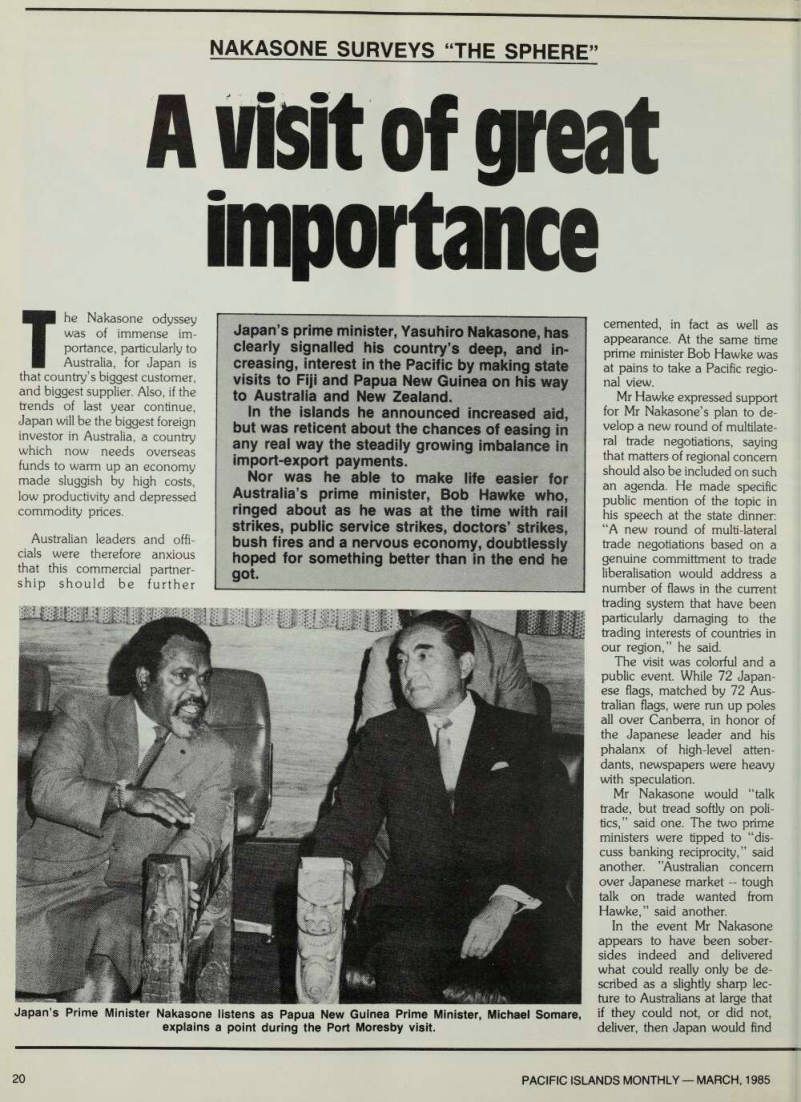
Japan’s Prime Minister Nakasone listens as Papua New Guinea Prime Minister, Michael Somare, explains a point during the Port Moresby visit.
other suppliers.
The admonition, couched, of course, in elaborate, chrysan themum-fringed courtesy, came in the wake of bitter reaction locally to the activities of Hunter Valley train drivers whose industrial action, had bulk coal ships sailing away empty from Newcastle for fore ign ports where stocks lay ready to fill Japanese steel mill bunk ers normally supplied from Aus tralia.
With that much of the situa tion more or less clear (and pundits dolefully chanting to a still largely deaf Australian public that Asia was passing it, and that even little Brunei had a higher per capita income now), it remained very difficult to discover exactly what Mr Hawke and Mr Nakasone did finally consider to be firmly agreed.
As far as they could, the Australians pushed for clear reiteration of Mr Nakasone’s undertaking, made in Tokyo in 1984, during Mr Hawke’s visit, that Japan would not allow third countries to influence their demand for Australian com modities, particularly coal.
Mr Nakasone said he would
do his “level best” to see Australia’s market share main tained in four vital categories beef and other meat, bauxite, aluminium and related raw materials, iron ore and coal.
Enthusiasts in the Department of Trade interpreted this to mean percentage share, but the Japanese declined to be drawn into an iron-clad guarantee.
Japan’s problem is obvious enough. They are under con siderable pressure from the U.S., their biggest customer, to buy more American products, in particular beef and coal. Last year Australia lost a good prop ortion of its beef market in Japan to U.S. producers.
Mr Nakasone did his best to soothe and said he would stick to the principle that Australia’s access to Japanese markets would not be impeded for thd benefit of others. But, he was very firm that Australia had to deliver; had to be competitive and reliable as a supplier.
One important plus from the visit has been the setting up of a high level committee of officials from both Japan and Australia to monitor energy trade and to “anticipate and avoid” future
problems.
Garry Barker
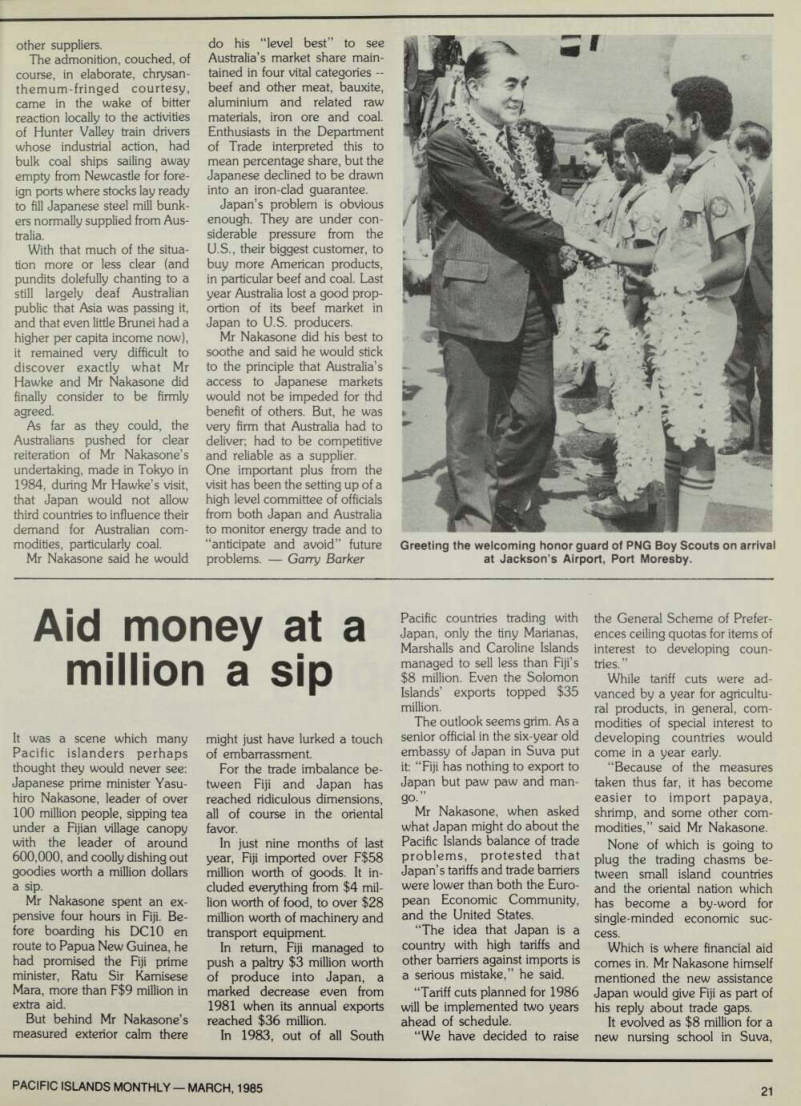
Greeting the welcoming honor guard of PNG Boy Scouts on arrival at Jackson’s Airport, Port Moresby.
$750,000 for a new fisheries terminal at the second city of Lautoka, a possible $120,000 for a rural mobile library service, and $700,000 for the
University of the South Pacific, This is extra to aid of around US$3 million mark received under normal circumstances and makes Japan second only
to Australia as chief donor.
Japan is a relative newcomer to the major aid scene for Fiji and its neighbors.
Six years ago its donations were around the half million dollars mark.
Japan’s reasons for the sudden splurge are complex. The Japanese are eager to continue to expand their industrial and consumer goods sales in the region, although not by producing them here.
According to Hiroshi Miki, second secretary at the Japanese embassy in Suva, Fiji is not about to attract the investmentconscious Japanese businessman pampered by a mass consumer market second to none, “Fiji is not a good investment. The population of just 600,000 is a very small market for the Japanese businessman, and in the Pacific islands generally there is also a very small market.
“And I don’t think Fiji or the other islands can do anything about it.”
His words are underlined by the fact that there are only two companies with Japanese in-
vestment in Fiji: the recently cyclone-struck Mana Island re sort, and the Pacific Fishing Company (PAFCO), which cans fish in Levuka, Fiji’s old capital.
And PAFCO, set up by a Tokyo trading and investment company as a 50-50 joint ven ture with the Fiji government, may soon lose its Japanese investor as the world market for canned fish - and fish con sumption in Japan - decline.
Japanese businessmen are not noted for hanging around to make great losses.
Mr Nakasone has made tremendous efforts to strengthen ties, not only with the South Pacific, but with China and the Asian countries.
He believes that only if na tions are economically prosper ous can the war which Japan dreads be averted.
By helping them along that route, Japan is keeping its trade and its economic wealth intact, and steering what he calls, “the most promising region in the world” towards even greater riches. Julie Richardson in Suva
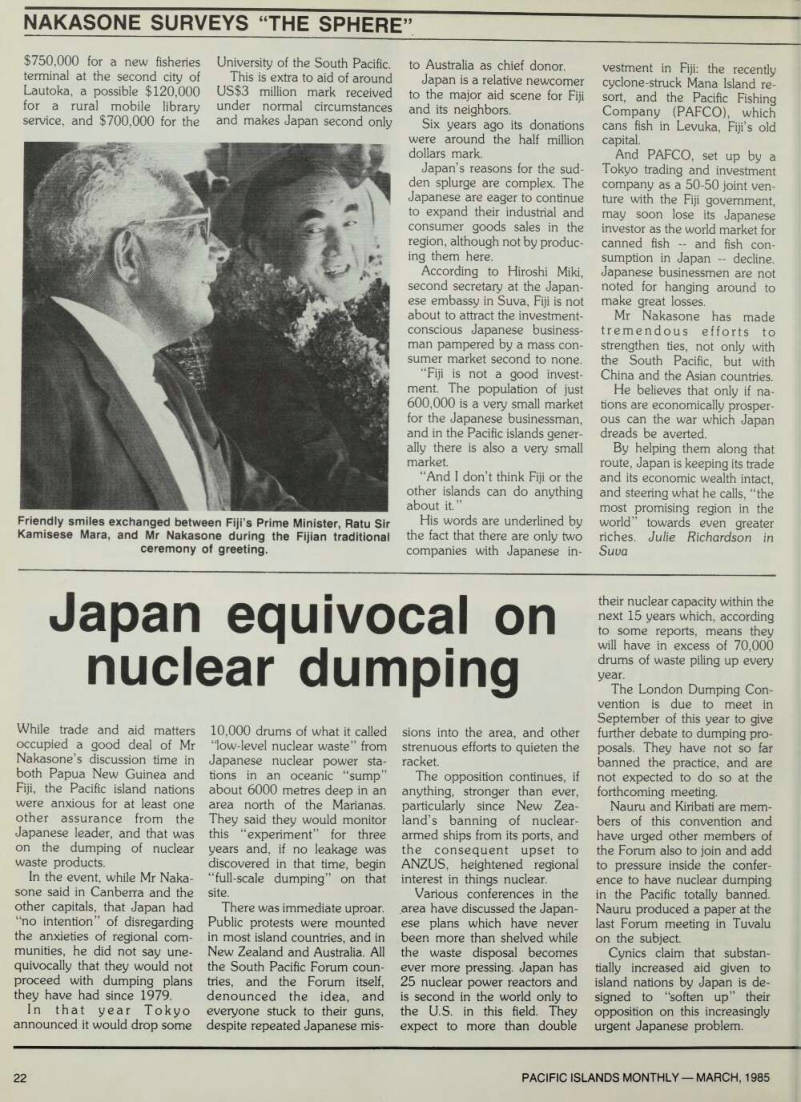
Friendly smiles exchanged between Fiji’s Prime Minister, Ratu Sir Kamisese Mara, and Mr Nakasone during the Fijian traditional ceremony of greeting.