Somare’s Edict
pp. 13-14 · Read in the full issue
Anyone, mining tycoon or man in the street, who was in any doubt about the determination of the PNG Government on the Ok Tedi issue, had only to hear prime minister Michael Somare at his press confer ence in Sydney He was in top form, and deadly determined: “I am not threatening the consortium,” he said. ’They made a committment in 1981. They have to meet it. We have made that quite clear. We mean business. We are not bluffing. The committment has not been met, therefore we are closing the mine.
“Since June of last year we had been negotiating with the companies for them to put in extra infrastruc ture such as the hydro-electricity scheme and the tailings dam. ”We fear that once our gold is taken out the mine could be abandoned. ”1 have a country to run, and the interests of three million people to protect. If you Australians had the same fear, you would move to protect the resources which belong to your people.” ”1 am not looking for alternative developers, although there have been inquiries. I am still hoping that the three friends, the three partners, that we have will be able to come back on good terms with us. ” ’The price of copper might have deteriorated, but it won’t stay this low for 10 or 15 years. Prices fluctuate.
If the company is interested in a long-term relation ship with Papua New Guinea, then it must honor the moral and legal obligation it undertook when it signed the contract with the government. ’’There may be an international corporate backlash, but let me remind you that in 19741 did the same thing with Kennecott. (This American corporation was first into Ok Tedi, but did not proceed with the required level of development and were relieved of their responsibilities). ”l think the World Bank, and international bankers generally appreciate our stand. ”ln this business you have to be prepared to take risks. My government will not expropriate as some have suggested we might. Nor do we entertain the idea of compensation. We seek mutual understan ding,” Mr Somare said. ”Our position is very clear. There is a mining agreement. It has been signed by all parties. We realise that copper prices are down, but if the companies have long-term interests in the mine they have to meet their obligations. I am sure the present consortium will come to the conference table.”
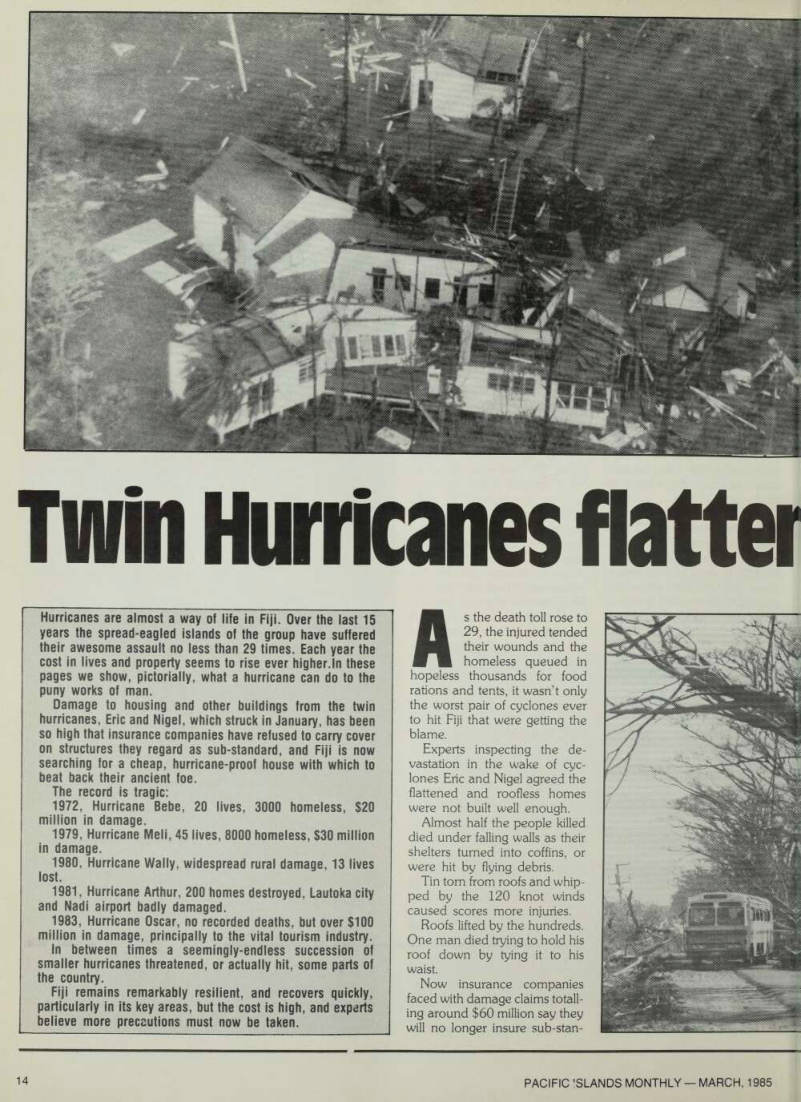
Hurricanes are almost a way of life in Fiji. Over the last 15 years the spread-eagled islands of the group have suffered their awesome assault no less than 29 times. Each year the cost in lives and property seems to rise ever higher.In these pages we show, pictorially, what a hurricane can do to the puny works of man.
Damage to housing and other buildings from the twin hurricanes, Eric and Nigel, which struck in January, has been so high that insurance companies have refused to carry cover on structures they regard as sub-standard, and Fiji is now searching for a cheap, hurricane-proof house with which to beat back their ancient foe.
The record is tragic: 1972, Hurricane Bebe, 20 lives, 3000 homeless, $20 million in damage. 1979, Hurricane Meli, 45 lives, 8000 homeless, $30 million in damage. 1980, Hurricane Wally, widespread rural damage, 13 lives lost. 1981, Hurricane Arthur, 200 homes destroyed, Lautoka city and Nadi airport badly damaged. 1983, Hurricane Oscar, no recorded deaths, but over $100 million in damage, principally to the vital tourism industry.
In between times a seemingly-endless succession of smaller hurricanes threatened, or actually hit, some parts of the country.
Fiji remains remarkably resilient, and recovers quickly, particularly in its key areas, but the cost is high, and experts believe more precautions must now be taken.