may be fading
pp. 11-13 · Read in the full issue
Ok Tedi Doubts
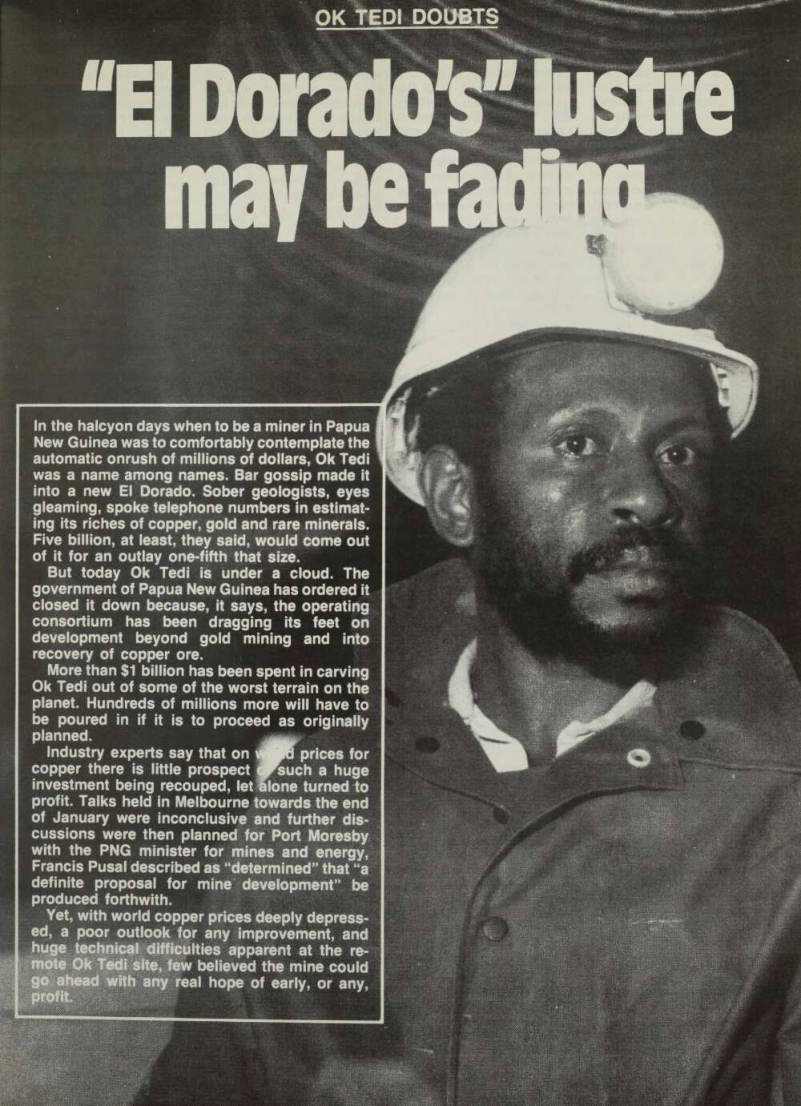
"EI Dorado's" Iustre may be fading
In the halcyon days when to be a miner in Papua New Guinea was to comfortably contemplate the automatic onrush of millions of dollars, Ok Tedi was a name among names. Bar gossip made it into a new El Dorado. Sober geologists, eyes gleaming, spoke telephone numbers in estimat ing its riches of copper, gold and rare minerals.
Five billion, at least, they said, would come out of it for an outlay one-fifth that size.
But today Ok Tedi is under a cloud. The government of Papua New Guinea has ordered it closed it down because, it says, the operating consortium has been dragging its feet on development beyond gold mining and into recovery of copper ore.
More than $1 billion has been spent in carving Ok Tedi out of some of the worst terrain on the planet. Hundreds of millions more will have to be poured in if it is to proceed as originally planned.
Industry experts say that on dHT prices for copper there is little prospect Vsuch a huge investment being recouped, let alone turned to profit. Talks held in Melbourne towards the end of January were inconclusive and further dis cussions were then planned for Port Moresby with the PNG minister for mines and energy, Francis Pusal described as “determined” that “a definite proposal for mine development” be produced forthwith.
Yet, with world copper prices deeply depress ed, a poor outlook for any improvement, and huge technical difficulties apparent at the re mote Ok Tedi site, few believed the mine could go ahead with any real hope of early, or any,
Developing Ok Tedi, originally feted as Papua New Guinea’s most promising mine, is beginning to look like buil ding the Panama Canal, only worse. Almost from the begin ning, problem has piled on problem; Ok Tedi seems to have developed into a monster, menacing everyone who comes in contact with it.
The site, at Mt Fubilan on the Fly River, deep in the remote and savage Star Mountains in the far south-west of the coun try, near the Irian Jaya border, is regarded as one of the richest copper deposits discovered in recent years. Mt Fubilan is, in mining terms, ’’made” of cop per ore which is rich with gold and other rare metals. All of this sits under a cap of gold ore which has to be removed be fore the copper can be mined.
The first (gold only) stage was to run from 1984 to 1986, then gold and copper were to be mined together for three years. After that copper only would be extracted for until about the end of the first decade of the 21st Century.
Revenue from the first stage was to pay for development to support the second and third stages. Because of this, PNG itself was to get very little return from the gold.
The gold-mining began ahead of schedule in May, 1984, using temporary genera tion and tailings disposal sys tems (the latter of a type which drew criticism from en vironmentalists). The PNG gov ernment did not like this, but approved it, partly because the miners really had no option if they were to get the project started at all. But, they felt they had to have the permanent tailings dam, and the hydro works as surety that the com pany would not just scrape off the gold and then leave the mine (by then much less viable) for development when (and if) the copper price improved.
Whether or not the govern ment’s fears were well-founded is open to debate, but, whatev er the financial conundrum, the Ok Tedi site itself seems to have proved more difficult than even
the darkest pessimists forecast.
In January, 1984, there was a massive landslide, a kilometre wide, of at least 50 million tonnes of mud, on the east bank of the Ok Ma river. No lives or equipment were lost, but the planned site of the tailings handling system, an essential part of the long-term development of the copper mine, was rendered impossible.
That one event is estimated to have raised the development cost at least $2OO million.
Then a barge carrying hun dreds of drums of cyanide over-turned in the mouth of the Fly River. There was also at least one leakage of cyanide from the gold treatment plant.
A drought in the Fly made it too shallow for navigation by freight barges at the port town of Kiunga, 800 km up river.
Equipment and supplies had to be flown in.
These were bad problems, adding perhaps $3OO million to the cost of the first stage deve lopment, but they were not at the heart of the consortium’s deepest concern. This was the state of world copper prices, down to 60 cents a pound (U.S.), with some countries, notably Zaire, Zambia and Chile, making sales as low as 50 cents. The bottom was out of
world copper prices, the gold price was also down, and the shareholders could not con fidently see a return on their money. El Dorado had stopped shining.
By January of this year the project was running more than 12 months behind time.
In June of 1984 the govern ment of Papua New Guinea wrote to the company asking that it provide, by the following September, an outline of its plans to develop the copper mine. The company asked for, and was given, an extension to the end of the year. A plan was produced, but the govern ment’s advisers considered it to be unsatisfactory. They gave another month as the deadline but were making little effort to hide their alarm and their fear that the company would not honor its agreement. An ultima tum was issued that the com pany get cracking or have the mine shut down.
Talks were then held in Port Moresby and Melbourne, aimed at finding a settlement.
These were generally unhappy and inconclusive, with the con sortium’s initial proposals de scribed, from Port Moresby, as having been ’’rejected.” There was talk of ”a compromise” but
no indication of what it might involve.
Further investment, of at least $550 million, and possibly $1 billion, is required to enter the copper mining stage.
PNG’s extreme interest in the copper arises from the fact that they get little out of the gold recovery program, but expect to have substantial and con tinuing revenues from the cop per, starting in 1988, which is when the Bougainville deposits, already fading, will be fairly much played out. But now, because of the engineering problems ahead, the size of the investment needed, and the gloomy outlook for world metal prices, the government fears that the consortium will skim off the gold and then lose com pletely whatever residual in terest it retains in the copper venture.
One of the curiosities of the situation is that the PNG Gov ernment is a full equity share holder in the mine with 20 per cent of the action. West Ger many’s Metalgesellschaft (also 20 per cent), Amoco Minerals of the U.S. (30 per cent), and Australia’s BMP (30 per cent), make up the rest of the consor tium.
Of them all, only BMP is
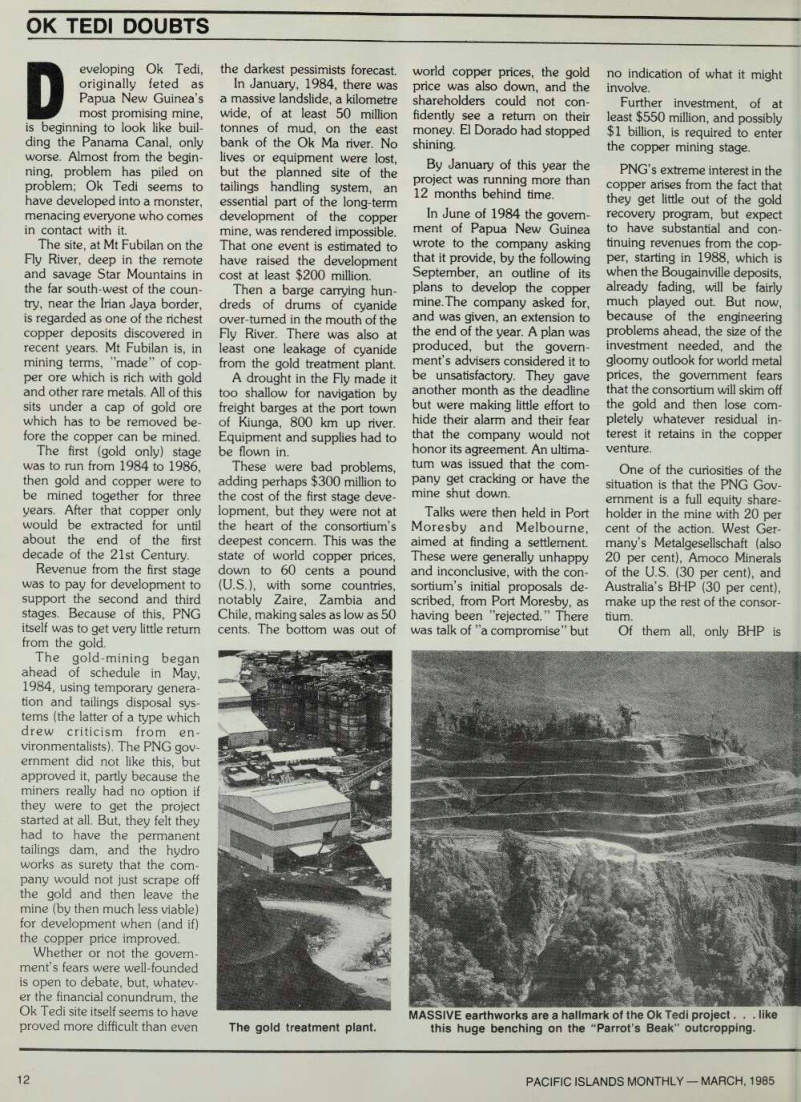
The gold treatment plant.
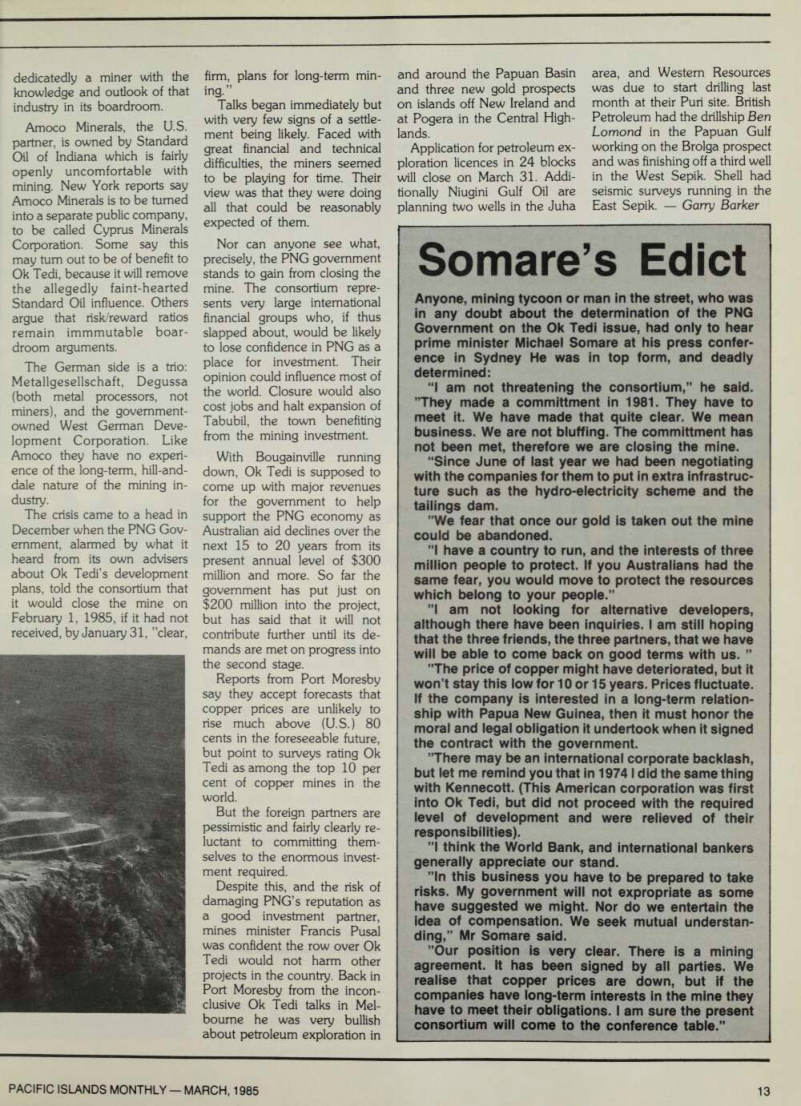
MASSIVE earthworks area hallmark of the Ok Tedi project. . .like this huge benching on the “Parrot’s Beak” outcropping.
dedicatedly a miner with the knowledge and outlook of that industry in its boardroom.
Amoco Minerals, the U.S. partner, is owned by Standard Oil of Indiana which is fairly openly uncomfortable with mining. New York reports say Amoco Minerals is to be turned into a separate public company, to be called Cyprus Minerals Corporation. Some say this may turn out to be of benefit to Ok Tedi, because it will remove the allegedly faint-hearted Standard Oil influence. Others argue that risk/reward ratios remain immmutable boar droom arguments.
The German side is a trio: Metallgesellschaft, Degussa (both metal processors, not miners), and the government owned West German Deve lopment Corporation. Like Amoco they have no experi ence of the long-term, hill-and dale nature of the mining in dustry.
The crisis came to a head in December when the PNG Gov ernment, alarmed by what it heard from its own advisers about Ok Tedi’s development plans, told the consortium that it would close the mine on February 1, 1985, if it had not received, by January 31, ’’clear,
firm, plans for long-term min ing.”
Talks began immediately but with very few signs of a settle ment being likely. Faced with great financial and technical difficulties, the miners seemed to be playing for time. Their view was that they were doing all that could be reasonably expected of them.
Nor can anyone see what, precisely, the PNG government stands to gain from closing the mine. The consortium repre sents very large international financial groups who, if thus slapped about, would be likely to lose confidence in PNG as a place for investment. Their opinion could influence most of the world. Closure would also cost jobs and halt expansion of Tabubil, the town benefiting from the mining investment.
With Bougainville running down, Ok Tedi is supposed to come up with major revenues for the government to help support the PNG economy as Australian aid declines over the next 15 to 20 years from its present annual level of $3OO million and more. So far the government has put just on $2OO million into the project, but has said that it will not contribute further until its de mands are met on progress into the second stage.
Reports from Port Moresby say they accept forecasts that copper prices are unlikely to rise much above (U.S.) 80 cents in the foreseeable future, but point to surveys rating Ok Tedi as among the top 10 per cent of copper mines in the world.
But the foreign partners are pessimistic and fairly clearly re luctant to committing them selves to the enormous invest ment required.
Despite this, and the risk of damaging PNG’s reputation as a good investment partner, mines minister Francis Pusal was confident the row over Ok Tedi would not harm other projects in the country. Back in Port Moresby from the incon clusive Ok Tedi talks in Mel bourne he was very bullish about petroleum exploration in
and around the Papuan Basin and three new gold prospects on islands off New Ireland and at Pogera in the Central High lands.
Application for petroleum ex ploration licences in 24 blocks will close on March 31. Addi tionally Niugini Gulf Oil are planning two wells in the Juha
area, and Western Resources was due to start drilling last month at their Puri site. British Petroleum had the drillship Ben Lomond in the Papuan Gulf working on the Brolga prospect and was finishing off a third well in the West Sepik. Shell had seismic surveys running in the
East Sepik.
Garry Barker