tropicalities
pp. 43-45 · Read in the full issue
Niue: And then there were none...?
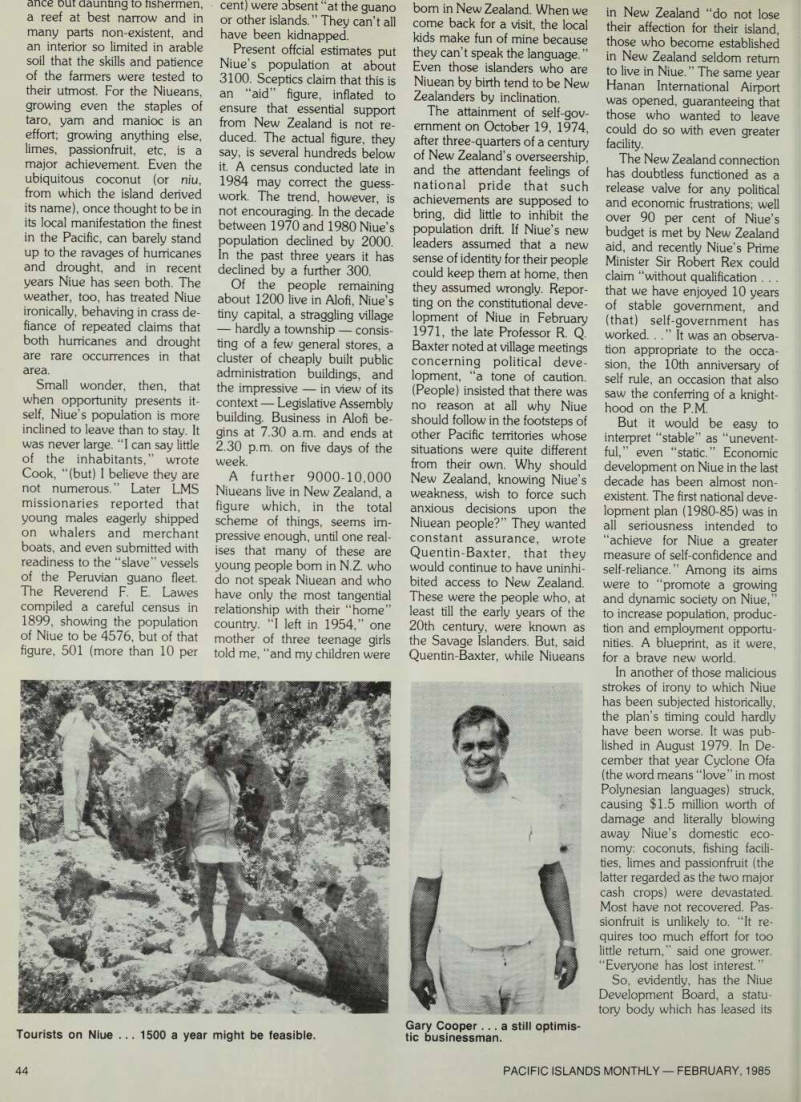
The houses, dismal-look ing constructions of concrete block and galvanised iron, are mostly boarded up. In one village alone, 12 of 15 houses are obviously deserted. In most others the prevailing feeling is one of abandonment. Even at those usually “busy” times in Polynesian villages late afternoons, Saturdays there is little activity. Niue’s 14 vil lages, described by the coun try’s scant travel literature as “lovely,” “quaint,” “unspoiled” have, in reality, two outstanding physical features: they are mostly ugly and they are mostly empty. A drive through the island’s depopulated villages is not one of the Pacific’s most uplifting experiences.
That this is so is not entirely the fault of the Niueans. Follow ing disastrous hurricanes in 1959 and 1960 the New Zea-
Roving RIM correspondent NORMAN DOUGLAS has visited Niue. His memorable report chronicles the difficulties faced by this tiny country in its efforts at economic development, and describes in detail the most formidable of all the tendency of Niueans to gravitate to N Zea and w j t j-, w hich the island is in a relationship of J . ’
“free association.
land administrators of Niue de cided to replace the “traditio nal” houses of lime plaster and thatch with dwellings better de signed to withstand cataclysmic natural forces. They erected 750 houses of “hurricane proof” materials concrete and iron for these were to be “permanent” houses. Many had no fitted doors and win dows, many still have none.
The majority looked squalid from the moment they were completed. But there was an even greater irony: they had
built “permanent” houses for an impermanent population.
Niue’s history has been stud ded with irony. Captain James Cook R.N. had termed it “Sav age Island.” The dour Yorkshireman was good at fin ding islands but bad at naming them (New Caledonia, New Hebrides etc.), and “Savage Island” was one of his worst misnomers. The Niueans had to live for generations with the reputation bestowed on them by Cook.
But their own legends were
hardly more generous to them.
It was Maui, the great trickster and fisherman of Polynesian myth, whose hauls included Tonga, New Zealand’s North Island, and other lands of great fertility, who dragged Niue out of the sea, creating for the first Niueans a home far more chal lenging, even forbidding, than many other Polynesians had to endure. Perhaps the great prankster’s humor had turned to malice that day; perhaps his hook had been badly baited. It was not one of his more bounti ful catches, for Niue is a single island, isolated from its nearest neighbor, Tonga, by 480 kilometres.
Maui was aided by sub marine volcanic activity which in a series of thrusts lifted a coral atoll and its shallow, en closed lagoon up to a height of over 60 metres, creating a coastline spectacular in appear-
Main street Alofi... Friday is a busy day.-Norman Douglas photos.
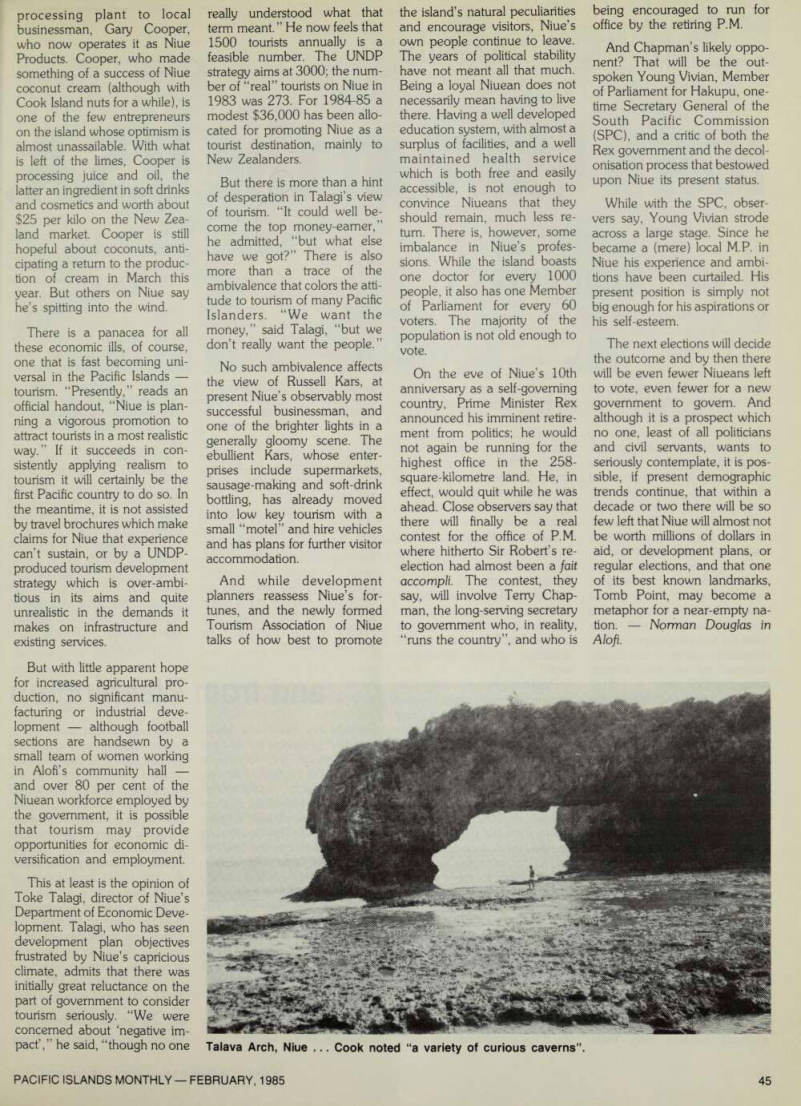
Niuean toddler... New Zealan der by inclination?
ance out aaunnng to nsnermen, a reef at best narrow and in many parts non-existent, and an interior so limited in arable soil that the skills and patience of the farmers were tested to their utmost. For the Niueans, growing even the staples of taro, yam and manioc is an effort; growing anything else, limes, passionfruit, etc, is a major achievement. Even the übiquitous coconut (or niu, from which the island derived its name), once thought to be in its local manifestation the finest in the Pacific, can barely stand up to the ravages of hurricanes and drought, and in recent years Niue has seen both. The weather, too, has treated Niue ironically, behaving in crass de fiance of repeated claims that both hurricanes and drought are rare occurrences in that area.
Small wonder, then, that when opportunity presents it self, Niue’s population is more inclined to leave than to stay. It was never large. “I can say little of the inhabitants,” wrote Cook, “(but) I believe they are not numerous. ” Later LMS missionaries reported that young males eagerly shipped on whalers and merchant boats, and even submitted with readiness to the “slave” vessels of the Peruvian guano fleet.
The Reverend F. E. Lawes compiled a careful census in 1899, showing the population of Niue to be 4576, but of that figure, 501 (more than 10 per
cent) were absent “at the guano or other islands.” They can’t all have been kidnapped.
Present offcial estimates put Niue’s population at about 3100. Sceptics claim that this is an “aid” figure, inflated to ensure that essential support from New Zealand is not re duced. The actual figure, they say, is several hundreds below it. A census conducted late in 1984 may correct the guess work. The trend, however, is not encouraging. In the decade between 1970 and 1980 Niue’s population declined by 2000.
In the past three years it has declined by a further 300.
Of the people remaining about 1200 live in Alofi, Niue’s tiny capital, a straggling village hardly a township consis ting of a few general stores, a cluster of cheaply built public administration buildings, and the impressive in view of its context Legislative Assembly building. Business in Alofi be gins at 7.30 a.m. and ends at 2.30 p.m. on five days of the week.
A further 9000-10,000 Niueans live in New Zealand, a figure which, in the total scheme of things, seems im pressive enough, until one real ises that many of these are young people bom in N.Z. who do not speak Niuean and who have only the most tangential relationship with their “home” country. “I left in 1954,” one mother of three teenage girls told me, “and my children were
bom in New Zealand. When we come back for a visit, the local kids make fun of mine because they can’t speak the language. ”
Even those islanders who are Niuean by birth tend to be New Zealanders by inclination.
The attainment of self-gov ernment on October 19, 1974, after three-quarters of a century of New Zealand’s overseership, and the attendant feelings of national pride that such achievements are supposed to bring, did little to inhibit the population drift. If Niue’s new leaders assumed that a new sense of identity for their people could keep them at home, then they assumed wrongly. Repor ting on the constitutional deve lopment of Niue in February 1971, the late Professor R. Q.
Baxter noted at village meetings concerning political deve lopment, “a tone of caution. (People) insisted that there was no reason at all why Niue should follow in the footsteps of other Pacific territories whose situations were quite different from their own. Why should New Zealand, knowing Niue’s weakness, wish to force such anxious decisions upon the Niuean people?” They wanted constant assurance, wrote Quentin-Baxter, that they would continue to have uninhi bited access to New Zealand.
These were the people who, at least till the early years of the 20th century, were known as the Savage Islanders. But, said Quentin-Baxter, while Niueans
in New Zealand “do not lose their affection for their island, those who become established in New Zealand seldom return to live in Niue. ” The same year Hanan International Airport was opened, guaranteeing that those who wanted to leave could do so with even greater facility.
The New Zealand connection has doubtless functioned as a release valve for any political and economic frustrations; well over 90 per cent of Niue’s budget is met by New Zealand aid, and recently Niue’s Prime Minister Sir Robert Rex could
claim “without qualification . . .
that we have enjoyed 10 years of stable government, and (that) self-government has worked. . . ” It was an observa tion appropriate to the occa sion, the 10th anniversary of self rule, an occasion that also saw the conferring of a knight hood on the P.M.
But it would be easy to interpret “stable” as “unevent ful,” even “static.” Economic development on Niue in the last decade has been almost non existent. The first national deve lopment plan (1980-85) was in all seriousness intended to “achieve for Niue a greater measure of self-confidence and self-reliance.” Among its aims were to “promote a growing and dynamic society on Niue,” to increase population, produc tion and employment opportu nities. A blueprint, as it were, for a brave new world.
In another of those malicious strokes of irony to which Niue has been subjected historically, the plan’s timing could hardly have been worse. It was pub lished in August 1979. In De cember that year Cyclone Ofa (the word means “love” in most Polynesian languages) struck, causing $1.5 million worth of damage and literally blowing away Niue’s domestic eco nomy: coconuts, fishing facili ties, limes and passionfruit (the latter regarded as the two major cash crops) were devastated.
Most have not recovered. Pas sionfruit is unlikely to. “It re quires too much effort for too little return,” said one grower.
“Everyone has lost interest.”
So, evidently, has the Niue Development Board, a statu tory body which has leased its
Tourists on Niue... 1500 a year might be feasible.
Gary Cooper... a still optimis tic businessman.
processing plant to local businessman, Gary Cooper, who now operates it as Niue Products. Cooper, who made something of a success of Niue coconut cream (although with Cook Island nuts for a while), is one of the few entrepreneurs on the island whose optimism is almost unassailable. With what is left of the limes, Cooper is processing juice and oil, the latter an ingredient in soft drinks and cosmetics and worth about $25 per kilo on the New Zea land market. Cooper is still hopeful about coconuts, anti cipating a return to the produc tion of cream in March this year. But others on Niue say he’s spitting into the wind.
There is a panacea for all these economic ills, of course, one that is fast becoming uni versal in the Pacific Islands tourism. “Presently,” reads an official handout, “Niue is plan ning a vigorous promotion to attract tourists in a most realistic way.” If it succeeds in con sistently applying realism to tourism it will certainly be the first Pacific country to do so. In the meantime, it is not assisted by travel brochures which make claims for Niue that experience can’t sustain, or by a UNDP produced tourism development strategy which is over-ambi tious in its aims and quite unrealistic in the demands it makes on infrastructure and existing services.
But with little apparent hope for increased agricultural pro duction, no significant manu facturing or industrial deve lopment although football sections are handsewn by a small team of women working in Alofi’s community hall and over 80 per cent of the Niuean workforce employed by the government, it is possible that tourism may provide opportunities for economic di versification and employment.
This at least is the opinion of Toke Talagi, director of Niue’s Department of Economic Deve lopment. Talagi, who has seen development plan objectives frustrated by Niue’s capricious climate, admits that there was initially great reluctance on the part of government to consider tourism seriously. “We were concerned about ‘negative im pact’,” he said, “though no one
really understood what that term meant. ” He now feels that 1500 tourists annually is a feasible number. The UNDP strategy aims at 3000; the num ber of “real” tourists on Niue in 1983 was 273. For 1984-85 a modest $36,000 has been allo cated for promoting Niue as a tourist destination, mainly to New Zealanders.
But there is more than a hint of desperation in Talagi’s view of tourism. “It could well be come the top money-earner,” he admitted, “but what else have we got?” There is also more than a trace of the ambivalence that colors the atti tude to tourism of many Pacific Islanders. “We want the money,” said Talagi, “but we don’t really want the people.”
No such ambivalence affects the view of Russell Kars, at present Niue’s observably most successful businessman, and one of the brighter lights in a generally gloomy scene. The ebullient Kars, whose enter prises include supermarkets, sausage-making and soft-drink bottling, has already moved into low key tourism with a small “motel” and hire vehicles and has plans for further visitor accommodation.
And while development planners reassess Niue’s for tunes, and the newly formed Tourism Association of Niue talks of how best to promote
the island’s natural peculiarities and encourage visitors, Niue’s own people continue to leave.
The years of political stability have not meant all that much.
Being a loyal Niuean does not necessarily mean having to live there. Having a well developed education system, with almost a surplus of facilities, and a well maintained health service which is both free and easily accessible, is not enough to convince Niueans that they should remain, much less re turn. There is, however, some imbalance in Niue’s profes sions. While the island boasts one doctor for every 1000 people, it also has one Member of Parliament for every 60 voters. The majority of the population is not old enough to vote.
On the eve of Niue’s 10th anniversary as a self-governing country, Prime Minister Rex announced his imminent retire ment from politics; he would not again be running for the highest office in the 258square-kilometre land. He, in effect, would quit while he was ahead. Close observers say that there will finally be a real contest for the office of P.M. where hitherto Sir Robert’s re election had almost been a fait accompli. The contest, they say, will involve Terry Chap man, the long-serving secretary to government who, in reality, “runs the country”, and who is
being encouraged to run for office by the retiring P.M.
And Chapman’s likely oppo nent? That will be the out spoken Young Vivian, Member of Parliament for Hakupu, one time Secretary General of the South Pacific Commission (SPC), and a critic of both the Rex government and the decol onisation process that bestowed upon Niue its present status.
While with the SPC, obser vers say, Young Vivian strode across a large stage. Since he became a (mere) local M.P. in Niue his experience and ambi tions have been curtailed. His present position is simply not big enough for his aspirations or his self-esteem.
The next elections will decide the outcome and by then there will be even fewer Niueans left to vote, even fewer for a new government to govern. And although it is a prospect which no one, least of all politicians and civil servants, wants to seriously contemplate, it is pos sible, if present demographic trends continue, that within a decade or two there will be so few left that Niue will almost not be worth millions of dollars in aid, or development plans, or regular elections, and that one of its best known landmarks, Tomb Point, may become a metaphor for a near-empty na tion. Norman Douglas in Aloft.
Talava Arch, Niue... Cook noted “a variety of curious caverns”.