1888 taupou of Apia
pp. 39-41 · Read in the full issue
Edwin William Gurr and the 1888 taupou of Apia
It was some time in 1888: A young Tasmanian lawyer wit nessed the investiture of a 16year-old girl as taupou, prin cess, virgin or maid, of Apia.
“The inauguration ceremony was an imposing one,” said the newspaper O le Fa’atonu years later, “and was attended by large numbers of people, in cluding the white residents of Apia.”
The young man had come out of a cultural interest, as these ceremonies were rare, certainly ceremonies of that size and importance. He had firsf visited the islands in 1885, in a sort of South Seas vacation, upon his acceptance into the University of New Zealand. He saw Fiji, Tonga and Samoa, but it was the latter which intrigued him. He returned home to tidy his affairs and returned that same year. For several years he read law with the Apia solicitor Richard Hetherington Car ruthers, and in 1887 was admit ted to the bar. “He made a special study of the habits and customs of the people, and was soon looked upon as an authority on Samoan affairs,” said the Cyclopedia of Samao.
So he had come to witness a colorful event, possibly take notes, certainly enjoy the festi vities. But something gave him pause.
The girl who was wrapped in fine mats, painted with loa and lama, crowned with a massive diadem, sat with the dignity of royalty, the demeanor of a queen. And yet something was not quite right. Something made him unnerved. Perhaps it was her striking appearance but we have no photographs of that day. Perhaps it was a gesture, a motion to him that escaped all others. But, judging from her character, it was almost surely that look of “mis chief in her eyes,” that the historian Henry Adams saw.
JOSEPH THEROUX here presents the first article of a three-part study in his series on Europeans who played prominent roles in various periods of Samoan history. His subject is the Australian-born lawyer EDWIN WILLIAM
Gurr, 1863-1933.
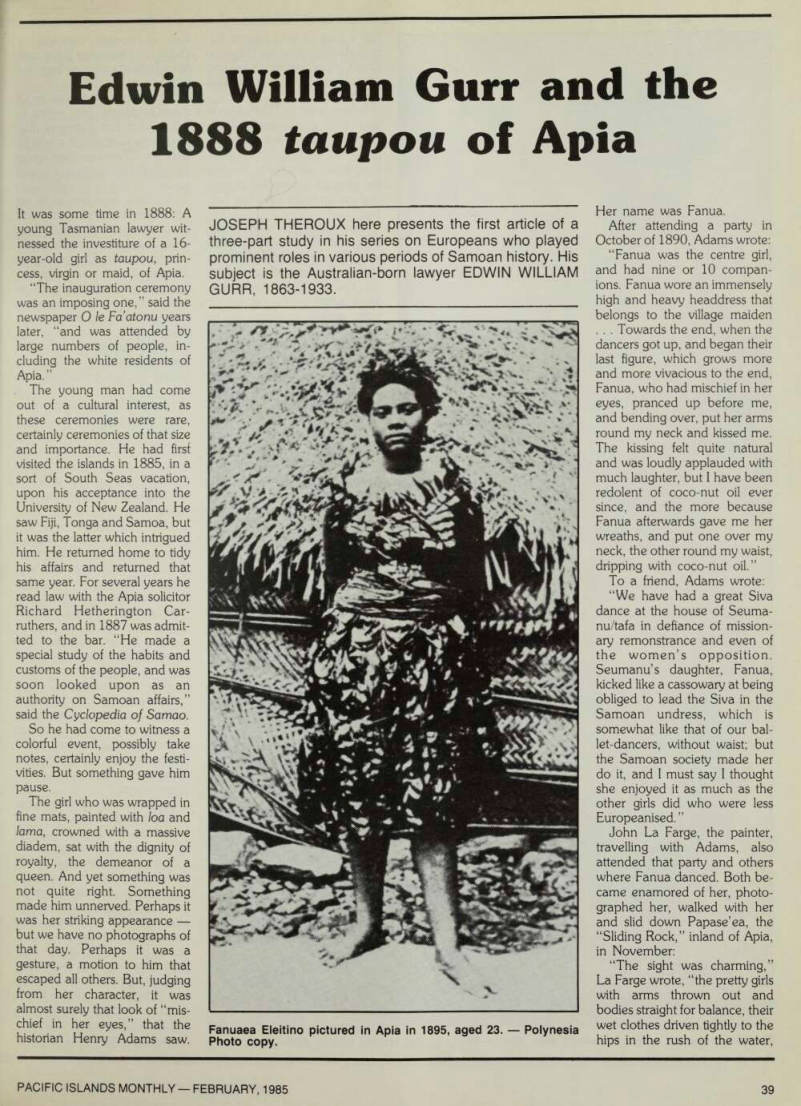
Her name was Fanua.
After attending a party in October of 1890, Adams wrote: “Fanua was the centre girl, and had nine or 10 compan ions. Fanua wore an immensely high and heavy headdress that belongs to the village maiden . . . Towards the end, when the dancers got up, and began their last figure, which grows more and more vivacious to the end, Fanua, who had mischief in her eyes, pranced up before me, and bending over, put her arms round my neck and kissed me.
The kissing felt quite natural and was loudly applauded with much laughter, but I have been redolent of coco-nut oil ever since, and the more because Fanua afterwards gave me her wreaths, and put one over my neck, the other round my waist, dripping with coco-nut oil.”
To a friend, Adams wrote: “We have had a great Siva dance at the house of Seuma nu/tafa in defiance of mission ary remonstrance and even of the women’s opposition.
Seumanu’s daughter, Fanua, kicked like a cassowary at being obliged to lead the Siva in the Samoan undress, which is somewhat like that of our bal let-dancers, without waist; but the Samoan society made her do it, and I must say I thought she enjoyed it as much as the other girls did who were less Europeanised. ”
John La Farge, the painter, travelling with Adams, also attended that party and others where Fanua danced. Both be came enamored of her, photo graphed her, walked with her and slid down Papase’ea, the “Sliding Rock,” inland of Apia, in November; “The sight was charming,”
La Farge wrote, “the pretty girls with arms thrown out and bodies straight for balance, their wet clothes driven tightly to the hips in the rush of the water,
Fanuaea Eleitino pictured in Apia in 1895, aged 23.-Polynesia Photo copy.
had a look of gold against the grey that brought up Clarence King’s phrase about Hawaii and the ‘old-gold girls that tumbled down waterfalls’.”
Adams added: “Only Fanua was timid and waited till the very last; indeed she made the jump but once and then pad died about with Nelly, hunting for shrimps under the stones, and eating them alive like ber ries.”
She evidently spent more time with the Americans than with the interested Tasmanian lawyer. But Samoan courtships are strange affairs, and some times seem to be carried on from across a room, or by long-distance. So in late November La Farge is writing: “After the feast, a siua in the open air, where Fanua danced.
The crowd was full all about her and her assistants, girls and men.”
Later, Fanua visited La Farge along with a little girl, having come from church. They had a leisurely conversation. La Farge commented: “Fanua has left after sending for the child of a neighbor and caressing it during part of our supposed conversation. They say that she is thinking of marrying, and certainly she will make a nice wife and mother if one can judge by looking at her. Is there anything sweeter
than a woman caressing a child? . . . Fanua has gone, and from Mata’afa’s house begins a hymn.”
Is there a wistful note in La Farge’s journal? We seem to detect one. But a proper dist ance is re-established a month later (on Christmas Eve) when he writes about Apia’s social news: “Fanua’s engagement to an Australian business man, and her marriage for the last of the year. There are many ‘cancans’ (cancan: gossip, Fr.) thereupon the question of marriage in due form, or of a Samoan marriage which does not bind the white man who leaves, being much discussed. It was even prop osed that she should marry first some Samoan why exactly would be too complicated to explain.”
Henry Adams, writing on the same day, said: “Fanua’s wedding invitations are out, for the 31st. She marries an English trader named Gurr, and this time the marriage is in English, not Sa moan.”
This entry suggests that there was an earlier, perhaps a church wedding. Also, since Gurr was neither a business man nor English, it appears that Fanua never discussed him with her American friends. Adams went on to say: “I like Fanua, who resembles Aenga a little, in being shy and sensitive, though not handsome in either face or figure.”
Fanny Stevenson disagreed, calling her “the magnificent Fanua” and “a grand specimen of the high-bred Samoan. ” And RSL’s mother, Mrs Thomas Stevenson, called her “a pretty Samoan girl.”
La Farge was present at her wedding and reception, but he makes no mention of it in his book. Adams described it: “Fanua was married at the British Consulate, her husband, Gurr being a British colonial here, and taking her as a wife after our law . . . Fanua was married without assistance from taupo (sic) colleagues, though she wore a very becoming wedding dress of fine mats. She had a ball, too, but La Farge and I do not go to balls ...”
Even Robert Louis Stevenson attended. He wrote
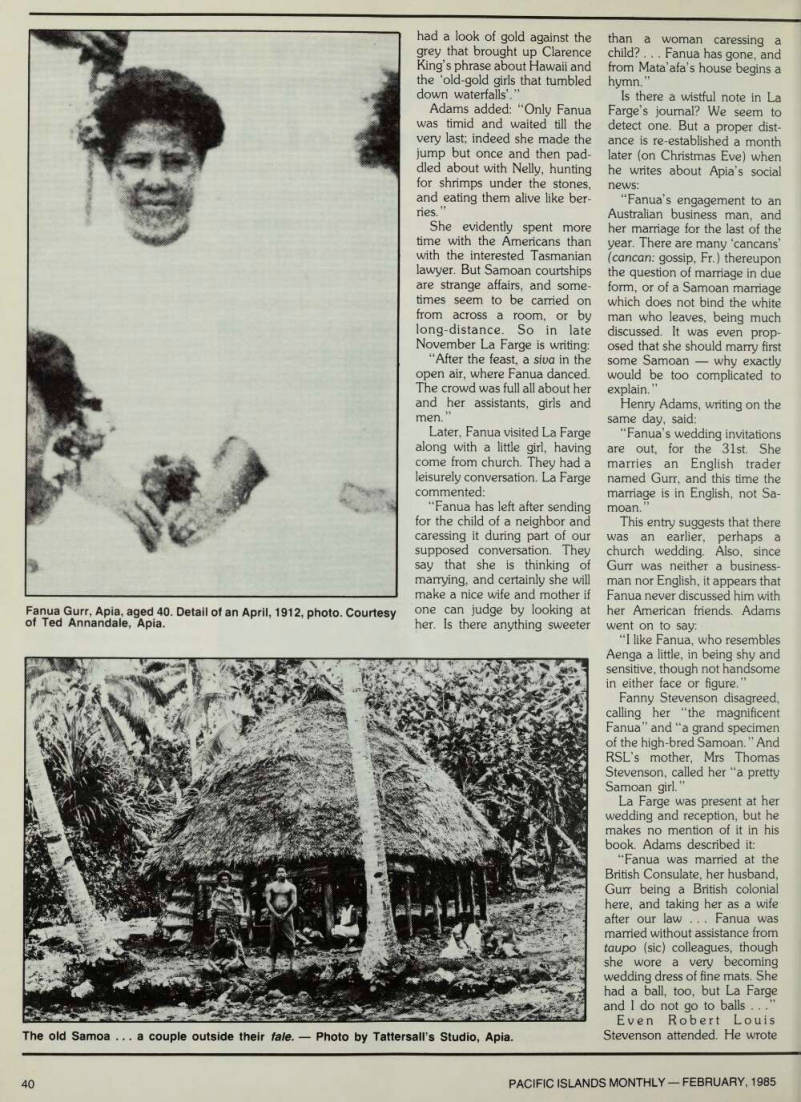
Fanua Gurr, Apia, aged 40. Detail of an April, 1912, photo. Courtesy of Ted Annandale, Apia.
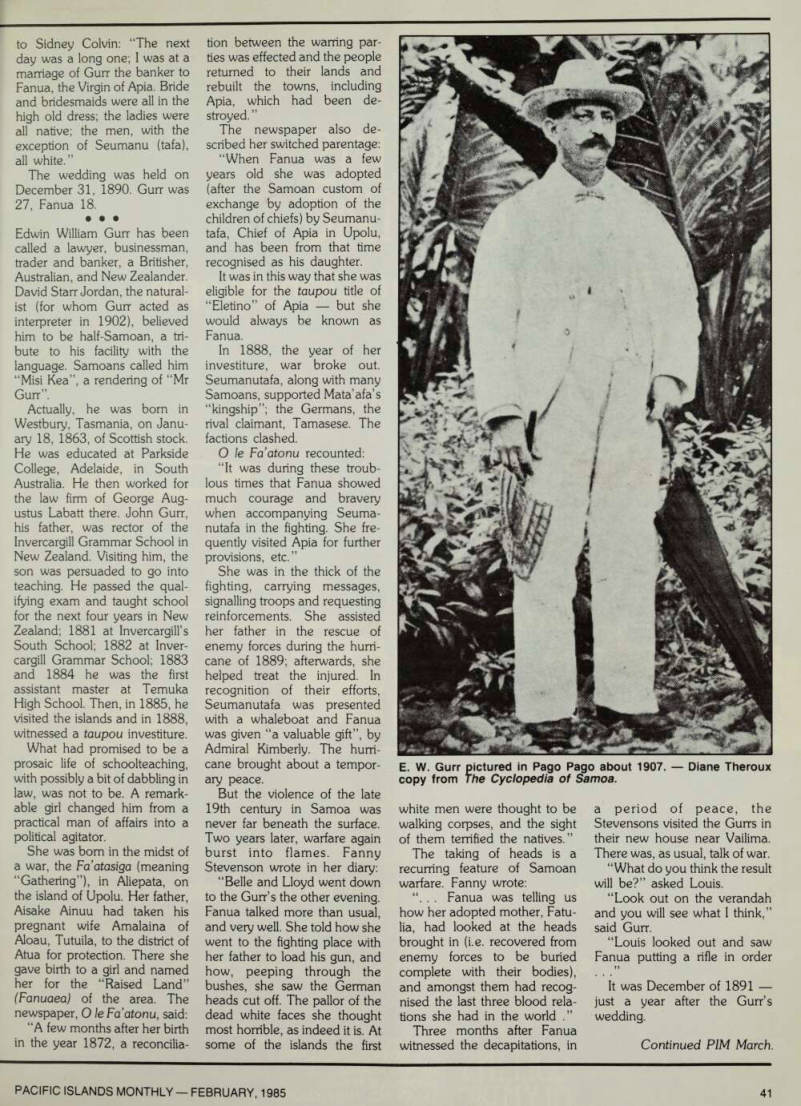
The old Samoa... a couple outside their fate. Photo by Tattersall’s Studio, Apia.
to Sidney Colvin: “The next day was a long one; I was at a marriage of Gurr the banker to Fanua, the Virgin of Apia. Bride and bridesmaids were all in the high old dress; the ladies were all native; the men, with the exception of Seumanu (tafa), all white.”
The wedding was held on December 31, 1890. Gurr was 27, Fanua 18. • • • Edwin William Gurr has been called a lawyer, businessman, trader and banker, a Britisher, Australian, and New Zealander.
David Starr Jordan, the natural ist (for whom Gurr acted as interpreter in 1902), believed him to be half-Samoan, a tri bute to his facility with the language. Samoans called him “Misi Kea”, a rendering of “Mr Gurr”.
Actually, he was born in Westbury, Tasmania, on Janu ary 18, 1863, of Scottish stock.
He was educated at Parkside College, Adelaide, in South Australia. He then worked for the law firm of George Aug ustus Labatt there. John Gurr, his father, was rector of the Invercargill Grammar School in New Zealand. Visiting him, the son was persuaded to go into teaching. He passed the qual ifying exam and taught school for the next four years in New Zealand; 1881 at Invercargill’s South School; 1882 at Inver cargill Grammar School; 1883 and 1884 he was the first assistant master at Temuka High School. Then, in 1885, he visited the islands and in 1888, witnessed a taupou investiture.
What had promised to be a prosaic life of schoolteaching, with possibly a bit of dabbling in law, was not to be. A remark able girl changed him from a practical man of affairs into a political agitator.
She was bom in the midst of a war, the Fa’atasiga (meaning “Gathering”), in Aliepata, on the island of Upolu. Her father, Aisake Ainuu had taken his pregnant wife Amalaina of Aloau, Tutuila, to the district of Atua for protection. There she gave birth to a girl and named her for the “Raised Land” (Fanuaea) of the area. The newspaper, O le Faatonu, said: “A few months after her birth in the year 1872, a reconcilia
tion between the warring par ties was effected and the people returned to their lands and rebuilt the towns, including Apia, which had been de stroyed.”
The newspaper also de scribed her switched parentage; “When Fanua was a few years old she was adopted (after the Samoan custom of exchange by adoption of the children of chiefs) by Seumanu tafa, Chief of Apia in Upolu, and has been from that time recognised as his daughter.
It was in this way that she was eligible for the taupou title of “Eletino” of Apia but she would always be known as Fanua.
In 1888, the year of her investiture, war broke out.
Seumanutafa, along with many Samoans, supported Mata’afa’s “kingship”; the Germans, the rival claimant, Tamasese. The factions clashed.
O le Faatonu recounted: “It was during these troub lous times that Fanua showed much courage and bravery when accompanying Seuma nutafa in the fighting. She fre quently visited Apia for further provisions, etc.”
She was in the thick of the fighting, carrying messages, signalling troops and requesting reinforcements. She assisted her father in the rescue of enemy forces during the hurri cane of 1889; afterwards, she helped treat the injured. In recognition of their efforts, Seumanutafa was presented with a whaleboat and Fanua was given “a valuable gift”, by Admiral Kimberly. The hurri cane brought about a tempor ary peace.
But the violence of the late 19th century in Samoa was never far beneath the surface.
Two years later, warfare again burst into flames. Fanny Stevenson wrote in her diary; “Belle and Lloyd went down to the Gurr’s the other evening.
Fanua talked more than usual, and very well. She told how she went to the fighting place with her father to load his gun, and how, peeping through the bushes, she saw the German heads cut off. The pallor of the dead white faces she thought most horrible, as indeed it is. At some of the islands the first
white men were thought to be walking corpses, and the sight of them terrified the natives.”
The taking of heads is a recurring feature of Samoan warfare. Fanny wrote: . . Fanua was telling us how her adopted mother, Fatu lia, had looked at the heads brought in (i.e. recovered from enemy forces to be buried complete with their bodies), and amongst them had recog nised the last three blood rela tions she had in the world .”
Three months after Fanua witnessed the decapitations, in
a period of peace, the Stevensons visited the Gurrs in their new house near Vailima.
There was, as usual, talk of war.
“What do you think the result will be?” asked Louis.
“Look out on the verandah and you will see what I think,” said Gurr.
“Louis looked out and saw Fanua putting a rifle in order 11 It was December of 1891 just a year after the Gurr’s wedding.
Continued PIM March.
E. W. Gurr pictured in Pago Pago about 1907.-Diane Theroux copy from The Cyclopedia of Samoa.