by an insider
p. 38 · Read in the full issue
The Fijian way of life by an insider
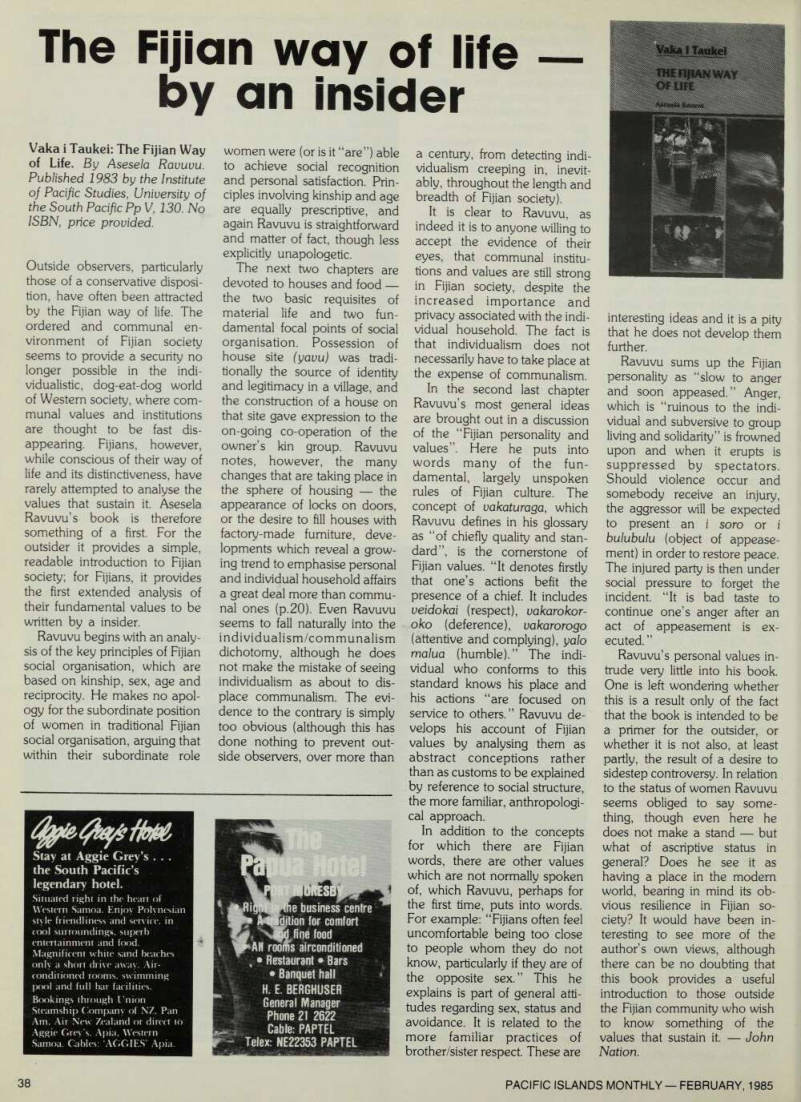
Vaka i Taukei: The Fijian Way of Life. By Asesela Ravuvu.
Published 1983 by the Institute of Pacific Studies, University of the South Pacific Pp V, 130. No ISBN, price provided.
Outside observers, particularly those of a conservative disposi tion, have often been attracted by the Fijian way of life. The ordered and communal en vironment of Fijian society seems to provide a security no longer possible in the indi vidualistic, dog-eat-dog world of Western society, where com munal values and institutions are thought to be fast dis appearing. Fijians, however, while conscious of their way of life and its distinctiveness, have rarely attempted to analyse the values that sustain it. Asesela Ravuvu’s book is therefore something of a first. For the outsider it provides a simple, readable introduction to Fijian society; for Fijians, it provides the first extended analysis of their fundamental values to be written by a insider.
Ravuvu begins with an analy sis of the key principles of Fijian social organisation, which are based on kinship, sex, age and reciprocity. He makes no apol ogy for the subordinate position of women in traditional Fijian social organisation, arguing that within their subordinate role
women were (or is it “are”) able to achieve social recognition and personal satisfaction. Prin ciples involving kinship and age are equally prescriptive, and again Ravuvu is straightforward and matter of fact, though less explicitly unapologetic.
The next two chapters are devoted to houses and food the two basic requisites of material life and two fun damental focal points of social organisation. Possession of house site (yavu) was tradi tionally the source of identity and legitimacy in a village, and the construction of a house on that site gave expression to the on-going co-operation of the owner’s kin group. Ravuvu notes, however, the many changes that are taking place in the sphere of housing the appearance of locks on doors, or the desire to fill houses with factory-made furniture, deve lopments which reveal a grow ing trend to emphasise personal and individual household affairs a great deal more than commu nal ones (p. 20). Even Ravuvu seems to fall naturally into the individualism/communalism dichotomy, although he does not make the mistake of seeing individualism as about to dis place communalism. The evi dence to the contrary is simply too obvious (although this has done nothing to prevent out side observers, over more than
a century, from detecting indi vidualism creeping in, inevit ably, throughout the length and breadth of Fijian society).
It is clear to Ravuvu, as indeed it is to anyone willing to accept the evidence of their eyes, that communal institu tions and values are still strong in Fijian society, despite the increased importance and privacy associated with the indi vidual household. The fact is that individualism does not necessarily have to take place at the expense of communalism.
In the second last chapter Ravuvu’s most general ideas are brought out in a discussion of the “Fijian personality and values”. Here he puts into words many of the fun damental, largely unspoken rules of Fijian culture. The concept of uakaturaga, which Ravuvu defines in his glossary as “of chiefly quality and stan dard”, is the cornerstone of Fijian values. “It denotes firstly that one’s actions befit the presence of a chief. It includes ueidokai (respect), vakarokor oko (deference), uakarorogo (attentive and complying), ya/o malua (humble).” The indi vidual who conforms to this standard knows his place and his actions “are focused on service to others.” Ravuvu de velops his account of Fijian values by analysing them as abstract conceptions rather than as customs to be explained by reference to social structure, the more familiar, anthropologi cal approach.
In addition to the concepts for which there are Fijian words, there are other values which are not normally spoken of, which Ravuvu, perhaps for the first time, puts into words.
For example: “Fijians often feel uncomfortable being too close to people whom they do not know, particularly if they are of the opposite sex.” This he explains is part of general atti tudes regarding sex, status and avoidance. It is related to the more familiar practices of brother/sister respect. These are
interesting ideas and it is a pity that he does not develop them further.
Ravuvu sums up the Fijian personality as “slow to anger and soon appeased.” Anger, which is “ruinous to the indi vidual and subversive to group living and solidarity” is frowned upon and when it erupts is suppressed by spectators.
Should violence occur and somebody receive an injury, the aggressor will be expected to present an i soro or i bulubulu (object of appease ment) in order to restore peace.
The injured party is then under social pressure to forget the incident. “It is bad taste to continue one’s anger after an act of appeasement is ex ecuted. ”
Ravuvu’s personal values in trude very little into his book.
One is left wondering whether this is a result only of the fact that the book is intended to be a primer for the outsider, or whether it is not also, at least partly, the result of a desire to sidestep controversy. In relation to the status of women Ravuvu seems obliged to say some thing, though even here he does not make a stand but what of ascriptive status in general? Does he see it as having a place in the modern world, bearing in mind its ob vious resilience in Fijian so ciety? It would have been in teresting to see more of the author’s own views, although there can be no doubting that this book provides a useful introduction to those outside the Fijian community who wish to know something of the
values that sustain it.
Nation.
John