boo ks
pp. 35-37 · Read in the full issue
World War II in the islands: A book that gets It right
Island Fighting. By Rafael Steinberg. Published 1984 by Time-Life Books, 541 North Fairbanks Court, Chicago, Illi nois 60611, U.SA. Libraiy of Congress catalogue card num ber 78-52847. Price $20.95.
An Australian who served in the Pacific War approaches a book like this with one thing in mind above all others: how fairly does the American author treat Australia’s role in the conflict?
This might seem a slightly para noid, “small-nation” attitude to adopt. But it should also be said that it is an attitude kept well nourished over the years by a number of fairly cavalier, “big nation” American treatments of the subject.
However, not even the most querulous Australian could have grounds for complaint in the case of this volume. The Australian part in the Pacific War is treated with the most scrupulous objectivity, with credit given generously where ver it is due.
Take the work of the pre dominantly Australian “coast watchers” in the Solomons fighting, for example. The au thor writes; “While the Japanese swept through the southwest Pacific, an intrepid band of Allied coast watchers manned more than 100 lonely, radio-equipped lookout posts on enemy occu pied islands. Recruited by the Australian navy, these former traders, planters, prospectors and government officers moni tored Japanese naval, troop and air movements across a 2500-mile crescent of ocean, stretching from New Guinea to the New Hebrides, and radioed the intelligence they gathered to Allied headquarters. On one
occasion, a radio flash from coastwatcher Jack Read on Bougainville in the Solomon Islands alerted American fliers, who subsequently shot down 36 of 44 Japanese planes that were heading for Guadalcanal.
“In addition to their intelli gence-gathering activities, the coastwatchers rescued downed Allied airmen and saved hun
dred of survivors of ships and boats destroyed by the Japan ese, including the crew of Lieutenant (jg) John F. Ken nedy’s FT 109.
“The success of the network depended heavily on the good will and often times the extraordinary bravery of many local inhabitants, some of whom risked their lives serving
the Allies as scouts, guides, porters and spies. One scout, Jacob Vouza, was captured by a Japanese patrol as he re turned from a mission on Guadalcanal in August of 1942.
The Japanese soon discovered that he was carrying a small American flag that had been given to him by a Marine, When Vouza refused to answer
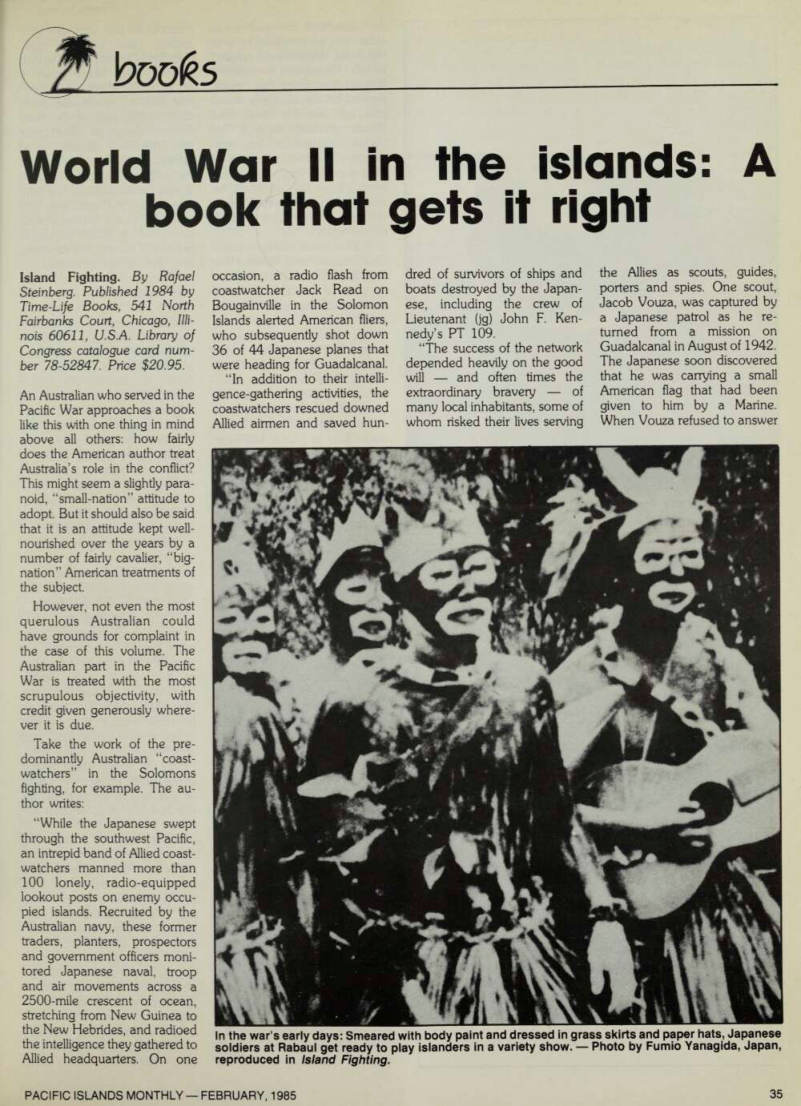
In the war’s early days: Smeared with body paint and dressed in grass skirts and paper hats, Japanese soldiers at Rabaul get ready to play islanders in a variety show. Photo by Fumio Yanagida, Japan, reproduced in Island Fighting.
their questions, they tied him to a tree and pummeled him with rifle butts. When he still refused to talk, his captors bayonetted him in the chest five times, slashed his throat with a sword and left him for dead. But Vouza gnawed through his bonds and half-crawled, half staggered three miles to a Marine post. There, before col lapsing from loss of blood, he managed to give the best report yet received of enemy strength on the island.
“ ‘The coastwatchers saved Guadalcanal,’ said Admiral Wil liam F. Halsey Jr., commander in chief of the South Pacific area, ‘and Guadalcanal saved the Pacific.’
The above passage is flanked on the left by a picture of the Australian Lieutenant-Com mander Eric Feldt and a num ber of coastwatchers, and on the right by a full-page picture of Jacob (later Sir Jacob) Vouza (who died in March last year, aged 83).
The book quotes a Japanese officer on the Australians in the Kokoda Trail (“Track” to the Americans) fighting: “Although the Australians are our ene mies, their bravery must be admired. ”
It goes so far as to share with readers a gentle dig from the official Australian army history directed at the US of As very own General Douglas MacAr thur. Writing of a period in 1944, it says: “Several days later it occur red to General Marshall, in Washington, to raise the ques tion of what was to be done, ultimately, about the Japanese forces that had been by-passed not just at Manokwari but all along the New Guinea coast and as far east as the Solo mons. ‘The various processes of attrition will eventually account for their final disposi tion,’ MacArthur replied. ‘The actual time of their destruction is of little or no importance’.
“Fortunately for MacArthur’s standing with the Australians, the comment was to lie buried in top-secret archives until after the war. All through the New Guinea campaign, Australian forces had been engaged in the perilous and costly task of cleaning out the Japanese pockets of resistance that the Americans had swept past. It was to continue to be the
Australians’ job until the War ended. Their supreme com mander, General Sir Thomas Blarney, had been given a signal to that effect in a MacAr thur directive in mid-July. Anti cipating the end of the New Guinea campaign, MacArthur had informed Blarney that henceforth he was to assume the responsibility for the ‘con tinued neutralisation’ of the Japanese. The mandate ex tended from the northern Solo mons to New Britain to Austra lian New Guinea, and excepted only the Admiralty Islands.
“The dynamic Blarney, who had hoped to take part in the action in the Philippines, dutifully agreed to the assign ment and estimated that six of his brigades the equivalent of two American divisions could handle it. MacArthur over-ruled him, insisting on 12 brigades. The nettled Austra lians managed to find some wry humor in the decision. As their official Army history noted, it appeared that MacArthur’s headquarters ‘did not wish it to be recorded that six American divisions had been relieved by six Australian brigades’.”
But I’m laboring the point. If the treatment given to Austra lia’s role in the war is excellent, so is almost everything else about this memorable book.
The work of Papuan carriers “lugging back-breaking loads over the Owen Stanleys” is treated with as much sympathy as that of the U.S. Navy’s Construction Battalions (the “can-do Seabees”) in “magical ly transforming the thickest jungle or most barren atoll” into a full-blown air or naval base.
Practically every Island nation in the Pacific today owes a debt of gratitude to the Seabees for the building of its original air port.
While carefully chronicling the doings of the “little people” in the war, the book also deals calmly and competently with the conflicts at the top within the U.S. command structure, notably the conflict between the naval and military comman ders. This appeared most sharply in the differing strategic perceptions of Admiral Chester W. Nimitz and General MacAr thur.
The text treats the Japanese foe with respect and understan ding, even as the process of his
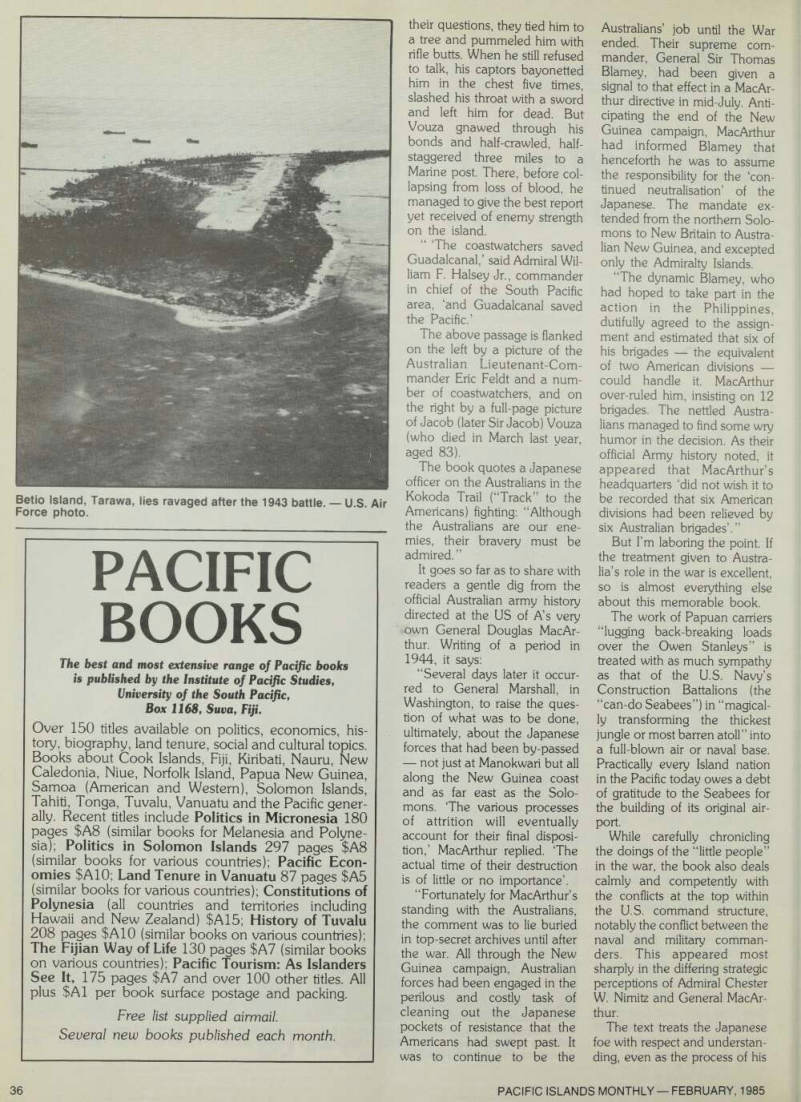
Betio Island, Tarawa, lies ravaged after the 1943 battle.-U.S. Air Force photo.
destruction is approvingly de scribed.
The book sticks scrupulously to its theme, with a minimum of diversions. Island Fighting tells of the fighting in the Solomons, Papua and New Guinea, Kiri bati, and the climactic episodes in the various Micronesian is lands, further west. It stops where the “island fighting” stops, and its story line does not even include the atomic bom bing of Japan and the subse quent surrender.
But when all is said and done, the greatest achievement of this book is that it gets the “spirit of the times” right. Any one who took part in this aspect of the Pacific War will have a reaction of “that’s right”.
This is a remarkable achieve ment since the main writer, Rafael Steinberg, is obviously too young to have taken part in the war. True, he had the advantage of three “consul tants” who had two retired senior American military offic ers, and a veteran journalist.
But perhaps Steinberg’s relative youth, and the fact that his view of the subject was unclouded by personal memories, ulti mately worked to his advan tage.
There is a complete lack of bravado about his treatment.
He writes of the 82-ship Task Force 61 steaming towards Guadalcanal for the first Amer ican offensive of World War 11, which began on August 7, 1942; “Aboard the transports, 19,000 members of the Ist Marine Division, Reinforced, played high-stakes poker in the ships’ heads, got together for songfests featuring such back home favorites as ‘Blues in the Night’ and ‘Chattanooga Choo- Choo,’ and listened to somber
know-your-enemy lectures
from officers who, by and large, had seen no more combat than their men had that is to say, none at all.”
Nor is there any attempt at glamorising the war experience.
On the physical realities of life on Guadacanal he quotes the writings of a gifted Marine pri vate, Robert Leckie: “Beneath Guadacanal’s loveliness, he wrote, ‘she was a mass of slops and stinks and pestilence; of scum-crested la goons and vile swamps inha bited by giant crocodiles; a
place of spiders as big as your fist and wasps as long as your finger, of lizards .. . tree leeches . . . scorpions . . . cen tipedes whose foul scurrying across human skin leaves a track of inflamed flesh ... By night, mosquitoes come in clouds bringing malaria, de ngue or any one of a dozen filthy exotic fevers . . . And Guadalcanal stank. She was sour with the odor of her own decay, her breath so hot and humid, so sullen and so still, that the Marines cursed and swore to feel the vitality oozing from them in a steady stream of enervating sweat.”
Steinberg’s overall picture of the American forces is true to the memory of those who fought alongside them. It is a picture a million miles from that image of the United States military as “an impotent giant” so current in more recent times, especially in the years of the Vietnam War.
It is a picture of a military machine adjusting rapidly and with brilliant success to a con flict such as it had never known before. It shows creativity and inventiveness of the highest
order in developing new weapons and tactics to meet the situation.
Among the most remarkable figures in this wave of military innovation were Fifth Air Force commander George C. Kenney (inventor of the “skip-bom bing” technique in which air force bombs performed with devastating effect the function of torpedoes against enemy shipping), and Vice-Admiral Marc A. Mitscher (with his handling of the completely novel “fast aircraft carrier” force provided by the navy as the U.S. industrial colossus moved into high gear to serve the war effort).
The irruption of all this high level U.S. technology into the islands scene is a story in itself. I had personal experience of it in October 1944, when our ship, HMAS Australia, was struck by a kamikaze aircraft in Leyte Gulf in the Philippines. All of us who had survived the attack looked forward confidently to some home leave while the ship was being repaired in Sydney.
Imagine our chagrin when we were told that we would not be going to Sydney at all, but to
the island of Espiritu Santo in the New Hebrides, where the U.S. naval dockyard was more modern and would do the job more quickly than any ship repair yard to be found in Sydney . . .
The wonder is not that the hectic years of the U.S. war effort in the islands in the years 1942-45 left behind a few cargo cults such as the John Frum movement on Tanna. The wonder is that they did not leave many, many more.
The pictures and the maps in Island Fighting are all that one would expect from such a pub lisher. The book is solidly bound, and has a sound, weighty feel to it.
My one complaint is that the index is not up to scratch. The New Hebrides, for example, just mentioned, does not appear in the index at all, although it is mentioned a good number of times in the text.
There are other deficiencies.
This is disappointing, especially since the list of people named as having had a hand in the production of the book itself approaches regimental propor
tions.
Malcolm Salmon.
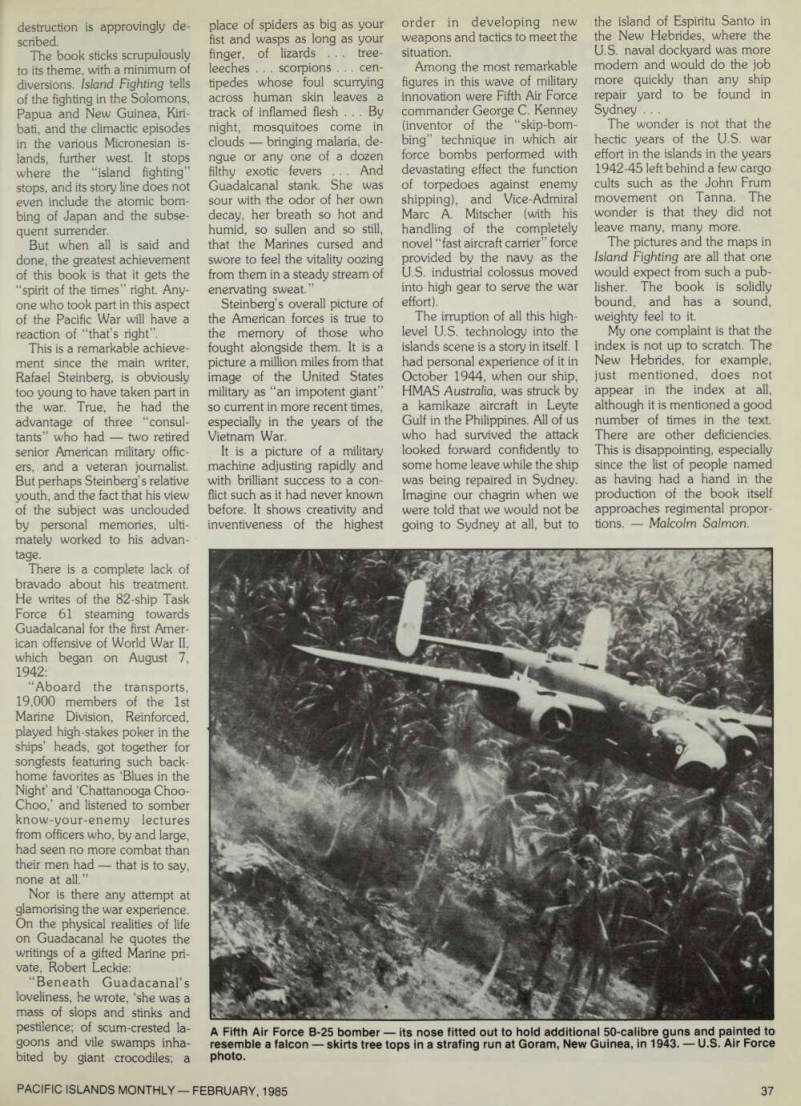
A Fifth Air Force B-25 bomber its nose fitted out to hold additional 50-calibre guns and painted to resemble a falcon skirts tree tops in a strafing run at Goram, New Guinea, in 1943. U.S. Air Force
photo.