Ratu Mara in the U.S.A.
pp. 46-47 · Read in the full issue
political currents
The visit as seen from Suva...
Fiji’s Prime Minister, Ratu Sir Kamisese Mara, made history late in November when he became the first head of state from the South Pacific to re ceive a personal invitation to visit the White House. He was accorded full honors by Presi dent Reagan in a meeting which is seen in Suva as mar king the acceptance of Fiji’s importance in the region and further noting America’s in terest in it.
Ratu Mara did not win any concrete benefits, in particular a new or larger sugar quota, (although the question was dis cussed), but he was assured that a proposal would be put before the U.S. Congress that the 1986 budget provide for a bilateral aid programme to Fiji.
No other country in the Pacific receives aid on such a basis from the U.S.
Other economic issues dis cussed between the two leaders included fishing rights in Fiji waters, and landing rights for Air Pacific, Fiji’s national airline on the mainland of America, preferably at Los Angeles. No decisions were taken on these points.
But the U.S. agreed under its defence corporation program with Fiji to immediately fund a $300,000 weapons stan dardisation program for the Royal Fiji Military Forces.
On the question of military relations between the two countries, American officials said they were not looking for military bases in Fiji and neither were they looking at Fiji as a substitute for New Zealand, should that country’s attitude towards nuclear ship visits
finally impede further ANZUS arrangements.
In his farewell statement after the official meeting at the White House, President Reagan said Ratu Mara had demonstrated “a high degree of political cour age” when having weighed his legitimate concern over nuclear issues against the defence needs of his country and the Oceania region”, in 1983, the Prime Minister decided to re open Fiji’s ports to all American naval vessels.
President Reagan said the United States wished to ’’work more closely with the people of Fiji and Oceania” to help them achieve prosperity and peace.
He described Fiji as a “model of democracy and freedom. A tremendous example for all countries of the developing world.”
President Reagan said Fiji’s accomplishments had earned “the deepest respect and admiration” of the American people. Ratu Mara had taught him the meaning of doing things in ’’the Pacific Way,” he said. ’’Vinaka,” said President Reagan. And then, amid broad smiles from the Fiji delegation, he bid them farewell with a perfect ”ni sa moce.”
Ratu Mara in reply said his visit to the U.S. signalled ’’the warm ties of friendship” be tween Fiji and the United States. There was now much greater understanding and appreciation of each other’s views and aspirations. Both na tions were committed to “jus tice, freedom and fair play,” he said. Like the United States, Fiji stood for peace and was ready
to play its part in order to demonstrate that belief, Ratu Mara said.
However, Fiji was small, and like other democratic communi ties in the South Pacific and elsewhere, looked to America, and its president,” for support and guidance in many of our endeavours. ”
After his official engagements in Washington the Fijian leader travelled to New York where he accepted the ’’Pacific Man of the Year” award from the Foundation for the Peoples of the South Pacific at a ceremony held in New York’s Metropoli tan Museum of Art.
Ratu Mara, 64, is the second regional personality to have the honor bestowed upon him by the foundation which is a pri vate voluntary organisation which funds and promotes de velopment projects in the island nations. The first recipient was PNG’s Prime Minister, Mr Michael Somare.
The $lO,OOO award in Ratu Mara’s name will be used to open a centre in Fiji for youths who move into the urban centres from the rural areas to help them adjust to city life.
After that ceremony, Ratu Mara met with the United Na tions secretary-general, Javier Perez de Cuellar and extended to him a personal invitation to make a visit to Fiji, which he will undertake in February on his way to Australia and New Zea land.
Mr Perez thanked the prime minister for Fiji’s support for the U.N. peace-keeping effort in the Middle East where a Fiji battalion has been attached to UNIFIL in Southern Lebanon for some years. Fiji is also one of the 10 nations which contri butes to the United Nations multi-national force which monitors the Sinai peninsula in accordance with the Egyptian- Israeli accord. By our Suva Correspondent.
... and from Washington
Perhaps the Fiji Prime Minis ter’s best prospects for an early breakthrough on economic issues was in the field of landing rights. Air Pacific, the Fiji airline, now lands at Honolulu; it would like to fly on to Los Angeles airport (LAX). This desire runs directly counter to the interests of at least one US airline, Continental, which has weekly direct flights to Fiji from both LAX and San Francisco. The Prime Minister raised the LAX access issue in a meeting with the Assistant Secretary of State for Economic Affairs, Richard McCormack, and Assistant Sec retary of Transportation for In ternational Affairs, Mathew Scocozza. But there was no resolution of the matter.
Virtually every nation in the world wants to sell sugar to the United States at the artificially inflated price set to meet the demands of politically powerful U.S. sugar producers. Quotas for foreign sales are worked out carefully to spread the benefits of the U.S. price level which nets at 12 cents a pound above the free world market price of about five cents a pound. Re cently, because of a decision of the U.S. government that it will import less sugar this year than last, the Fiji quota was reduced from the previous level of 21,294 short tons (in 1983-84), to 17,780 short tons in 1984- 85. Given this price structure, Fiji got about $5,110,000 in bonuses for its 1983-84 sugar
but faces a reduction of this bonus to about $4,267,000 in the coming year. The Prime Minister met with Michael Smith, the Deputy U.S. Trade Representative, on this point.
He may have raised it with Agricultural Secretary, John Block, who was one of the three Cabinet members at the White House luncheon (the others being Secretary of State George Shultz, who also met with Ratu Mara privately, and Secretary of Defense Caspar Weinberger).
The Prime Minister discussed the possibility of major Amer ican investment in tuna-related activities in Fiji; he would like U.S. tuna-fishing fleets to make use of Fiji ports as away-from home bases for their Pacific activities, and perhaps for tuna processing as well. With this in mind he visited David Burney, the executive director of the United States Tuna Founda tion, a non-governmental or ganisation. Any real prospects for this kind of activity, how ever, will have to wait until the 12-mile limits v. 200-mile limits controversy about tuna fishing is resolved. Fiji at present holds that no tuna can be taken without her permission within 200 miles of her shores.
Peter Macpherson, adminis trator of the Agency for In
ternational Development, dis cussed his agency’s program with the prime minister, as did Assistant Secretary of State James L. Malone, whose do main is oceans, environmental and scientific affairs, a post formerly held by Hawaii’s Patsy Mink.
Fiji’s two battalions of peacekeepers, stationed in the Sinai to keep the Egyptians and the Israelis apart, and in South ern Lebanon, played a major role during the five-day trip to the United States. U.S. Defense and State Department officials regard the Fijians as “perfect peacekeepers,” explaining “they are good, well-trained, assertive troops and no one can argue that they have any con ceivable axe to grind in the Middle East.”
U.S. gratitude for the work of the battalions was one of the subjects discussed at the lunch for the prime pinister hosted by the Deputy Secrtary of De fense, William Howard Taft IV.
Taft, incidentally, slim, young and clean-shaven, is great grandson of the original William Howard Taft, the rotund first U.S. civilian governor of the Philippines, who went on to become President of the United States in 1909-13.
Prime Minister Mara met with Norwegian Lt.-General Egil Ingebrightsen, commander of
the multi-national force and observers, the outfit in the Sinai, as well as with Peter Constable, the director-general of the operation. The Sinai operation is a non-UN, in ternational organisation with 10 nations providing troops. A third of the infantry is provided by Fiji. The United States, Egypt and Israel pay for this force; but, in effect, the U.S. pays for it all, because it pro vides extensive financial sup port to both the other nations as part of the Camp David accords.
While the battalion in the Sinai is rarely under fire, and the Multi-National force and Observers pays Fiji regularly for the use of the men, things are not going so well with the Fiji battalion in southern Lebanon.
People are busily shooting at each other, for one thing, and Fiji is not receivng full payment for the battalion’s work there.
The Lebanese assignment is to a United Nations peacekeeping force, and the Soviets and some of their allies have been refusing to pay their share of the costs. As a result Fiji is being paid only $750 per man per month, instead of the full fee of $950 per man per month.
It is not clear whether the prime minister sought clarifica tion of the finances of the
United Nations peace-keeping operation during his brief visit to the Secretary-General of the United Nations, but that was one stop on his one-day visit to New York City. What is clear, however, is that fully-paid or not, the two battalions in the Middle East are more important to the economy of Fiji than the U.S. sugar market. At $750 a month for each of the 600 members of the battalion in Lebanon the gross to Fiji (and there are heavy expenses), would come to $5.4 million (U.S.) a year; if the gross receipts for the force in the Sinai amount to as much, that would produce more than $lO million (U.S.) for Fiji annually.
The prime minister’s entour age included Dr Isireli Lasaqa, secretary to the cabinet, Ambassador Jioji Kotobalavu, permanent secretary of foreign affairs, and Rashid Ali, general manager of the Fiji Sugar Corporation. In charge of arrangements for Fiji was Fiji’s Ambassador to both the United States and the United Nations, Ratu done Radrodro. Former U.S. ambassador to Fiji, Con gressman-elect Frederick Eck ert, and the next U.S. ambassa dor, Edward Dillery, were pre sent at both the White House and the vice-presidential functions. David S. North in Washington.
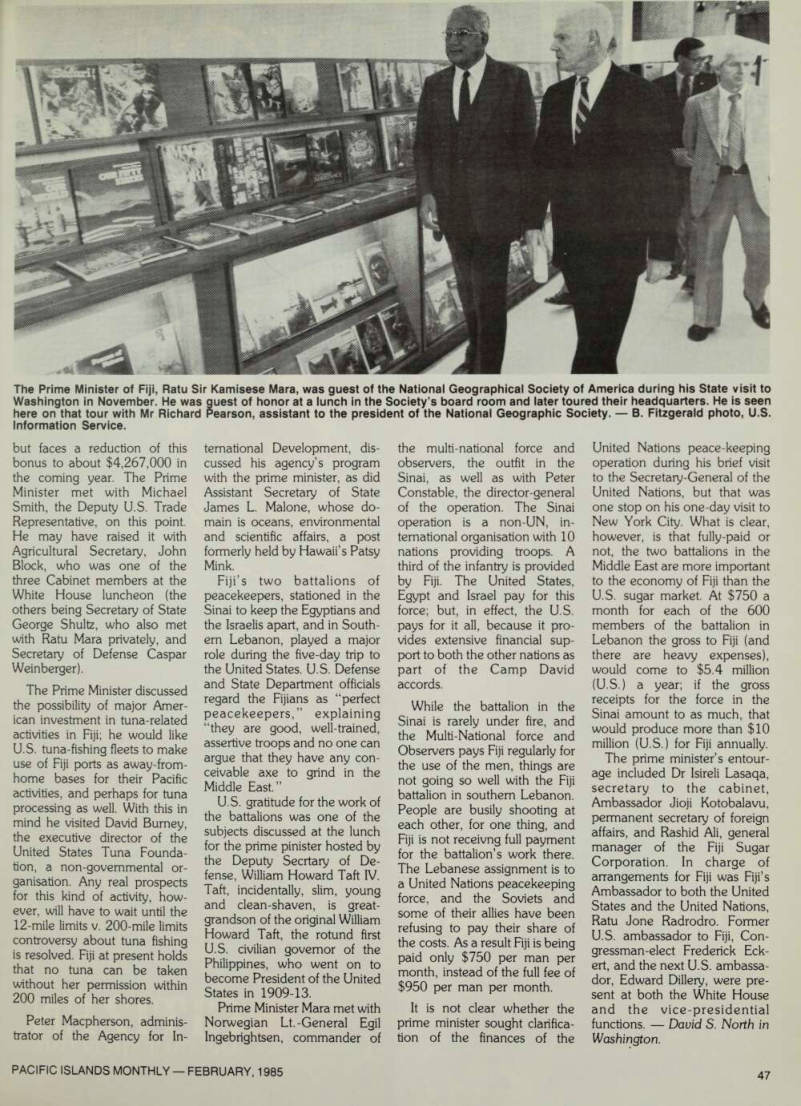
The Prime Minister of Fiji, Ratu Sir Kamisese Mara, was guest of the National Geographical Society of America during his State visit to Washington in November. He was guest of honor at a lunch in the Society’s board room and later toured their headquarters. He is seen here on that tour with Mr Richard Pearson, assistant to the president of the National Geographic Society.-B. Fitzgerald photo, U.S.
Information Service.