for Remeliik
p. 27 · Read in the full issue
Palau: A win for Remeliik
In an island group where poli tics is played out with an intense passion, the second presidential and legislative elections in Palau in late November pro vided both surprise and promise.
The big winner was incum bent President Haruo I. Re meliik. According to final unoffi cial results, Remeliik polled 4050 votes to Airai State Gov ernor Roman Tmetuchl’s 2482.
Koror Mayor Idedul Yutaka Gibbons, who also holds high chiefly rank, was a distant and surprising third with only 1418 votes.
Eighty-three per cent of Palau’s 9605 registered voters cast their ballots in the Novem ber 30 election, That was three per cent more than the number that voted in the first presi dential election in 1980.
Remeliik’s victory, as well as the easy re-election of Vice- President Alfonso Oiterong (who ran separately), is a clear signal by Palauans that they want to move ahead with im plementation of the Palau-U.S.
Compact of Free Association.
Remeliik based his campaign on support for the embattled compact. Of the three candi dates, he was most clearly in favor of the relationship.
That analysis is supported by other returns. Only five mem bers of the generally anti-corn
pact Senate were re-elected.
Notable among the upper chamber newcomers is Lazarus Salii, the veteran politician who has most recently been Palau’s ambassador to the free associa tion negotiations.
In the lower chamber, which has been more supportive of the compact, eleven of 16 members were re-elected.
With such a commanding lead, Remeliik should be able to move ahead on the contentious compact issue. But whether he will be able to move as quickly as he or the United States might like is another matter. Unless there is some magic formula to revise the compact yet another time to meet Palau’s con stitutional prohibition on the introduction of nuclear material, the stalemate will con tinue. What seems a likely route is amending the constitution to allow it and the compact to live in harmony.
Palauans will be able to prop ose constitutional amendments for the first time this year.
American policy is that it cannot carry out its defence obligations to Palau if it is prohibited from, on occasion, sending nuclear powered ships to Palau or allowing ships or aircraft carrying nuclear weapons to use local facilities. America’s difficulties with New Zealand
are a reminder that this prob lem is not Palau-specific.
As a continued U.S. defence posture in Micronesia has al ways been a given, Palauans again have the essential choice of either chucking the compact (and with it about $1 billion in American aid over the next 50 years) or changing their con stitution. It has been noted before here and elsewhere that Palauans are a pragmatic peo ple. One does not discredit them by saying that their most pressing concern is mainten ance of a good standard of life, a standard that is measured in materialistic terms.
It will not be easy to alter the constitution. The document has received world-wide attention, and rightly so. In the process, a cheering squad who see in Palau the coming of an anti nuclear Nirvana have lent their backing to the relatively small number of people who actively support anti-nuclear issues. Any effort to amend the constitution on this point will likely receive considerable outside attention.
But as has been the case from the beginning, the Palauans must either drop the
Notes from the North
free association agreement or change their constitution if they hope to break the stalemate that has soured political deve lopment there. That is the choice they face. It is at once an easy and difficult choice. But the longer they delay making the decision, the farther they will fall behind their Microne sian cousins who are moving closer to self-government.
K. Takeuchi.
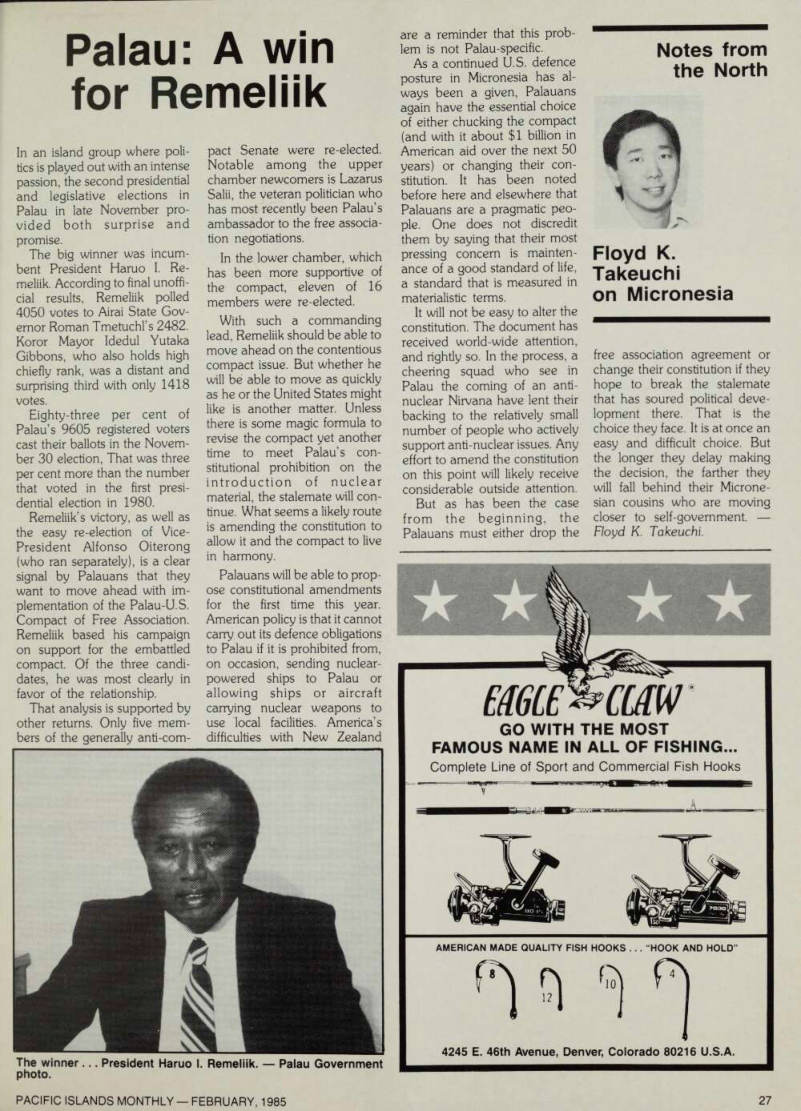
The winner... President Haruo I. Remeliik.-Palau Government photo.
Floyd K.
Takeuchi on Micronesia