equipment in Tuvalu
p. 29 · Read in the full issue
trade winds
State of the art telephone equipment in Tuvalu
Behind the scenes at Aug ust’s meeting of the South Pacific Forum was a revolutionary new communications system de signed by the Canadian Marc oni electronics and communica tions company. It is called RACE, which stands for Radio telephone with Automatic Channel Evaluation, and it bids fair to solve the problem of achieving cheap, reliable, com munications with the more re mote parts of the world.
In tiny Tuvalu telephone communications are something of a luxury, and in short supply.
There is no earth station for the satellites, and no link with the several big telphone and televi sion cables now traversing the Pacific. The hotel has one tele phone, and there are several instruments in official offices, but the total installation for the country is about the size of a small office PABX in a big city.
With teams of journalists, plus diplomats and officials due in Tuvalu for the important Forum meeting, the quickest and also the cheapest way of providing extra telphone chan nels had to be found, the solution came from Canada, in the hands of Marconi electro nics engineer, Michel Bedard, who worked in conjunction with Harry Powell, head of the Suva, Fiji, offices of AWA New Zealand, Ltd.
In effect the RACE system gave Tuvalu direct access to an exchange line in the Suva Tele com headquarters and, through it, to anywhere in the world.
Anyone who has used HF radio knows the frustrations involved as channel quality suddenly deteriorates in a mess of “hash”, cutting communica
tions in mid-sentence.
The RACE system links up to 16 telephone extensions in the remote area, through a series of HE radio channels, to the major telephone exchange. Anyone in the remote station then needs only to dial the number he requires, as if he were attached to the exchange by a standard telephone line.
But, the secret of the RACE system is that it automatically and continuously sifts through the radio channels of the trans mitter-receiver, choosing the best and clearest of them.
In a conversation lasting only three or four minutes a caller
might, quite without knowing it, or perceiving any alteration in the quality of his call, have his voice switched among anything up to a dozen different radio channels. RACE Knows the best channel all the time, and switches to it, automatically and continuously, throughout the call.
RACE does not need skilled operators, is relatively cheap to buy and install, and in its more advanced form can handle not only voice, but also radio tele type and telex signals. Marconi says it is also possible to handle high-speed computer data, a
facility which employs the ex tensive electronic memory with in the RACE system.
Development work is con tinuing and the venture in Tuvalu was in fact part of this world-wide research and evaluation process. Other units will be taken out into the Pacific in future months to test Marco ni’s contention that their machine is the best and cheapest method yet designed to bring the ease and reliability of the telephone to remote islands where small communi ties need, but cannot afford, conventional systems.
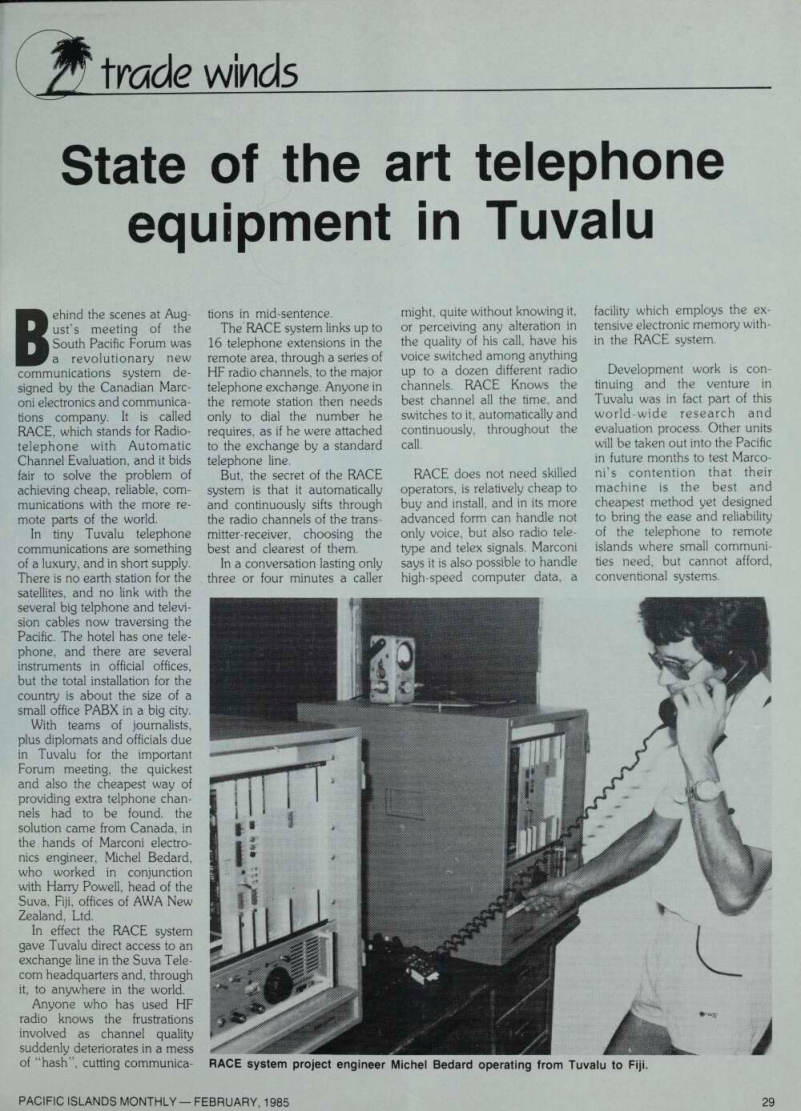
RACE system project engineer Michel Bedard operating from Tuvalu to Fiji.