politics
pp. 25-26 · Read in the full issue
the month
Tahiti’s budget politics
“A budget is above all a political act, a statement of the aims pursued by the party in power, ” declared Premier Gaston Flosse in his address to the Territorial Assembly when it convened on December 6, 1984, for the annual budget debate. How firm was his own grip on the helm of the ship of state could be seen most clearly in the brisk manner in which the data processed 1985 budget was presented and adopted at one sitting by his eagerly nodding, silent majority, made up of 18 of the 30 assemblymen.
The portion of the CFP45,189 million (SA3I2 mil lion) budget (an 18 per cent increase over the previous one) which best reflects the credo of Flosse and his Tahoeraa Party is the section listing anticipated revenues. Of the projected 1985 revenues, not less than 78 per cent consists of indirect taxes, such as customs duties on imported goods to the amount of CFP20,820 million, (SAI44 million), shop licences, death and land registration duties, and sales tax on various services, transactions and goods, of which tobacco sales alone are expected to yield a whopping CFPIB2O million (5A12.5 million).
The only income tax is levied on commercial firms which pay 35 per cent on their declared profits, without undue nosing around by over-zealous inspec tors. Among the many indirect taxes, several this is a new trend will be levied for specific purposes in 1985. For instance, a tax on car insurance is expected to produce CFPISO million (SAI million), which will be earmarked for the Papeete hospital on the grounds that its running costs have risen drama tically due to the steadily in creasing number of road acci dents. Another tax applied to video and music cassettes will
be used to develop native handicrafts. Car owners will also pay a special tax to assist the professional training of the many unemployed youth in the territory.
The most original of these so-called taxes para-fiscales, which will bring in a total of CFPIBOO million (SAI2 mil lion), is the one destined to cover the hole in the territorial treasury made by a swindle. It was committed in 1978 by a person since shown to be an international crook, who was paid no less than SUS 4 million for a worthless “feasibility study” promising a bright future for a projected oil refinery ser ving the whole of the South Pacific. To rub in the memory of this disastrous blunder by the previous Autonomist majority, Flosse has now, after a court has ordered the local govern ment to repay, slapped an additional franc on every litre of beer, and two extra francs on every litre of petrol, as well as
25 francs surcharge per 100 kilograms on all imported goods.
Budget financing, based almost wholly on indirect taxa tion, reflects Gaston Flosse’s belief in the free enterprise system. The underlying assumption is that local businessmen will reinvest the huge profits they make and are allowed to keep, and that it will thus be easier to attract new foreign capital. As a result, there will be more jobs and more customers for all businessmen and tradesmen. In other words, everybody will be happy and prosperous.
Opposition leaders have often protested that all this constitutes a “tax haven” only for the wealthy, who pay an infinitely smaller proportion of their income in taxes than the poor. Flosse’s most outspoken opponents, the three la mono assemblymen, who preach a socialist, worker-controlled eco nomy, land redistribution, and a partial return to old Polyne sian values and practices, de monstrated their total rejection of the 1985 budget draft by refusing even to take part in the parliamentary debate. Flosse has cleverly parried by lowering
Postmark Papeete
or abolishing certain customs duties on essential consumer goods, and by increasing the minimum wage to CFP7O,OOO a month (SA4BO).
Most readers will probably be surprised to learn that projected budget revenues for 1985 do not contain a section marked “French contribution”. The sur prise is understandable, as there exists a widespread belief, assiduously fostered by the French propaganda machine, that Tahiti is a sort of de luxe mistress, living in grand style on the unbounded generosity of her French protector. In reality, the only direct French contribu tions to the local budget consist of customs duties paid by the defence ministry for goods, material and equipment (such as nuclear weapons) used by French army personnel at Moruroa. By increasing the cus toms duties in a selective man ner, the local government ex pects this “blood money” to reach the sum of CFFSOOO million (SA34 million) in 1985.
To tell the whole story, France also finances several departments and services, with out any trace of these expendi tures being found in the territo rial budget. The reason is not purely altruistic, but simply that France, in order to preserve the present colonial system, insists on keeping full control of such
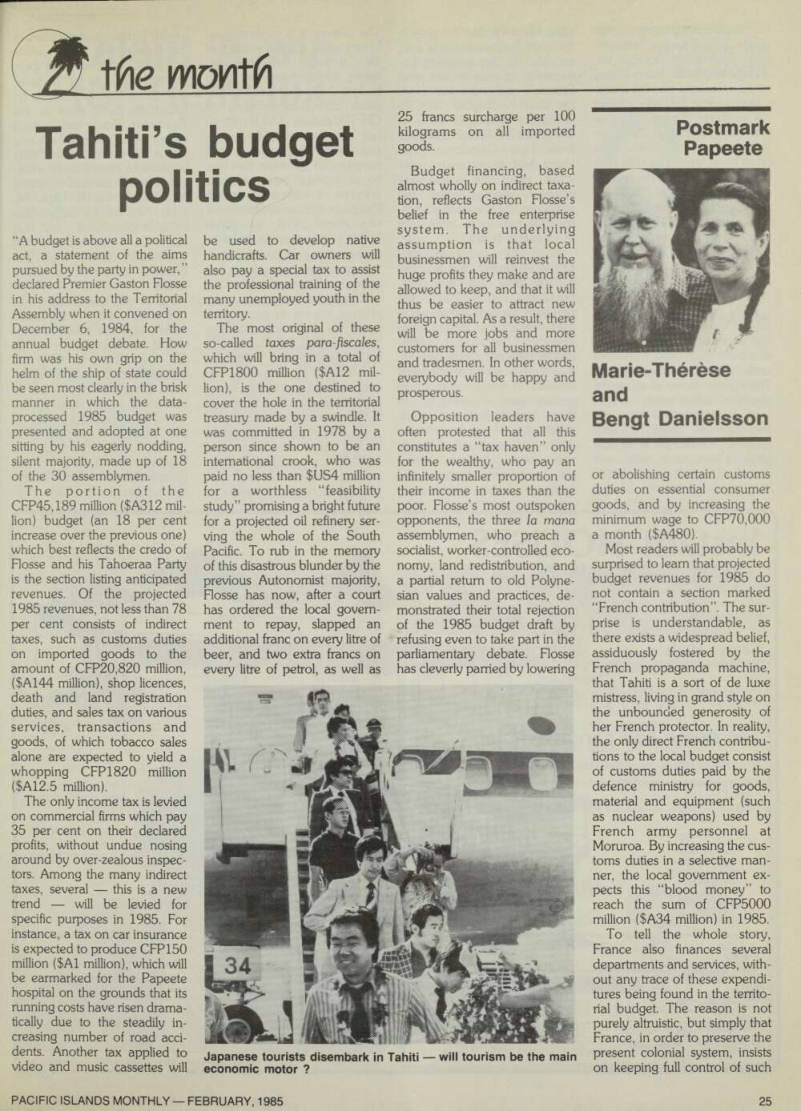
Japanese tourists disembark in Tahiti will tourism be the main economic motor?
Marie-Therese and Bengt Danielsson
vital sectors as defence, foreign affairs, police, justice, immigra tion, information, foreign ex change and trade, international communications and the exclu sive economic 200-mile zone of the territory. France also pro vides free of charge 2200 ex patriate “experts”, who have often been known to take over or at least to infiltrate heavily many branches of the sup posedly local administration.
More useful to the local govern ment are undoubtedly the occasional French contributions of a few hundred million francs for specific projects, such as a new road or sports stadium.
If we now look at the other side of the coin, showing plan ned expenditures, it is possible, and even quite easy, to discern underlying government policy.
The figures above all show the all-round effort made by the local government to meet the educational, medical and material needs of a rapidly growing population, which will pass the 170,000 mark in 1985.
The rapid growth in budget
expenditures is due not only to the high Polynesian birth rate, but also to the on-going im migration of new settlers from France still more than 1000 per year coupled with the predictable influx in 1985 of thousands of French refugees from New Caledonia. The sharp budget increases since 1984 along the whole line therefore simply reflect the willingness of the local govern ment to pursue an open-door immigration policy.
Incidentally, the government offices in Papeete are also be coming more and more over populated, and the budget ex penditure for staff salaries will in 1985 reach the astronomical figure of CFPII,OOO million (SA76 million). Consequently, the item called investments consists in most instances of money spent on putting up still more unprepossessing office buildings.
The big question is whether there are among these numer ous sumptuous outlays also some productive investments.
The answer is a qualified yes.
For instance, a closer scrutiny of the 18 huge, data-processed reams which form the 1985 budget draft, indicates that the quite considerable sum of CFP7OO million (SA4.B million) has been set aside for tourist promotion. The urgency and necessity of this item can best be gauged from the fact that the number of visitors to French Polynesia has remained station ary since 1978, at about 100,000 per year. In another, perhaps more decisive manner, the government has for some time tried to stimulate the growth of the tourist industry by offering private investors gen erous tax deductions and low interest loans. As a first visible result, several new hotels are a-building, and total accommodation capacity in the territory is expected to rise to 3000 rooms at the end of 1985.
An almost equally important budget item is the allocation of CFPS9O million (SA4 million) for the exploration and ex ploitation of the enormous
wealth hidden in the ocean in the form of fish, shells, pearls and metal nodules (PIM Dec. ’Bl pplB-19). As for the valu able phosphate deposits to be found on some atolls in the Tuamotus, Flosse had nothing to say in his inaugural address about the international mining consortium Raro Moana which last year was accused of robber tactics at Mataiva (PIM Apr. ’B4, p 23). Nor did the responsible minister give the slightest clue as to how the territory will eventually benefit from the planned extraction of phos phate.
All in all, the budget thus seems to confirm that Flosse means business when he pro claims in season and out that his basic aim is to make the territory economically indepen dent. On this point at least, he can count on the warm appro val of all opposition parties the strongest support, of course, coming from those who likewise are in favor of political independence. Marie-Theri'se and Bengt Danielsson.