Percy Chatterton: A life
pp. 23-24 · Read in the full issue
that was loved
Percy came to Papua New Guinea as a teacher. He re mained a teacher all his life.
He had taught for three years before coming here in a school run by the Society of Friends (Quakers). He embraced and lived Quaker values. In the 1970 s he added to his commit ments an involvement in a small Quaker Meeting in Port Moresby. The pomp and circumstance of a military fune ral would have been appreci ated by him with irony and laughter. During World War 1 he had carried stretchers rather than fight. Quakers are noted for their addiction to non violence.
When Percy retired 20 years ago he turned to politics and writing. Perhaps he “taught” more through his columns, his speeches in the House, and his radio interviews than he had to his thousands of pupils at Hanuabada and Delena be tween 1924 and 1954 the 30 years he was formally a teacher (both primary and teacher-training).
Percy’s first column in PIM appeared in October, 1966. It was called “To the Point”. It was titled “Five Books for a Pacific Journey on a Raft”. He meandered over many of his concerns. It reflects both his wit and wisdom, his fundamental bias for the underdog, and his energetic support of mother tongue instruction. In 1966 in the House he was a regular challenger of the authorities on what was happening to “border crossers” from Irian Jaya something he was still doing with concern and zest in 1984.
It was his conviction that led to an Ombudsman Commission and a National Capital District.
His belief that “Paguineans” could run their own affairs led him to back the establishment of their own church as early as
Papua New Guinea educationist SHELDON WEEKS, a friend of the late Sir PERCY CHATTERTON, here pays tribute to him, with special regard to his ideas concerning the education of young Papua New Guineans. The tribute captures much of the savor of an outstanding personality, and an outstanding human being.
1950. But he also saw the other side of the coin in 1972 he wrote: “One of the greatest of the many perils threatening this embryo nation may be that of the leaders getting so far ahead of the led that they disappear from sight.”
Percy was a strong supporter of Papua. He was also a cham pion of the urban villager and the unemployed. He wrote fre quently about the problems of those youth who were “pushed out” by the educational system.
In October, 1967, he wrote: “The gang, with engaging frankness, called itself The Ras cals’. Their speciality was petty thieving from parked cars.
When they were finally round ed up by the police their ages were found to range from eight to 13.” He went on to propose a special school for delin quents— “Such a school should have a flexible program unhampered by red tape, and an entrance standard that rec ognised no qualification but human need. Syllabuses pre scribed by Konedobu would be taboo. Percentiles too ... to carry out such a scheme will cost a lot of money, but at least some of these young people will become assets to the coun try’s economy. To do nothing about it will cost a lot of money, too, in 10 or 15 years’ time.
And it will be money poured down the drain; because it will be money spent in maintaining habitual criminals in our jails. ”
Or in 1985, on our “law and
order” budget.
In Percy’s old school at Hanuabada the children attended only four days a week.
This was because parents wanted time to teach them to hunt, fish and garden. “By basing our curriculum on the vernacular and teaching the rudiments of English as a sub ject we produced no BA’s, but we also produced no misfits.”
In the early 1970 s Percy changed the name of his col umn in PIM to “Footnotes”. In 1972 Percy was concerned about how selection into high school by boards of manage ment would work (it didn’t, and was abandoned). He went on: “We have abolished failure. We have substituted for it the E Pass. As 1972 draws to a close there will be a fresh crop of E Pass holders wondering why their pieces of paper are not getting them anywhere .. .
From 1921 to 1941 Papua harbored a system of payment by results schooling invented in Victorian England. Once a year a pupil (not merely in the top standard but in all standards) was examined by an external examiner generally a retired Queensland school inspector.
The pupils who scored 50 per cent or over had the letter “P” entered against their names and earned a grant for their mission ranging from 5/- a head for Standard 1 passes to 25/- a head for Standard 5 passes.
How we cherished those poten tial 25 bobsworth in Standard 5
during the weeks preceding the examination. Those who scored less than 50 per cent had (I hate to confess) the letter “F” entered against their names and earned nothing but opprobrium. The chief differ ence between our pre-war bob a-nob and the post-war Stan dard 6 examination appears to be that in the latter case the prize has gone to the pupil instead of the school, and has taken the form of a place in high school instead of a cash grant. ”
In his “Footnotes” column of March, 1972, Percy asks: “Is backwards the way ahead for Paguineans?” He notes that in the ’6os the Education Depart ment was pushing for younger children to enter school: “The fiat went forth. Pupils must be enrolled at an earlier age and pushed relentlessly through the two preparatory classes and the six standards of the eight-year primary course. Missionaries who had used the two prepara tory years to teach their pupils to read the mother tongue while acquiring a basic know ledge of spoken English were told that whatever the educatio nal arguments in favor of such a plan might be, there just wasn’t time to spare for it. English, English all the way. Only so could the pupils acquire enough knowledge of the magic language to enable them to profit by a secondary educa tion. The fact that this meant that those who didn’t win through to a place in high school left their primary school not effectively literate in any language was conveniently ignored. Excelsior! No time for two prep, classes. Cut one out, and settle for a seven-year course. Faster yet faster. Why have a prep, class at all? Cut it out and settle for a six-year course. Think of the saving in
teachers! Now we’re getting somewhere. Ready for high school at 12. Marvellous provided they can get into high school. But what about the ones who don’t? What to do?
Well, if they are finishing too soon we must start them off later. Let’s raise the entrance age to seven, then the town kids will have a chance of becoming apprentice gangsters before they enter school instead of having to wait until they leave it. (But 20 years ago you said we must bring the entrance age down. Never mind what we said 20 years ago.) One or two old-time missionaries have sug gested timidly that the now unwanted prep, years might be utilised, as they used to be in many mission schools, to teach the pupils to read and write their own language. No, that won’t do. Not enough teachers.
Can’t spare any for that rubb ish. Well, what about recruiting teaching aides? Blimey, what would the Teachers’ Associa tion say? Go ahead, go ahead, go ahead. But which way is ‘ahead’?”
Percy was always amused by the irony of “progress”, and saw how what was “forwards” for some people might be “backwards” for others. In 1966 he proposed an anti progress association. “When I get tossed out of the House of Assembly in 1968 I think I shall turn my energies to founding and promoting ‘The Anti-Prog ress Association of Papua’: it will be a lost cause from the start, of course, but it will be great fun. I have already de signed a badge a Bandicoot Rampant over a Yam Couchant (one of those long thin ones that grow so well in sandy soil and which are so delicious when baked in hot ashes).
Underneath there is a tasteful scroll carrying the legend ‘To Hell with Progress’.”
In July, 1972, he wrote again about education, noting that “It’s been here for centuries”.
He was amused over a senior public servant claiming “before 1946 there was no education in Papua New Guinea”. “I am surprised that the suggestion
has never been put forward that that year should be regarded as the beginning of a new era, and that the years thereafter should be re-numbered making the present year AK. (After Konedobu) 26 . . . the speaker was doubly wrong. There was not only education in pre-war
Papua New Guinea, but there was also education in pre contact Papua New Guinea. If we regard education as being preparation for adult life, then I think that it may be said that education in Papua New Guinea before the arrival of the white man was more effective
in attaining its objective than much of our educational effort is now in A.K. 26”.
He then did a quick history of education in Papua New Guinea. “At long last the tide has turned, and we are now getting back to the ideals of Bill Groves and the practice of the best of the pre-war mission schools. Head teachers are being encouraged to re-establ ish links between community and school, to invite members of the adult community into the schools to teach traditional arts and crafts and tell stories in the until recently despised vernacu lar. Who knows, if we go on like this we may eventually get back to encouraging Paguinean chil dren to read and write their own language.” In the 1980 s Percy was encouraged by the re-development of vernacular schools in the North Solomons and plans for them in Enga.
Percy’s Christmas message in December 1966 could well be what he would have written (with only slight modifications to take account of pop music fashions) for Christmas 1984: “Most of those who come to town have little education and no skills. They eke out a preca rious existence from unskilled and often casual jobs, with not infrequent periods of un employment. Their shanties are built of every conceivable sort of scrap material . . . sanitation is primitive, and water has to be fetched ... yet even from these sordid surroundings comes the sound of children singing. It doesn’t sound quite like ‘Away in a Manger’ or The First Noel’.
It isn’t a Papuan tune either.
The sound swells as the young singers reach the chorus, and now the words come through clearly. ‘We all live in a yellow submarine, yellow submarine, yellow submarine.’ To all of you who read this I offer seaso nal greetings, Whether you in tend to celebrate the season with angels and the wise men, or in a Holden sedan, or on a reindeer sleigh, or in a yellow submarine with the Beatles, I wish you a very happy Christmas.”
We will miss him. Shel don Weeks.
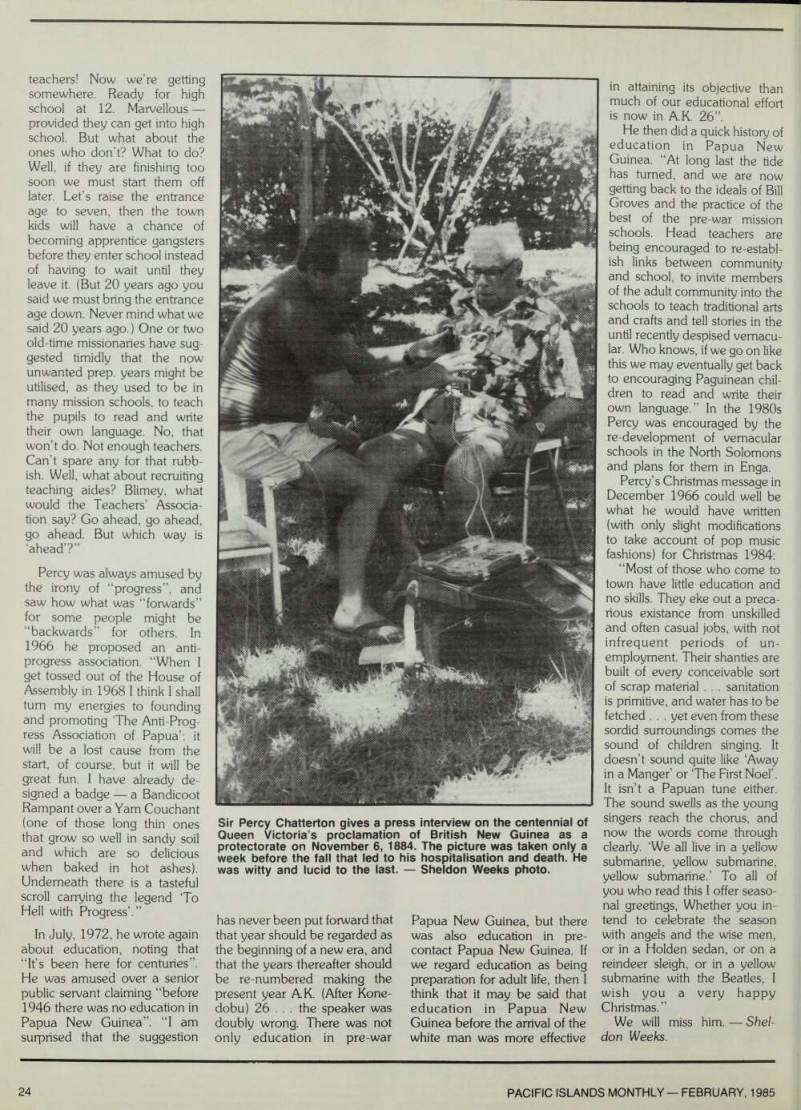
Sir Percy Chatterton gives a press interview on the centennial of Queen Victoria’s proclamation of British New Guinea as a protectorate on November 6, 1884. The picture was taken only a week before the fall that led to his hospitalisation and death. He was witty and lucid to the last. Sheldon Weeks photo.