Sergio Rapu, Rapanui’s
pp. 20-21 · Read in the full issue
emissary in Australia
Rapanui (Easter Island) is a long way from anywhere; souvenirs sold there proc laim it to be u the most remote island in the world”.
But in early December of 1984, the first citizen of that tiny Chilean province, came to Australia.
Sergio Rapu is the first Islander to hold the position of governor of his island, and he was appointed to that post in early 1984; he is also the first non-military governor the place has had since the early part of this century.
Rapu is large in the Polynesian fashion, with a full smile and broad face, not at all like the angular moai figures for which Rapanui is best known. He is more than an appointed official, serving as well as host for visitors to his land, and able to converse with them in either Spanish or English.
The facility with English came about due to Rapu’s association with Professor William Mu Hoy, the archaeologist who worked longest on the Island. It was Mulloy who sponsored Rapu to go to the University
of Wyoming, where the Rapanui acquired not only a degree in Anthropology, but also Yankee-accented Eng lish, and his wife, Cindy.
Rapu is currently enrolled in the PhD program at the East-West Center, from which he received a mas ter’s degree a few years ago.
It is an irony of modem Chilean life that his Amer ican degrees are not recog nised by the Chilean univer sities, a fact which cost him in salary during the time when he was curator of the local museum.
The possibility of a visit by Rapu to Australia was first mooted during the First International Congress on Easter Island and Eastern Polynesia, which was held on the island in September of 1984. (See PIM, October 1984.) At that time, there was a plan to send a Rapa nui folklore team to the Festival of Pacific Arts, in Noumea. Given that he was to cross most of the Pacific to reach New Caledonia, a side visit to Australia seemed like a good idea.
Many other people thought so as well and when
media, as well as scholarly, organisations heard about the visit, they were quick to fill up his brief eight-day stay.
Aside from making con tacts with various museum and university people, he wished also to find out about sources of informa tion on tropical agriculture for his island. In particular, he was seeking details on Australia’s famous nut, the macadamia, and crop in formation on a kind of white maize which used to be used as pig feed by the English company, William son Balfour, in the first half of this century, when they ran the island as a large sheep ranch.
The first quest resulted in three macadamia plants carefully packed in a beer carton, for transport as hand luggage an unusual souvenir. The Macadamia Nursery in Sydney kindly threw in a handful of raw nuts they happened to have on hand to boost the fledg ling crop.
Pig feed remained a mys tery, but various persons in Australia have undertaken
to find out about the matter.
Radio interviews ranged from a spot on the ABC’s “Morning Extra” with Jane Singleton, to a more scien tific discussion of recent archaeological discoveries with Halina Szepzik, of the ABC Science Unit. The Syd ney educational FM station, 2SER, grabbed a general interview on the hop, just before Rapu was to address the anthropology staff of the Australian Museum.
University contacts in cluded lunch with the Uni versity of New South Wale’s Pro Vice-Chancellor, Pro fessor Jarloth Ronayne, and a seminar in the department of anthropology of Sydney University.
Professor Jack Colson, of the department of prehistory at the Australian National University, invited Rapu to give a paper in Canberra, where other Pacific special ists interviewed him on his work.
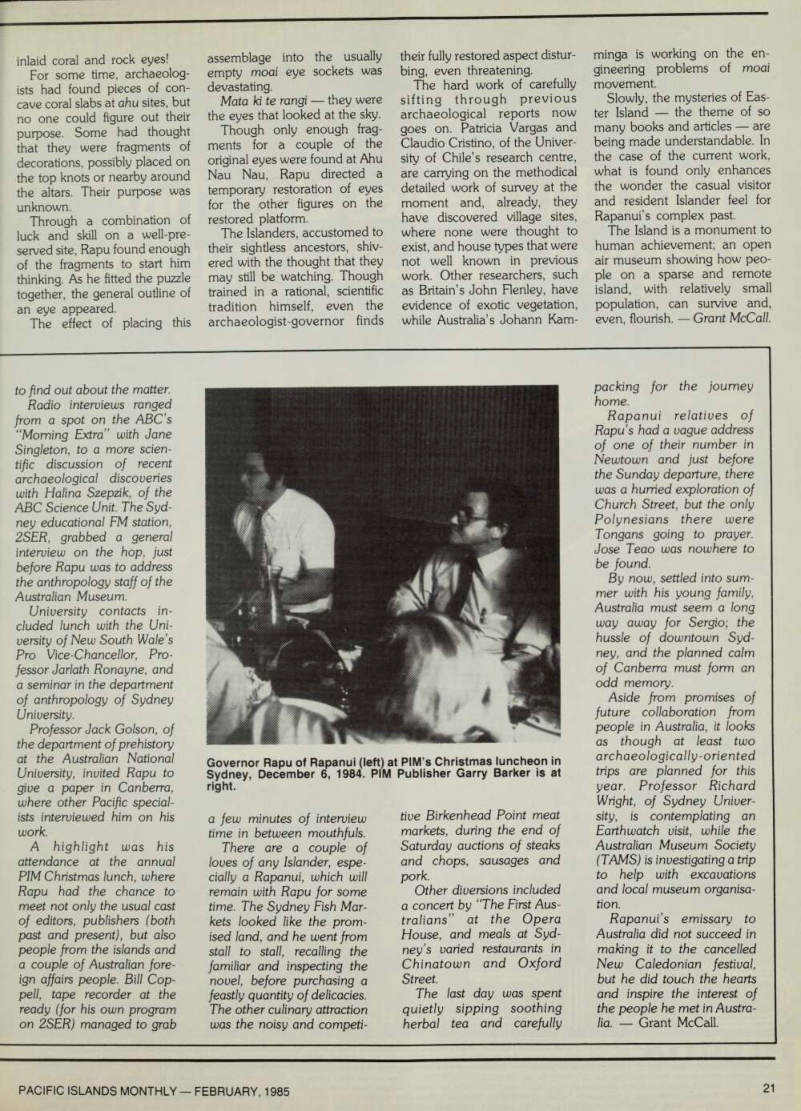
A highlight was his attendance at the annual PIM Christmas lunch, where Rapu had the chance to meet not only the usual cast of editors, publishers (both past and present), but also people from the islands and a couple of Australian fore ign affairs people. Bill Cop pell, tape recorder at the ready (for his own program on 2SER) managed to grab
a few minutes of interview time in between mouthfuls.
There are a couple of loves of any Islander, espe cially a Rapanui, which will remain with Rapu for some time. The Sydney Fish Mar kets looked like the prom ised land, and he went from stall to stall, recalling the familiar and inspecting the novel, before purchasing a leasilyIeasily quantity of delicacies.
The other culinary attraction was the noisy and competi
tive Birkenhead Point meat markets, during the end of Saturday auctions of steaks and chops, sausages and pork.
Other diversions included a concert by “The First Aus tralians” at the Opera House, and meals at Syd ney’s varied restaurants in Chinatown and Oxford Street.
The last day was spent quietly sipping soothing herbal tea and carefully
packing for the journey home.
Rapanui relatives of Rapu’s had a vague address of one of their number in Newtown and just before the Sunday departure, there was a hurried exploration of Church Street, but the only Polynesians there were Tongans going to prayer.
Jose Teao was nowhere to be found.
By now, settled into sum mer with his young family, Australia must seem a long way away for Sergio; the hussle of downtown Syd ney, and the planned calm of Canberra must form an odd memory.
Aside from promises of future collaboration from people in Australia, it looks as though at least two archaeologically-oriented trips are planned for this year. Professor Richard Wright, of Sydney Univer sity, is contemplating an Earth watch visit, while the Australian Museum Society (TAMS) is investigating a trip to help with excavations and local museum organisa tion.
Rapanui’s emissary to Australia did not succeed in making it to the cancelled New Caledonian festival, but he did touch the hearts and inspire the interest of the people he met in Austra lia. Grant McCall.
Governor Rapu of Rapanui (left) at PIM’s Christmas luncheon in Sydney, December 6, 1984. PIM Publisher Garry Barker is at right.