Australia’s birdwatchers map
pp. 41-42 · Read in the full issue
their feathered friends
Atlas of Australian Birds.
Published by Melbourne Uni versity Press. 1984. ISBN 0 522 84285 2. Price SA49.
Birds have long been the envy of people. Even the most ele gant of aeroplanes cannot match the versatility afforded by the flesh and feathers of a bird in flight. Because of this astonishing ability they have flourished all over the world; our lives would be poorer with out their color and song. We would also find life more diffi cult. Many activities of wild birds are of benefit to humans.
Some eat insects which affect our crops, guano from the breeding colonies of seabirds forms the basis of our fertilisers.
All have places in their own communities. The same birds that provide our fertiliser also contribute to the richness of the coral reefs that surround their breeding islands, many plants cannot grow unless their seed has first been eaten by a bird.
However, we do not know the importance of most birds, either to us or their communities. It is a responsibility of our modern society to conserve the natural diversity that has developed
over thousands of years, and to plan our development so that no species are lost. One of the first steps in conservation is to find out where birds live, and it was with the needs of environ mental planning in mind that the Royal Australasian Ornthologists Union (RAOU) began, in 1977, to map the distribution of Australia’s birds.
Initially the country was di vided into 812 degree squares, each about 100 km on each side. Members of the RAOU and other birdwatchers were then encouraged to record every sort of bird they saw within each square. It was a big job: Australia is an enormous country.
Gradually, over the five years of the project, the patterns built up. Scattered points, marking grid squares visited, were at first concentrated around the capital cities of each state, showing more the distribution of bird watchers than of birds. Slowly the points coalesced and spread further and further into the outback. Major expeditions were organised which travelled deep into the sandy hinterland, to country never before seen by
birdwatchers. All manner of vehicles jeeps and aero planes, motor bikes and sailing boats were used to pursue the more elusive unvisited grid squares. Some places were only accessible on foot.
Just under 3000 ornitholog ists, both amateur and pro fessional, contributed records which, by the end of the study, totalled nearly three million.
Every one of the grid blocks in Australia was visited and some areas, like the entire state of Victoria, were surveyed on a much finer scale.
Of course such a project is not free of financial cost and yet the half million dollars needed was remarkably cheap for a project which included five years field work, and two years analysis and writing. No gov ernment could have obtained so much information with only the four full-time staff employed on the atlas project. In fact, had the project been carried out entirely by paid professionals it would have cost more than 10 times as much. On the other hand a voluntary organisation such as the RAOU could not have funded the administration
from its own resources. The result is therefore a splendid example of how government and other funding bodies have been able to work together with enthusiastic and informed volunteers to create a project of benefit to all.
One of the most useful fea tures of the atlas has been to show how the distribution of birds has changed since Euro pean settlement. At the same time as the atlas fieldwork was going on, an historical atlas was prepared from the RAOU’s own journal The Emu, from museums, from books, the re cords of other societies and from the old notes of many birdwatchers. Originally it was intended to publish the his torical maps separately but it is encouraging that there has been too little change in the distribution of most birds for this to be justified. Nevertheless it is disturbing that nearly 20 species are not as widespread as they once were. Six of these are parrots, of which one, the Paradise Parrot, has probably been lost forever. Only two of the bird species that have de clined are found anywhere ex cept Australia the Magpie Goose and the Cotton Pygmy- Goose are fortunately still com mon in Papua New Guinea and South-east Asia. On the other hand some species have bene fited from the changes in en-
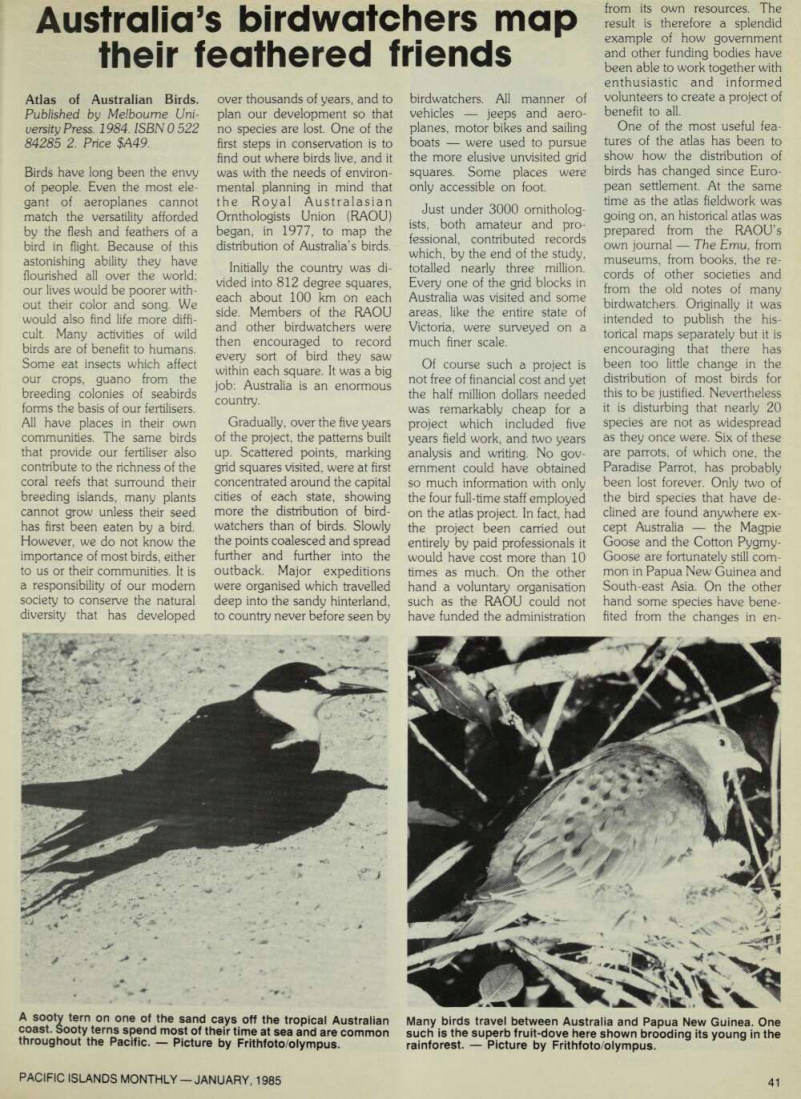
A sooty tern on one of the sand cays off the tropical Australian coast. Sooty terns spend most of their time at sea and are common
throughout the Pacific. Picture by Frithfoto/olympus.
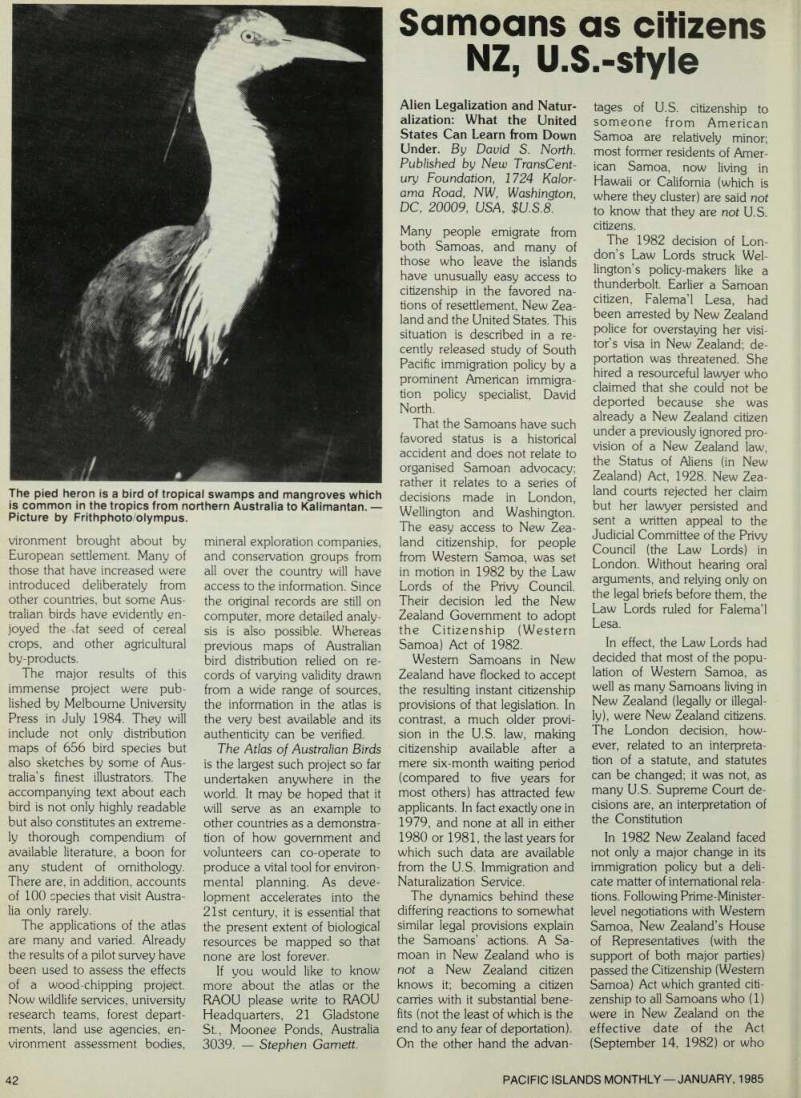
Many birds travel between Australia and Papua New Guinea. One such is the superb fruit-dove here shown brooding its young in the rainforest. Picture by Frithfoto/olympus.
vironment brought about by European settlement. Many of those that have increased were introduced deliberately from other countries, but some Aus tralian birds have evidently en joyed the dat seed of cereal crops, and other agricultural by-products.
The major results of this immense project were pub lished by Melbourne University Press in July 1984. They will include not only distribution maps of 656 bird species but also sketches by some of Aus tralia’s finest illustrators. The accompanying text about each bird is not only highly readable but also constitutes an extreme ly thorough compendium of available literature, a boon for any student of ornithology.
There are, in addition, accounts of 100 species that visit Austra lia only rarely.
The applications of the atlas are many and varied. Already the results of a pilot survey have been used to assess the effects of a wood-chipping project.
Now wildlife services, university research teams, forest depart ments, land use agencies, en vironment assessment bodies,
mineral exploration companies, and conservation groups from all over the country will have access to the information. Since the original records are still on computer, more detailed analy sis is also possible. Whereas previous maps of Australian bird distribution relied on re cords of varying validity drawn from a wide range of sources, the information in the atlas is the very best available and its authenticity can be verified.
The Atlas of Australian Birds is the largest such project so far undertaken anywhere in the world. It may be hoped that it will serve as an example to other countries as a demonstra tion of how government and volunteers can co-operate to produce a vital tool for environ mental planning. As deve lopment accelerates into the 21st century, it is essential that the present extent of biological resources be mapped so that none are lost forever.
If you would like to know more about the atlas or the RAOU please write to RAOU Headquarters, 21 Gladstone St., Moonee Ponds, Australia
3039.
Stephen Garnett.
The pied heron is a bird of tropical swamps and mangroves which is common in the tropics from northern Australia to Kalimantan.
Picture by Frithphoto Olympus.