NZ, U.S.-style
pp. 42-43 · Read in the full issue
Samoans as citizens NZ, U.S.-style
Alien Legalization and Natur alization: What the United States Can Learn from Down Under. By David S. North.
Published by New Trans Cen tury Foundation, 1724 Kalor ama Road, NW, Washington,
Dc, 20009, Usa, Su.S.B.
Many people emigrate from both Samoas, and many of those who leave the islands have unusually easy access to citizenship in the favored na tions of resettlement, New Zea land and the United States. This situation is described in a re cently released study of South Pacific immigration policy by a prominent American immigra tion policy specialist, David North.
That the Samoans have such favored status is a historical accident and does not relate to organised Samoan advocacy; rather it relates to a series of decisions made in London, Wellington and Washington.
The easy access to New Zea land citizenship, for people from Western Samoa, was set in motion in 1982 by the Law Lords of the Privy Council.
Their decision led the New Zealand Government to adopt the Citizenship (Western Samoa) Act of 1982.
Western Samoans in New Zealand have flocked to accept the resulting instant citizenship provisions of that legislation. In contrast, a much older provi sion in the U.S. law, making citizenship available after a mere six-month waiting period (compared to five years for most others) has attracted few applicants. In fact exactly one in 1979, and none at all in either 1980 or 1981, the last years for which such data are available from the U.S. Immigration and Naturalization Service.
The dynamics behind these differing reactions to somewhat similar legal provisions explain the Samoans’ actions. A Sa moan in New Zealand who is not a New Zealand citizen knows it; becoming a citizen carries with it substantial bene fits (not the least of which is the end to any fear of deportation).
On the other hand the advan
tages of U.S. citizenship to someone from American Samoa are relatively minor; most former residents of Amer ican Samoa, now living in Hawaii or California (which is where they cluster) are said not to know that they are not U.S. citizens.
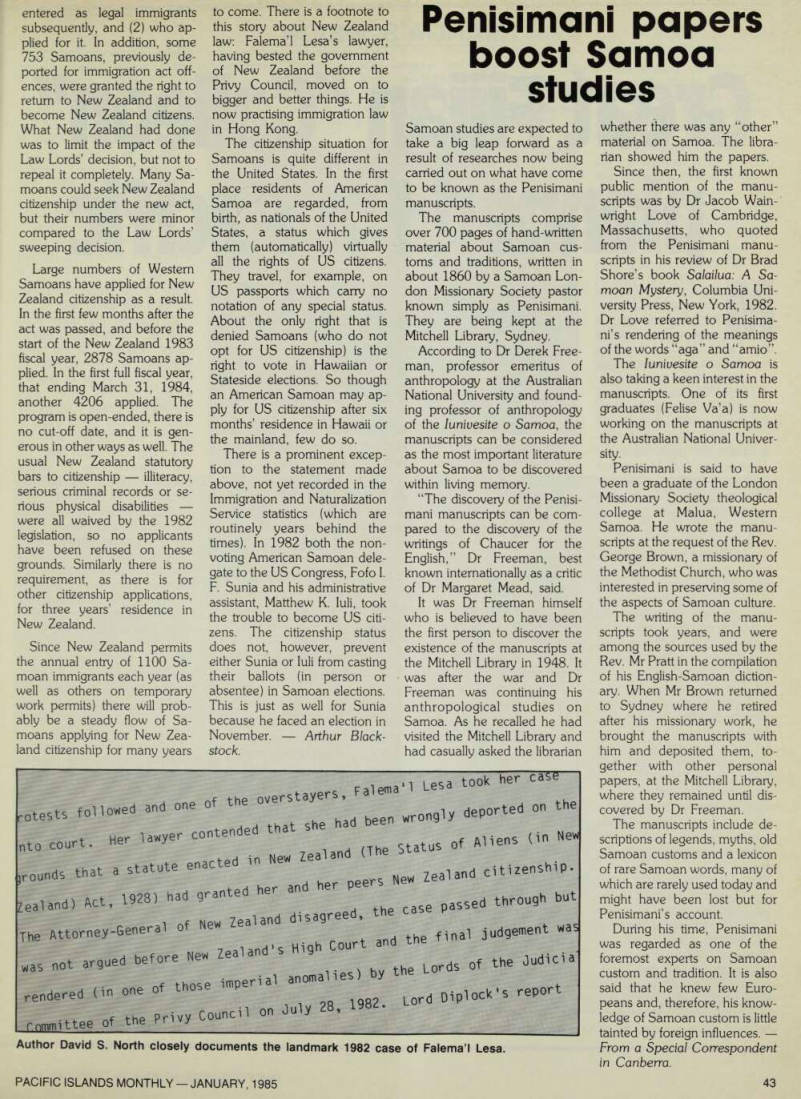
The 1982 decision of Lon don’s Law Lords struck Wel lington’s policy-makers like a thunderbolt. Earlier a Samoan citizen, Falema’l Lesa, had been arrested by New Zealand police for overstaying her visi tor’s visa in New Zealand; de portation was threatened. She hired a resourceful lawyer who claimed that she could not be deported because she was already a New Zealand citizen under a previously ignored pro vision of a New Zealand law, the Status of Aliens (in New Zealand) Act, 1928. New Zea land courts rejected her claim but her lawyer persisted and sent a written appeal to the Judicial Committee of the Privy Council (the Law Lords) in London. Without hearing oral arguments, and relying only on the legal briefs before them, the Law Lords ruled for Falema’l Lesa.
In effect, the Law Lords had decided that most of the popu lation of Western Samoa, as well as many Samoans living in New Zealand (legally or illegal ly), were New Zealand citizens.
The London decision, how ever, related to an interpreta tion of a statute, and statutes can be changed; it was not, as many U.S. Supreme Court de cisions are, an interpretation of the Constitution In 1982 New Zealand faced not only a major change in its immigration policy but a deli cate matter of international rela tions. Following Prime-Minister level negotiations with Western Samoa, New Zealand’s House of Representatives (with the support of both major parties) passed the Citizenship (Western Samoa) Act which granted citi zenship to all Samoans who (1) were in New Zealand on the effective date of the Act (September 14, 1982) or who
entered as legal immigrants subsequently, and (2) who ap plied for it. In addition, some 753 Samoans, previously de ported for immigration act off ences, were granted the right to return to New Zealand and to become New Zealand citizens.
What New Zealand had done was to limit the impact of the Law Lords’ decision, but not to repeal it completely. Many Sa moans could seek New Zealand citizenship under the new act, but their numbers were minor compared to the Law Lords’ sweeping decision.
Large numbers of Western Samoans have applied for New Zealand citizenship as a result.
In the first few months after the act was passed, and before the start of the New Zealand 1983 fiscal year, 2878 Samoans ap plied. In the first full fiscal year, that ending March 31, 1984, another 4206 applied. The program is open-ended, there is no cut-off date, and it is gen erous in other ways as well. The usual New Zealand statutory bars to citizenship illiteracy, serious criminal records or se rious physical disabilities were all waived by the 1982 legislation, so no applicants have been refused on these grounds. Similarly there is no requirement, as there is for other citizenship applications, for three years’ residence in New Zealand.
Since New Zealand permits the annual entry of 1100 Sa moan immigrants each year (as well as others on temporary work permits) there will prob ably be a steady flow of Sa moans applying for New Zea land citizenship for many years
to come. There is a footnote to this story about New Zealand law: Falema’l Lesa’s lawyer, having bested the government of New Zealand before the Privy Council, moved on to bigger and better things. He is now practising immigration law in Hong Kong.
The citizenship situation for Samoans is quite different in the United States. In the first place residents of American Samoa are regarded, from birth, as nationals of the United States, a status which gives them (automatically) virtually all the rights of US citizens.
They travel, for example, on US passports which carry no notation of any special status.
About the only right that is denied Samoans (who do not opt for US citizenship) is the right to vote in Hawaiian or Stateside elections. So though an American Samoan may ap ply for US citizenship after six months’ residence in Hawaii or the mainland, few do so.
There is a prominent excep tion to the statement made above, not yet recorded in the Immigration and Naturalization Service statistics (which are routinely years behind the times). In 1982 both the non voting American Samoan dele gate to the US Congress, Fofo I.
F. Sunia and his administrative assistant, Matthew K. luli, took the trouble to become US citi zens. The citizenship status does not, however, prevent either Sunia or luli from casting their ballots (in person or absentee) in Samoan elections.
This is just as well for Sunia because he faced an election in
November.
Arthur Black-
stock.
Author David S. North closely documents the landmark 1982 case of Falema’l Lesa.