Davies (6 per cent). The figures
p. 40 · Read in the full issue
are for total tonnage of sugar produced in 1920. And all this commercial enterprise was built upon a foundation of imported labor. On August 22, 1889 T.
H. Davies sent the manager of the Laupahoehoe Plantation a receipt of an order for; Tobacco Portuguese labourers Lumber 7ft. iron bar Wool mattress Olive oil Under “King Sugar” human beings became a commodity.
Hawaii’s plantation owners had a problem. In 1778 Hawaii’s population was around 300,000. By 1853 this had dropped to 71,000, largely because of the diseases brought in by Europeans. The history of the next 70 years was a history of the importation of laborers from a growing list of other countries China, Japan, Portugal, Norway, Germany, Korea, Puerto Rico, the Philip pines and even Russia and the inadvertent creation of the multi-ethnic society we know today.
Pau Hana examines the very different experiences of six of these ethnic groups; the Chinese, Portuguese, Norwe gians, Japanese, Koreans and Filipinos. Some groups, like the Chinese and 'Japanese, came intending only to work out a contract. Others, like the Portu guese, really expected to be settlers. The Koreans sought both to bring Christianity to Hawaii, and to escape Japan ese imperialism. Not all groups included a significant number of women. By 1920 some 300,000 had responded to the labor recruiters and migrated to Hawaii. When they reached “the land of glory” described by the recruiters each man or woman was given a bango , a metal tag with a number stamped on it, like a lei.
Kasuke Okawa was 19 when he left Yamaguchi Prefecture in 1886. The 400 yen he hoped to earn in only three years repre sented the entire wages of a silk mill worker in Japan for 10 years.
Kasuke would have been awakened on his first day by the plantation siren and com-
pany policemen shouting “Hana-hana.” Gangs turned out for planting, watering, hoeing, ploughing, cultivating, ditching, stripping off dead leaves, cutting cane, carting cane to the mill or work in the mills.
“Plantation paternalism was designed not only to extract a good day’s work from the laborers but also to weaken the power of workers to organise and strike. John M. Horner, manager of the Kukaiau Planta tion, bluntly told the Labor Commission in 1895 that pa ternalism was an effective tactic to avoid strikes,” reports Taka ki. He goes on to show how it was linked to a caste/class sys tem. Non-whites were em ployed as laborers (94 per cent in 1872, 88 per cent by 1920), and Germans, Norwegians and Portuguese as tunas (foremen) or managers. On each planta tion racial groups were mixed to lessen the chance of worker solidarity. When 7000 Japan ese laborers acted collectively in the “Great Strike” of 1909, the planters broke the strike by using labor from other ethnic groups and by 1915 the per centage of Japanese workers was reduced from 70 per cent (at the strike) to 54 per cent.
The 1920 strike was more successful because Japanese and Filipinos struck together.
While corporal punishment was illegal in Hawaii Takaki has found evidence that it did occur. The manager of Paauhau Plantation told the 1895 Labor Commission: “This class of people have no feelings except through the hide,” and many tuna carried whips. Fines, however, were more common.
Equally effective, during the contract labor period, local police would arrest deserters.
For anyone who seeks to
understand the origins of multi ethnic modern Hawaii, this book must become a first port of-call.
Epilogue
A book like Ronald Takaki’s Pau Hana, for all its careful research and fascinating anec dote, might seem like a book of the past, confining itself, as it does, to the Hawaiian sugar plantations of 1835-1920. But its applicability to today was brought forcibly home to me in 1979. In that year I was briefly at the East-West Center in Honolulu as a visiting New Zealand writer. Deeply in terested in Hawaiian poetry, I was told by one poet a story which so angered me that I took it to a local newspaper.
Apparently, one large pine apple plantation had found it increasingly hard to attract labor and they had turned to a church group on the U.S. main land to provide high school children who might like to com bine a summer holiday with some fund-raising.
In reality the “holiday” turned out to be long hours, hot and dirty work, and poor living conditions. My friend, a nurse, had been treating a boy with bruising and a black eye who had started to tell her how he had been punished for trying to “escape,” when one of the church-camp organisers had come in and the teenager had quickly shut up.
But his eyes had told her everything. She felt she had to tell someone and chose me, knowing I had worked for Radio New Zealand. I’ve often wondered what that paper did with that story. Apparently, the final chapter in the story of Hawaiian plantation life and labor has yet to be written.
D. S. Long.
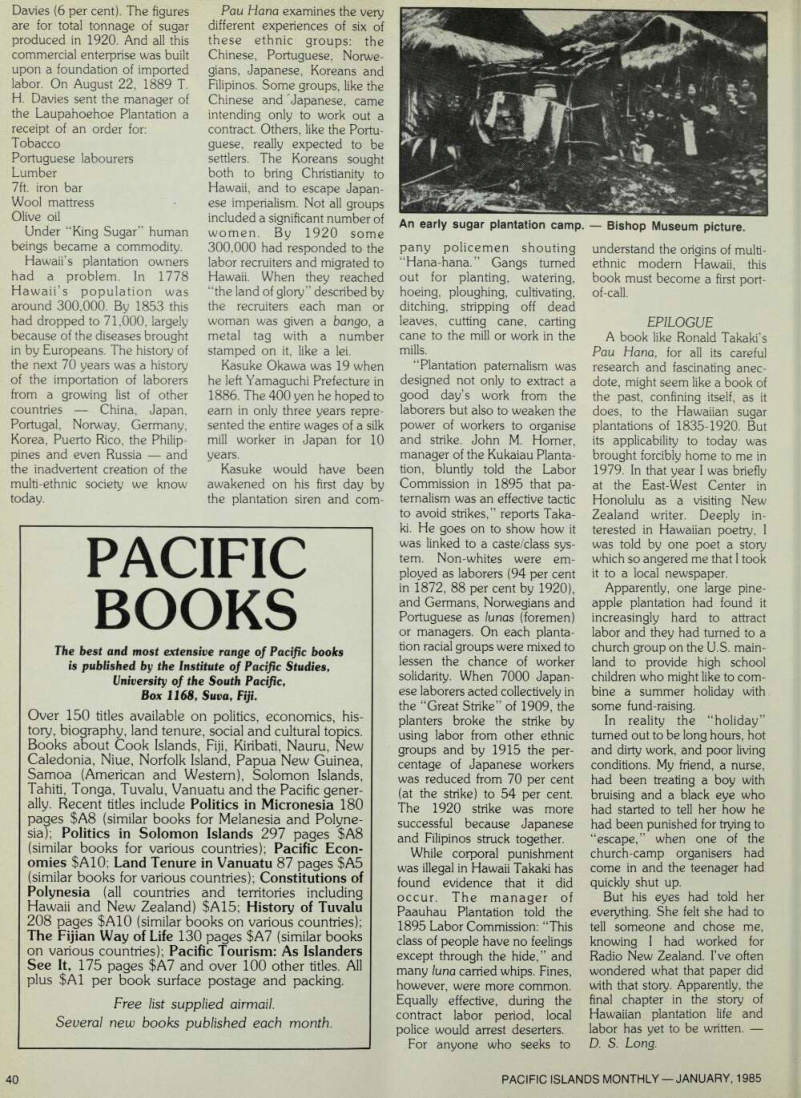
An early sugar plantation camp. Bishop Museum picture.