in the reign of King Sugar
p. 39 · Read in the full issue
books
How multi-ethnic Hawaii was born in the reign of King Sugar
Pau Hana Plantation Life and Labor in Hawaii, 1835- 1920. By Ronald Takaki. Pub lished by the University of Hawaii Press, Honolulu, 1983. 213 pp. ISBN 0 8248 0865 7.
and weathered tombstones standing like erect and voiceless guards. But many of the old plantation laborers still remain; they linger in their pau hana years. For most of their lives, they had worked in the hot canefields and the rumbling sugar mills. Now, in their final
Isogu pau hana Mibi no ha ga karamu Korobya mi o sasu Kibi no iga In the rush at pau hana I get caught in cane leaves, When I stumble and fall, They prickle, they jab.
This work song of Japanese plantation laborers opens Ronald Takaki’s Pau Hana, which roughly translates as “work’s end.” Sometime around 1980 Takaki had stop ped by his uncle Richard Oka wa’s in Moiliili to “talk story” and his uncle put it to him, “Hey, why you no go write a book about us?” Takaki’s grandfather had arrived in Hawaii as a contract laborer in 1886 and his mother had been bom on the Hawi Plantation in Kohala. Pau Hana, the first study of Hawaiian plantation life and labor from a historical and multi-ethnic perspective, was the result.
Takaki, a professor of ethnic studies at the University of California at Berkeley, grew up in the Palolo Valley near Hon olulu and is, perhaps, uniquely placed to have written such a book. Using a wealth of primary sources, he tells us the stories of those thousands of people who left their homes in many lands to go and work in Hawaii’s canefields.
“Most of them are gone.
Buried in forlorn and windswept cemeteries near san dy beaches and rocky shorelines on the edges of the canefields, they seem to be a forgotten people, their lonely
years, they rest and re member. ”
The story begins 50-odd years after Cook’s landing at Waimea. In 1835 William Hooper of Ladd and Co. wrote in his diary, “Koloa, Island of Kauai, S. Islands, obtained from Govr. Kaikioewa the use of 25 kanakas at two dollars each per month . . . laid out a piece of land supposed to con tain 12 acres to be cultivated with cane.” As Takaki docu
ments, “Within one year the young man from Boston had transformed both the land and native society.” Indeed, there is evidence that Hooper himself felt that he had something of a mission to introduce modern industrial agriculture to the is lands. In 1835 Hooper visited
William French’s sugar mill at Waimea. Here he found Chinese laborers processing wild cane and working much longer hours than his own workers. “Slavery is nothing to it,” he wrote to Ladd and Co., and he began enticing them to Koloa.
A pattern of ethnic labor segmentation soon found the Chinese working the mill and the Hawaiians the canefields. In 1839, when Hooper left, the
corporate-dominated sugar economy was already firmly in place. It had the distinction of paying wages. In Jamaica, Cuba, Haiti and Puerto Rico the plantation owners had en slaved the indigenous people and imported further slave laborers from Africa to work in their canefields. “King Sugar” in the Sandwich Islands could have been a lot worse. Its immediate effects were bad enough.
Sugar became “King” be cause of the Great Mahele (divi sion) of 1848 which destroyed the traditional system of land ownership of Hawaii. By 1890 three out of every four privately owned acres were in the hands of haoles or their corporations.
But 1848 was decisive not just because of the mahele of land it also marked the discovery of gold in the nearby market of California. Then, in the early 1860 s, the American Civil War boosted the price of sugar from 4c per pound in 1861 to 25c in 1864. In 1875 the United States and Hawaii signed a Reciprocity Treaty which let Hawaiian sugar into the United States duty free and Hawaii’s annexation in 1898 confirmed this. From Hooper’s 30 tons in 1837-1838 sugar production rose to 556,871 tons in 1920. From Hooper’s “25 kanakas” in 1835 the plantation workforce had jumped to 43,917 by 1910. By 1897 sugar exports were worth $15.4 million out of an export total of $16.2 million.
Throughout this dramatic period of expansion a process of corporate consolidation led to the creation of the “Big Five”: American Factors (29 per cent), C. Brewer (26 per cent), Alexander and Baldwin (23 per cent), Castle and Cooke (10 per cent) and T. H.
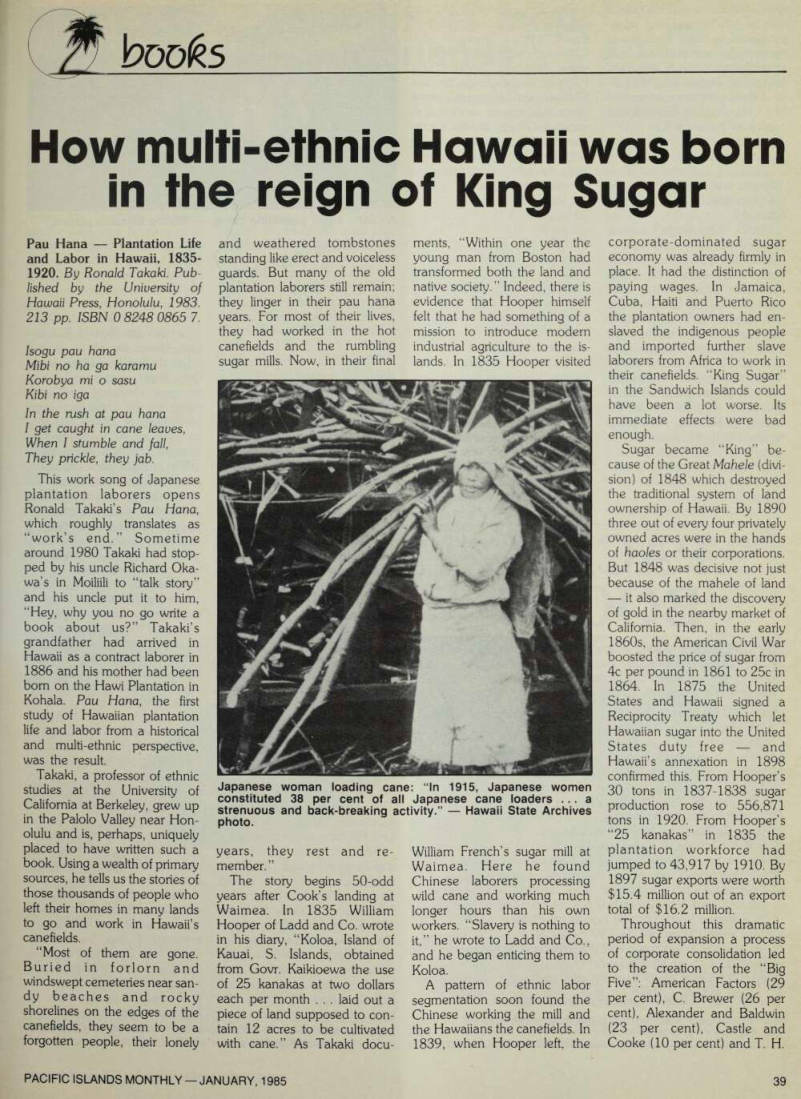
Japanese woman loading cane: “In 1915, Japanese women constituted 38 per cent of all Japanese cane loaders ... a strenuous and back-breaking activity.” Hawaii State Archives photo.