Commercial radio
p. 37 · Read in the full issue
comes to Fiji
Fiji citizens are poised to tune into their second radio station after 31 years of monopoly by the partly-government funded Fiji Broadcasting Commission.
Fiji has just approved a private radio licence for a Suva-based company, Communications, Fiji, Ltd., which was among the six which applied. Fiji’s two local daily newspapers. The Fiji Times and the Fiji Sun, were among the applicants.
Communications Fiji,Ltd., is headed by 22-year-old Mr Wil liam Parkinson who has had a stint with Radio Fiji as an announcer/producer. He left his radio job to do an arts degree at the Australian National Univer sity in Canberra and graduated last year.
His local partner is Mr Matt Wilson, a former journalist who now runs his own public rela tions firm in Suva. Mr Parkin son said he may take in other partners later. He said the initial capital required to start trans mission was about $300,000, which would be raised locally.
Mr Parkinson is the only child of the well-known South Pacific nutritionist, Mrs Susan Parkin son, whose late husband served in the Fiji civil service as the Government Statistician.
The new company plans to begin its services with a daily transmission of 18 hours from 6 am to midnight in three lan guages ... English, Fijian and Hindustani, the three main lan guages of Fiji.
It plans to operate an FM station from Suva and with it cover the eastern part of the main island of Viti Levu, includ ing the capital, Suva, and greater Suva, which extends to Nausori in the east. Programs will be aimed at the under-30 age group, which forms about 70 per cent of Fiji’s population.
Mr Parkinson said he was unable to give more details on the types of programs or further plans of the company until he had negotiated with the Fiji Government several still unre vealed conditions attached to the licence.
The first round of talks with
the government about the radio programs was held late in September when Mr Parkinson described them as ’’very pre liminary” but ’’fruitful.” He said that if all went well his company could start broadcasting within 7 months with, initially, a work force of about 20 people.
Although Mr Parkinson is the first private radio station oper ator to gain a licence in Fiji, the government has not ruled out the possibility of other licences being granted in the future despite the small size of the market. In the last general elec tion, the Alliance Party, which has ruled Fiji since independ ence was gained in 1970, made the granting of radio licences a pledge in its manifesto.
The current network, Radio Fiji, run by the Fiji Broadcasting Commission, was established in 1953. It is financed partly by advertising revenue, and partly by government funds. Last year
advertising brought in Fsl.s million, leaving a further Fsl million to come from the tax payers. FBC broadcasts in the three main languages on two AM networks covering the whole of Fiji’s 320 islands. In the Suva area there is also an FM transmitter which carries the national English-language service and in the Western Division, centred on the big sugar city of Lautoka, a regional service operates for four hours daily with news and programs designed especially for listeners in the sector from Nadi to Ba.
Fiji yet has no television, although video sets are ex tremely common and video libraries flourish in even the smallest towns. Some efforts, notably by Australia’s Channel Nine, have been made to per suade the government to allow broadcast television but, at the moment, their view is that video is sufficient, and even more desirable, and they have embarked on a project to pro duce local video-tape prog rams, using aid funds from Europe.
From our Suva correspon dent.
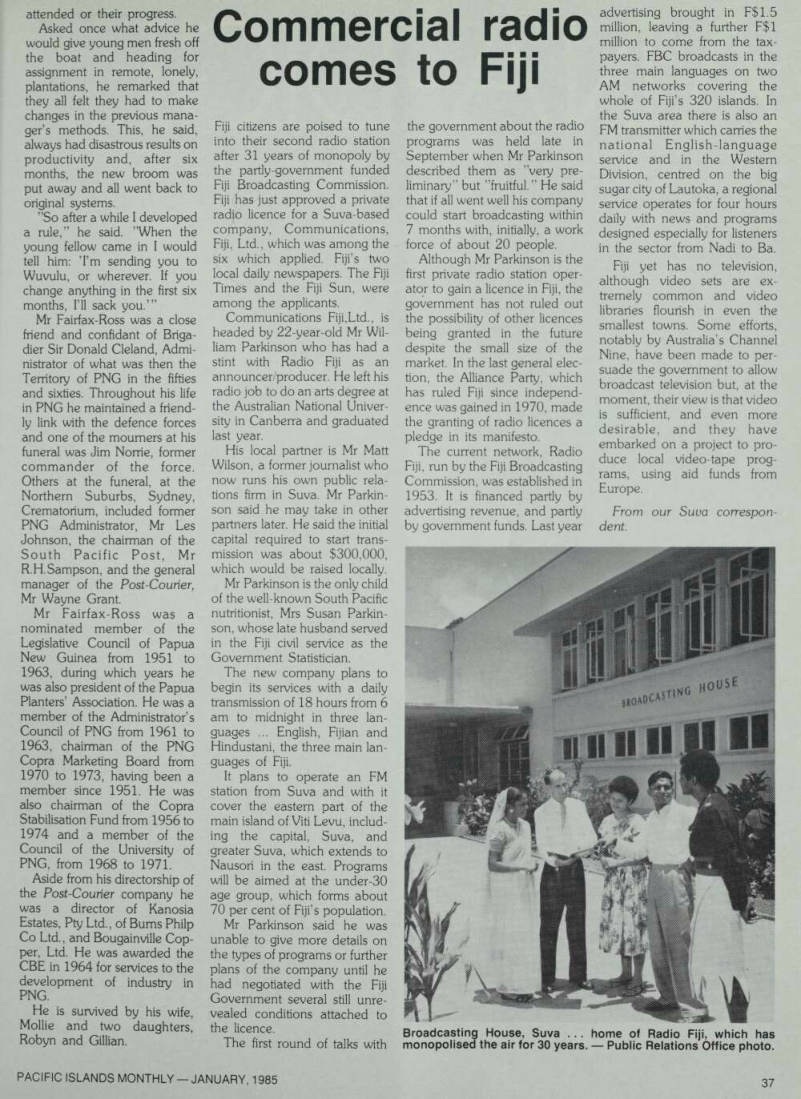
Broadcasting House, Suva ... home of Radio Fiji, which has monopolised the air for 30 years. Public Relations Office photo.