New ways to “zap
pp. 33-36 · Read in the full issue
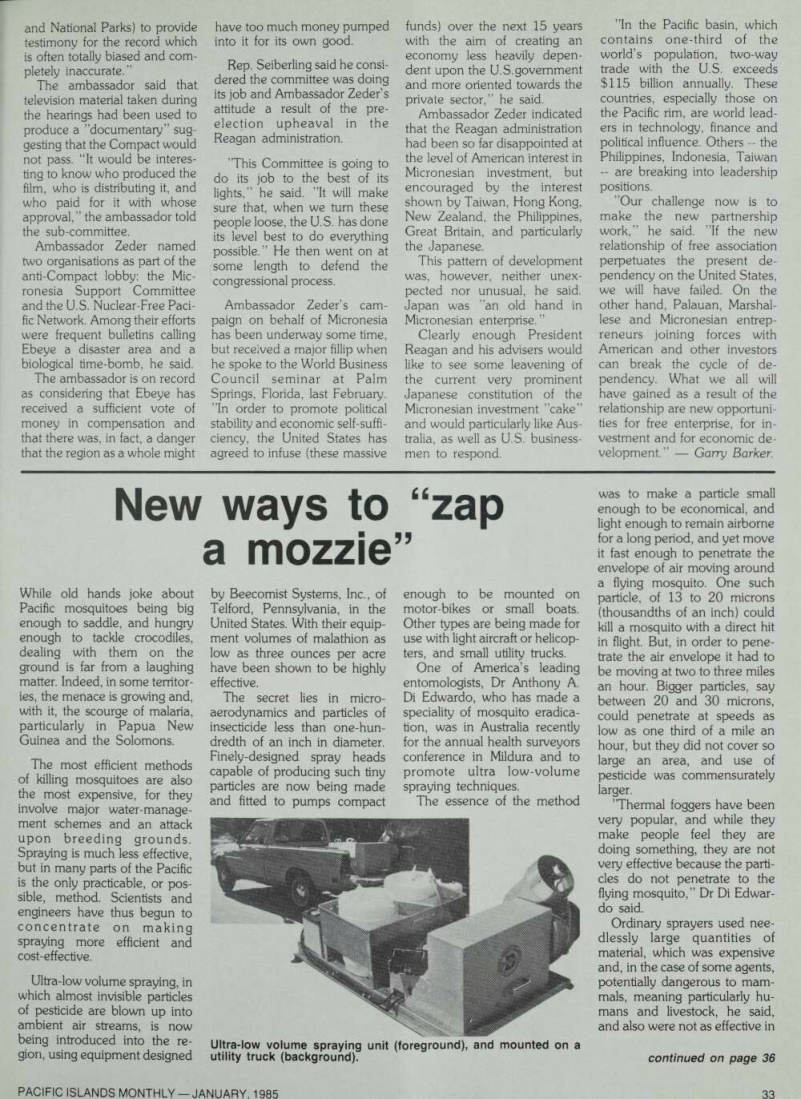


a mozzie”
While old hands joke about Pacific mosquitoes being big enough to saddle, and hungry enough to tackle crocodiles, dealing with them on the ground is far from a laughing matter. Indeed, in some territor ies, the menace is growing and, with it, the scourge of malaria, particularly in Papua New Guinea and the Solomons.
The most efficient methods of killing mosquitoes are also the most expensive, for they involve major water-manage ment schemes and an attack upon breeding grounds.
Spraying is much less effective, but in many parts of the Pacific is the only practicable, or pos sible, method. Scientists and engineers have thus begun to concentrate on making spraying more efficient and cost-effective.
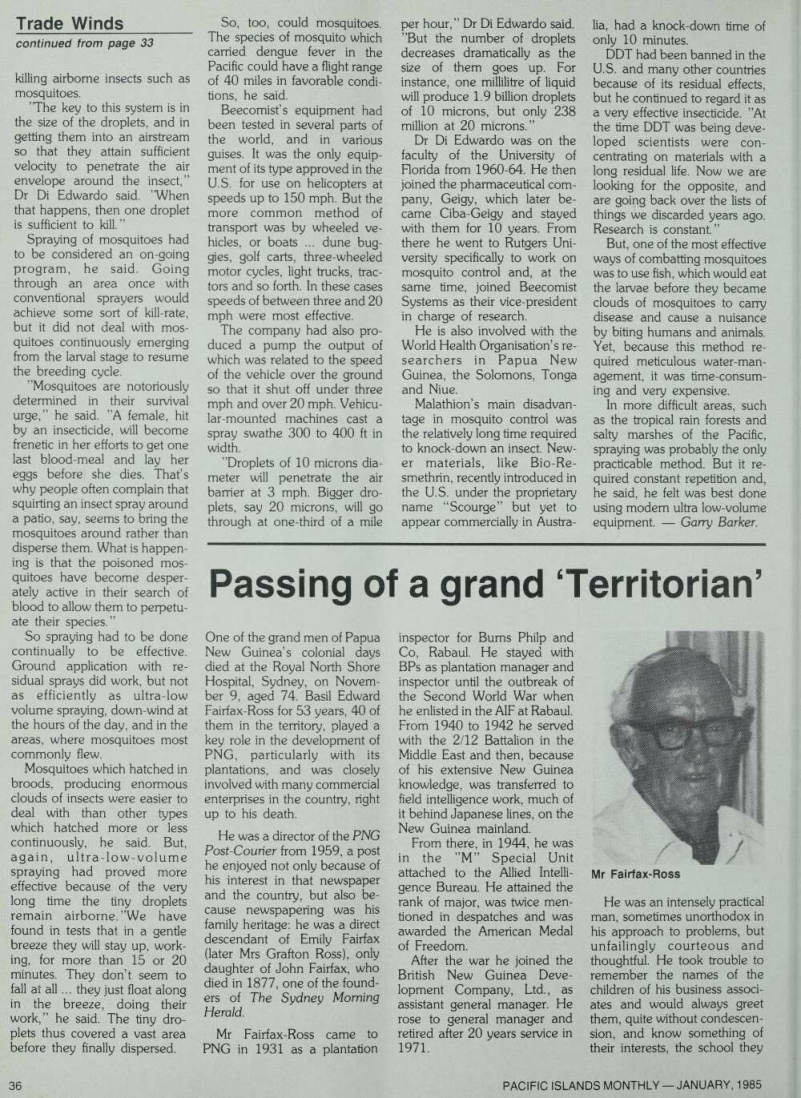
Ultra-low volume spraying, in which almost invisible particles of pesticide are blown up into ambient air streams, is now being introduced into the re gion, using equipment designed
by Beecomist Systems, Inc., of Telford, Pennsylvania, in the United States. With their equip ment volumes of malathion as low as three ounces per acre have been shown to be highly effective.
The secret lies in micro aerodynamics and particles of insecticide less than one-hun dredth of an inch in diameter.
Finely-designed spray heads capable of producing such tiny particles are now being made and fitted to pumps compact
enough to be mounted on motor-bikes or small boats.
Other types are being made for use with light aircraft or helicop ters, and small utility trucks.
One of America’s leading entomologists, Dr Anthony A.
Di Edwardo, who has made a speciality of mosquito eradica tion, was in Australia recently for the annual health surveyors conference in Mildura and to promote ultra low-volume spraying techniques.
The essence of the method
was to make a particle small enough to be economical, and light enough to remain airborne for a long period, and yet move it fast enough to penetrate the envelope of air moving around a flying mosquito. One such particle, of 13 to 20 microns (thousandths of an inch) could kill a mosquito with a direct hit in flight. But, in order to pene trate the air envelope it had to be moving at two to three miles an hour. Bigger particles, say between 20 and 30 microns, could penetrate at speeds as low as one third of a mile an hour, but they did not cover so large an area, and use of pesticide was commensurately larger. ’Thermal foggers have been very popular, and while they make people feel they are doing something, they are not very effective because the parti cles do not penetrate to the flying mosquito,” Dr Di Ed war do said.
Ordinary sprayers used nee dlessly large quantities of material, which was expensive and, in the case of some agents, potentially dangerous to mam mals, meaning particularly hu mans and livestock, he said, and also were not as effective in
continued on page 36
Ultra-low volume spraying unit (foreground), and mounted on a utility truck (background).
killing airborne insects such as mosquitoes. ’’The key to this system is in the size of the droplets, and in getting them into an airstream so that they attain sufficient velocity to penetrate the air envelope around the insect,”
Dr Di Edwardo said. ’’When that happens, then one droplet is sufficient to kill.”
Spraying of mosquitoes had to be considered an on-going program, he said. Going through an area once with conventional sprayers would achieve some sort of kill-rate, but it did not deal with mos quitoes continuously emerging from the larval stage to resume the breeding cycle. ’’Mosquitoes are notoriously determined in their survival urge,” he said. ”A female, hit by an insecticide, will become frenetic in her efforts to get one last blood-meal and lay her eggs before she dies. That’s why people often complain that squirting an insect spray around a patio, say, seems to bring the mosquitoes around rather than disperse them. What is happen ing is that the poisoned mos quitoes have become desper ately active in their search of blood to allow them to perpetu ate their species.”
So spraying had to be done continually to be effective.
Ground application with re sidual sprays did work, but not as efficiently as ultra-low volume spraying, down-wind at the hours of the day, and in the areas, where mosquitoes most commonly flew.
Mosquitoes which hatched in broods, producing enormous clouds of insects were easier to deal with than other types which hatched more or less continuously, he said. But, again, ultra-low-volume spraying had proved more effective because of the very long time the tiny droplets remain airborne. ”We have found in tests that in a gentle breeze they will stay up, work ing, for more than 15 or 20 minutes. They don’t seem to fall at a 11... they just float along in the breeze, doing their work,” he said. The tiny dro plets thus covered a vast area before they finally dispersed.
So, too, could mosquitoes.
The species of mosquito which carried dengue fever in the Pacific could have a flight range of 40 miles in favorable condi tions, he said.
Beecomist’s equipment had been tested in several parts of the world, and in various guises. It was the only equip ment of its type approved in the U.S. for use on helicopters at speeds up to 150 mph. But the more common method of transport was by wheeled ve hicles, or boats ... dune bug gies, golf carts, three-wheeled motor cycles, light trucks, trac tors and so forth. In these cases speeds of between three and 20 mph were most effective.
The company had also pro duced a pump the output of which was related to the speed of the vehicle over the ground so that it shut off under three mph and over 20 mph. Vehicu lar-mounted machines cast a spray swathe 300 to 400 ft in width. ’’Droplets of 10 microns dia meter will penetrate the air barrier at 3 mph. Bigger dro plets, say 20 microns, will go through at one-third of a mile
per hour,” Dr Di Edwardo said. ’’But the number of droplets decreases dramatically as the size of them goes up. For instance, one millilitre of liquid will produce 1.9 billion droplets of 10 microns, but only 238 million at 20 microns.”
Dr Di Edwardo was on the faculty of the University of Florida from 1960-64. He then joined the pharmaceutical com pany, Geigy, which later be came Ciba-Geigy and stayed with them for 10 years. From there he went to Rutgers Uni versity specifically to work on mosquito control and, at the same time, joined Beecomist Systems as their vice-president in charge of research.
He is also involved with the World Health Organisation’s re searchers in Papua New Guinea, the Solomons, Tonga and Niue.
Malathion’s main disadvan tage in mosquito control was the relatively long time required to knock-down an insect. New er materials, like Bio-Re smethrin, recently introduced in the U.S. under the proprietary name “Scourge” but yet to appear commercially in Austra
lia, had a knock-down time of only 10 minutes.
DDT had been banned in the U.S. and many other countries because of its residual effects, but he continued to regard it as a very effective insecticide. ”At the time DDT was being deve loped scientists were con centrating on materials with a long residual life. Now we are looking for the opposite, and are going back over the lists of things we discarded years ago.
Research is constant.”
But, one of the most effective ways of combatting mosquitoes was to use fish, which would eat the larvae before they became clouds of mosquitoes to carry disease and cause a nuisance by biting humans and animals.
Yet, because this method re quired meticulous water-man agement, it was time-consum ing and very expensive.
In more difficult areas, such as the tropical rain forests and salty marshes of the Pacific, spraying was probably the only practicable method. But it re quired constant repetition and, he said, he felt was best done using modem ultra low-volume
equipment.
— Garry Barker.