Zeder: “Keep out the
pp. 31-33 · Read in the full issue
trade winds
Micronesian Sbillions
Zeder: “Keep out the carpetbaggers”
With the thick end of $3 billion (that’s three thousand million dol lars) slated to be given in virtually untied grant to the former Micronesian Trust Terri tories by the United States over the next 15 years it is easy to imagine phalanxes of in ternational con-men shaking the moths, and the bones of previous victims, out of their carpetbags as they phone their travel agents for advice on the quickest route to the region.
At least, that is seen as a large potential problem by Ambassa dor Fred M. Zeder, President Reagan’s personal representa tive on the Micronesian status negotiations.
“I anticipate there will be the usual problems,” he said. “We have seen them develop already. There will be carpet baggers and scallywags con tinuing to rove the area with the intention of divesting the na tives of their new-found wealth.
It’s only normal and natural.
But that doesn’t mean we have to accept it, or ignore it,”
Ambassador Zeder said.
The recent presidential elec tion has delayed passage of the legislation through the U.S.
Senate and Congress but, “the Compact of Free Association should be fully in place by the U.S. spring of 1985. After it has moved through the Congress we will then make our manners with the United Nations.”
“That done we should then begin to see the start of the process which will make be tween $2.5 and $3 billion avail able during a 15-year period in the Federated States of Mic ronesia and in the Marshall Islands, and over a 50-year
The Compact of Free Association, covering the U.S. administered Trust Territories of the Pacific Islands, is unique in international law. Indeed, it has no precise definition accepted around the world, but has been recognised in the United Nations as a proper political status for communities emerging from colonial, or trust status. It continues their association with the United States, but gives them independence and self-government.
For the last two years and a half the task of taking this awkward bag of conflicting ideals and aspira tions not only through the governments of the territories themselves, but also through the U.S.Congress, has been largely in the hands of Ambassador Fred M.Zeder 11, who is President Reagan's personal representative for the Microne sian status negotiations.
Fie is now, he hopes, reaching the end of his assignment. "To get it all through by March 14, 1985, would make a nice birthday present for me," he told me in Sydney last month. "Tve been wrong so many times in predicting the completion but, here I go again - Spring in the United States will perhaps spring forth the Compact of Free Associa tion."
But, characteristically, for he is noted for his foresight and dynamism, as well as his patience and diplomacy, Ambassador Zeder is now doing his considerable best to promote Micronesia's future and has been touring Australia and New Zealand talking to Pacific area investors.
Ambassador Zeder is well-qualified to judge such matters for his own business background is extensive.
His background is engineering and marketing, but he also has many years of sen/ice behind him as an executive of businessmen’s organisations, city councils, and airport management at the board level.
In this interview he talks about the promise and the problems ahead for Micronesia... Gany Barker.
period in Palau,” he said.
The United States is being scrupulously careful to avoid intruding upon Micronesia’s planning for its future, and stays out unless it is asked to help.
“We are not forcing ourselves, our interests, our concepts or ideas, on the Micronesians, ” he said.
“These moneys are coming to Micronesia in grants and, as grants, should, in our judgment, have as few strings as possible attached to them. It is not odd that the Micronesians agree with that concept.
“So, one of the purposes of my visit to Australia and New Zealand is to meet with re sponsible and responsive com panies which are sincere in their interests and are qualified to make a contribution and to participate in a legitimate and useful way, throughout Mic ronesia, with the Microne sians. ”
But, while he was concerned that the enormous sums of money involved were used for the greatest benefit of the largest possible number of Micronesians, he was aware also, he said, of a developing flair among Micronesians for
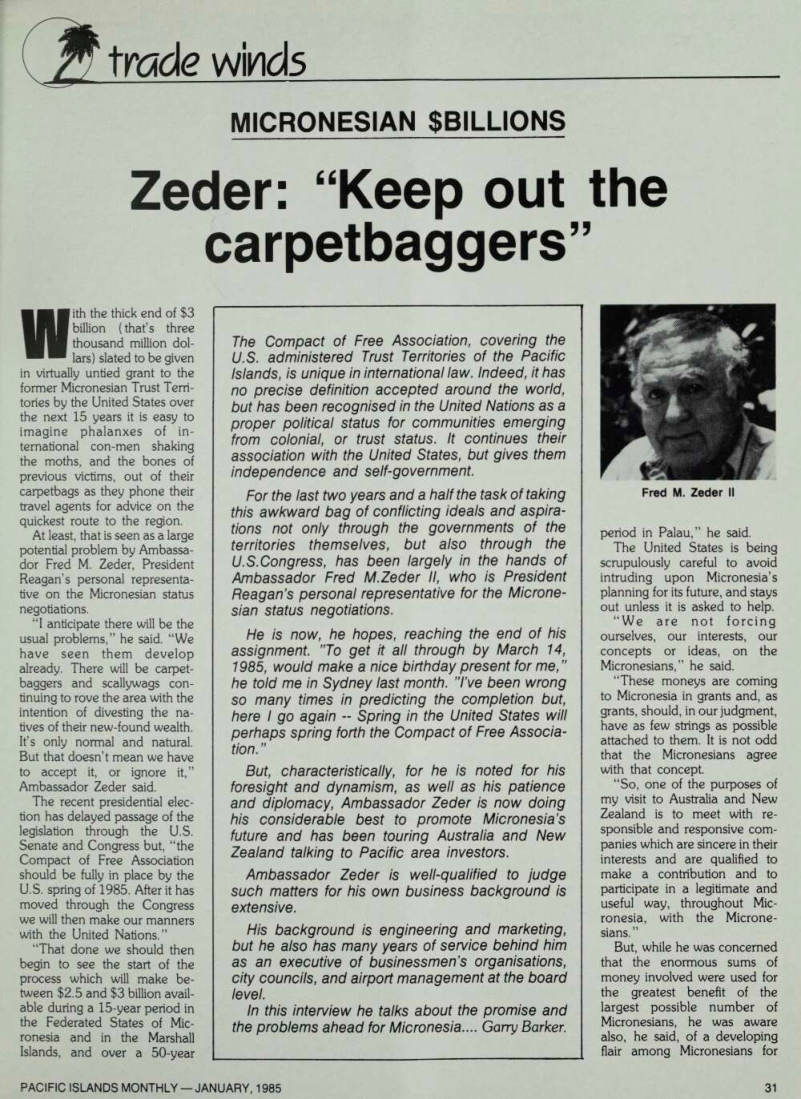
Fred M. Zeder II
business. “They have surprised a number of doubters in the U.S. with their economic deve lopment plans, and they are showing not only an increased awareness, but also skill in entrepreneurial adventures,” he said.
But, what sort of opportuni ties exist among a total popula tion of about 140,000 scattered over 2000 or more islands spread across nearly 10 million square kilometres of ocean?
Ambassador Zeder thinks there are quite a number, particularly when, in overall terms, every Micronesian man, woman and child is going to be worth about $20,000.
“We have seen a great deal of interest by the Japanese and, indeed, by the British, who are investing in power plants, parti cularly in Micronesia,” Ambas sador Zeder said.
“I think we will see now an increasing interest in business opportunities and venture capi tal situations throughout Mic ronesia. My purpose is to call the attention of our friends in Australia to these areas of in terest, and encourage invest ment, or at least inquiries about investment.”
According to the ambassador opportunities will grow as in vestment itself grows but, at present, the promising areas include, fairly obviously, fishing and fish processing, ship repair, minerals and agriculture.
“In the past the Micronesians have generally sold, or leased out, their fishing rights on an annual basis, to the Japanese and the South Koreans, and have not involved themselves
very directly in the industry.
“I believe there is opportun ity to establlish canneries, ship repair facilities and so forth, to have an integrated fishing in dustry throughout Micronesia,” he said. “Given the geographi cal closeness to Australia, I would think this might be a good area to look.
“There is also tremendous interest now in the mineral bearing mounds that abound in relatively shallow waters in the region. U.S. interests, as well as Japanese and German, have been doing some testing and taking sea samples. In most regions these high grade mine ral deposits are found only in nodules at great depth, but in Micronesia they are in quite easy depths and apparently offer promise of profitable operation.”
Micronesia also had minerals oin its lands, the ambassador said. “Prior to World War II Micronesia was one of Japan’s principal sources of bauxite from which aluminium is smelted. There were also some quite rich copper mines, which I understand could reward fur ther exploration.”
But, of all the areas of invest ment interest, agriculture might offer the best prospects, he said. Japan once referred to Micronesia as its “rice bowl.”
“There is very fertile land,” said the ambassador. “Almost anything will grow and already, over the last 10 to 15 years, there has been considerable growth in commercial farming.
Livestock-raising, and poultry farming, are two areas of great promise.
“I think, also, that there is opportunity for industrialising the agricultural effort, both in growing and processing.”
Shipping services to Mic ronesia were something of a worry at present, but “it would be my judgment that the ship ping people, hungry as they are, will provide service as soon as it is needed and viable,” he said.
“Meantime there is good air transportation, with Air Nauru and Air Micronesia, Contin ental’s offshoot, and I think Japan Airlines will continue to expand their routes.
“They are now coming from Tokyo to Saipan and Guam, and they are talking about operating into Palau. But, gen erally, I think you will find transportation following the market, rather than leading it,” the ambassador said.
“Anyone who wants to find out more about investment in Micronesia could talk with any U.S. embassy’s commercial attache. They will supply in formation as it develops, although I have to point out that I am the harbinger of things to come, rather than the bearer of much formal material. This will be developed over the next few months.”
As for the Compact of Free Association ... “I think I under estimated the degree of resist ance I was going to receive from certain elements in the U.S. Congress,” Ambassador Zeder said.
“There is little or no resist ance from the Micronesians themselves for they are anxious to get on with the job. Nor is
there much from the U.S. Sen ate. But the Congress has been a different story.
“I had hoped I might have been able to ram all of this through before they recessed, but that proved impossible. The election brought near chaos to Washington; they didn’t even pass legislation to meet their own payrolls.
“I doubt there will be a lame duck session and so the legisla tion remains hanging in the Senate and the House for them to deal with when they recon vene in January, 1985.
“Then it will be on top of the pile and I will be back there again, doing what I frankly don’t enjoy too much: hammering on the doors of various senators and congress men, urging them to take fast action and get the Compact through.’’
One of Ambassador Zeder’s principal opponents is the Ohio Democratic congressman, John Seiberling. Seiberling is one of the leaders of a push in the House which feels that $3 bil lion might not be enough to launch Micronesia into inde pendence.
A recent issue of the Marshall Islands Journal carried a fairly partial report of an exchange in Washington between Zeder and Seiberling. According to their correspondent, Walden Bello, the ambassador “ranted” before an “astounded audi ence,” but Mr Seiberling re sponded ’’quietly, but firmly.”
What the ambassador said was that in his judgment ’’there has been an excessive amount of unnecessary time and ex pense expended” on getting the Compact through Con gress. ’’Too often, he said, the questions submitted indicate a failure, or refusal, on the part of the authors to take cognisance of facts, information and material already made available over the years. ”We have to spend an un conscionable amount of time addressing phantom issues, clarifying basic factual matters and rebutting false and mislead ing representations. Lawyers and their clients representing special interest groups opposing the Compact have been granted hours of this subcom mittee’s time (the House Sub- Committee on Public Lands
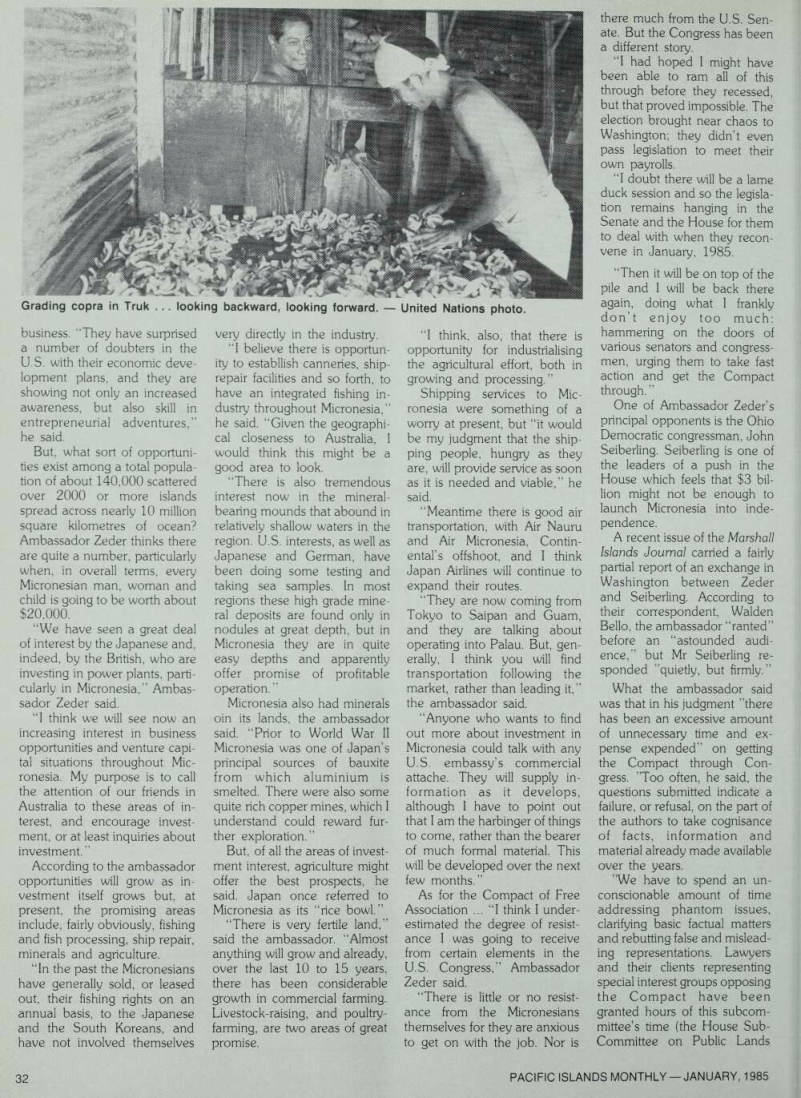
Grading copra in Truk ... looking backward, looking forward. United Nations photo.
and National Parks) to provide testimony for the record which is often totally biased and com pletely inaccurate.”
The ambassador said that, television material taken during the hearings had been used to produce a ’’documentary” sug gesting that the Compact would not pass. “It would be interes ting to know who produced the film, who is distributing it, and who paid for it with whose approval,” the ambassador told the sub-committee.
Ambassador Zeder named two organisations as part of the anti-Compact lobby: the Mic ronesia Support Committee and the U.S. Nuclear-Free Paci fic Network. Among their efforts were frequent bulletins calling Ebeye a disaster area and a biological time-bomb, he said.
The ambassador is on record as considering that Ebeye has received a sufficient vote of money in compensation and that there was, in fact, a danger that the region as a whole might
have too much money pumped into it for its own good.
Rep. Seiberling said he consi dered the committee was doing its job and Ambassador Zeder’s attitude a result of the pre election upheaval in the Reagan administration. ’’This Committee is going to do its job to the best of its lights,” he said. ”It will make sure that, when we turn these people loose, the U.S. has done its level best to do everything possible.” He then went on at some length to defend the congressional process.
Ambassador Zeder’s cam paign on behalf of Micronesia has been underway some time, but received a major fillip when he spoke to the World Business Council seminar at Palm Springs, Florida, last February. ”In order to promote political stability and economic self-suffi ciency, the United States has agreed to infuse (these massive
funds) over the next 15 years with the aim of creating an economy less heavily depen dent upon the U.S.government and more oriented towards the private sector,” he said.
Ambassador Zeder indicated that the Reagan administration had been so far disappointed at the level of American interest in Micronesian investment, but encouraged by the interest shown by Taiwan, Hong Kong, New Zealand, the Philippines, Great Britain, and particularly the Japanese.
This pattern of development was, however, neither unex pected nor unusual, he said.
Japan was ”an old hand in Micronesian enterprise.”
Clearly enough President Reagan and his advisers would like to see some leavening of the current very prominent Japanese constitution of the Micronesian investment ’’cake” and would particularly like Aus tralia, as well as U.S. business men to respond.
”In the Pacific basin, which contains one-third of the world’s population, two-way trade with the U.S. exceeds $ll5 billion annually. These countries, especially those on the Pacific rim, are world lead ers in technology, finance and political influence. Others - the Philippines, Indonesia, Taiwan are breaking into leadership positions. ”Our challenge now is to make the new partnership work,” he said. ”If the new relationship of free association perpetuates the present de pendency on the United States, we will have failed. On the other hand, Palauan, Marshal lese and Micronesian entrep reneurs joining forces with American and other investors can break the cycle of de pendency. What we all will have gained as a result of the relationship are new opportuni ties for free enterprise, for in vestment and for economic de
velopment. ”
Gany Barker.