Kwaio claims
p. 23 · Read in the full issue
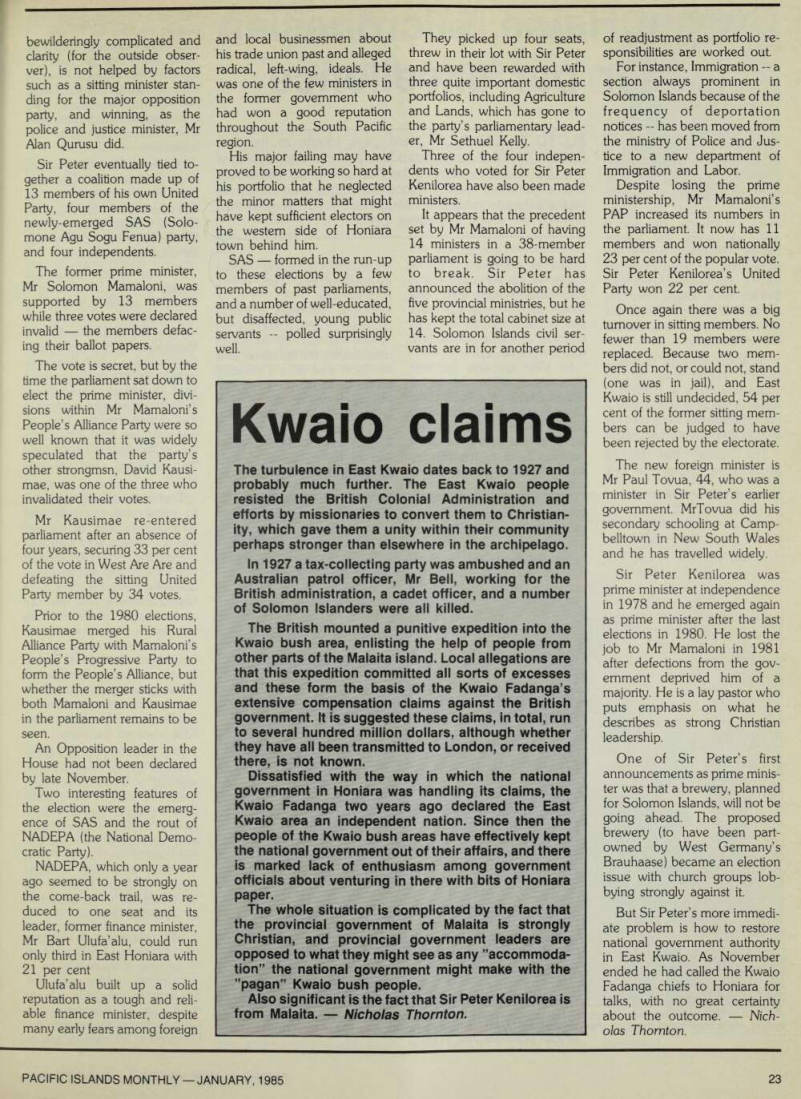
The turbulence in East Kwaio dates back to 1927 and probably much further. The East Kwaio people resisted the British Colonial Administration and efforts by missionaries to convert them to Christian ity, which gave them a unity within their community perhaps stronger than elsewhere in the archipelago.
In 1927 a tax-collecting party was ambushed and an Australian patrol officer, Mr Bell, working for the British administration, a cadet officer, and a number of Solomon Islanders were all killed.
The British mounted a punitive expedition into the Kwaio bush area, enlisting the help of people from other parts of the Malaita island. Local allegations are that this expedition committed all sorts of excesses and these form the basis of the Kwaio Fadanga’s extensive compensation claims against the British government. It is suggested these claims, in total, run to several hundred million dollars, although whether they have all been transmitted to London, or received there, is not known.
Dissatisfied with the way in which the national government in Honiara was handling its claims, the Kwaio Fadanga two years ago declared the East Kwaio area an independent nation. Since then the people of the Kwaio bush areas have effectively kept the national government out of their affairs, and there is marked lack of enthusiasm among government officials about venturing in there with bits of Honiara paper.
The whole situation is complicated by the fact that the provincial government of Malaita is strongly Christian, and provincial government leaders are opposed to what they might see as any ’’accommoda tion” the national government might make with the ’’pagan” Kwaio bush people.
Also significant is the fact that Sir Peter Kenilorea is
from Malaita.
Nicholas Thornton.