Dwight Heine, Micronesian
pp. 24-25 · Read in the full issue
leader par excellence
A Micronesian epoch ended on November 13 with the death of Dwight Heine on Majuro, in the Marshall Islands. He was 65.
There are talented leaders in Micronesia today, and many more will emerge. But few, if any, will enjoy the stature Dwight achieved during his more than 30 years of public service. His death, after a long illness, is a tragedy for his family, for the people of the Marshall Islands, and for all Micronesians.
By every objective standard, Dwight Heine was an in strumental figure in helping to usher in the post-World War II era to Micronesia. He paved the way so that others could follow.
The ’’firsts” that Dwight accumulated during his long
FLOYD D. TAKEUCHI here pays tribute to the late DWIGHT HEINE, an outstanding leader of the peoples of the U.S. Trust Territory of the Pacific Islands. His tribute has a personal quality, since his father worked as Mr Heine’s deputy in Majuro throughout the 19705. (See also Deaths, p 65.)
tenure in government are a history of the American era in Micronesia. Reading them, one senses the flavor of the times and appreciates that self-gov ernment in those islands is a recent occurrence.
In 1948 he was the first Micronesian to be sent to the United States on a Trust Terri tory scholarship. To achieve the honor, Dwight had to compete with the best young minds of the Trust Territory. It is a far cry from today when post
secondary schooling seems commonplace for many Micronesians.
Despite few years of formal education - Dwight was trained before the war by American missionaries on his home atoll of Ebon and at a Protestant school on Kusaie (now Kosrae), in English and for church work - he enrolled at the University of Hawaii. His command of English was excellent, a reflec tion of his missionary school days and Dwight’s bright mind.
He once recounted how he helped improve his English: ”1 read Time magazine from boy hood. We’d also get copies of Life and the Saturday Evening Post. In fact, as I remember it, the Sears, Roebuck and Montgomery Ward catalogues were among my early text books. ”
Dwight studied in Honolulu from 1948 to 1950, and then from 1957 to 1959. Thus he was now the first Micronesian to receive a college degree, but those years away from campus life were hardly wasted.
Perhaps no finer tribute can be paid to Dwight Heine than to note his activities during the interim period between his col lege studies. He returned to the Marshalls to run the education department which then only went to the intermediate school level. Dwight was a young man in an important government job that carried prestige. True, he was paid less than Americans, the double-standard wage scale then applying. But he was secure.
That is when Dwight decided to speak out forcefully and often against what he thought was a desecration of his island home: the American nuclear weapons testing at Bikini and Enewetak atolls. He went to the United Nations and was an eloquent critic. The mid-1950s was not a time to seem un- American, particularly for an ’’island ward” of the U.S., but Dwight went around the United States speaking out against the testing on a trip sponsored by church groups. He made head lines wherever he went.
And when he returned to the Marshall Islands, Dwight Heine was out of a job. Like today, most jobs were in the govern ment. Dwight stayed unem ployed for some time. How ever, his supporters in the Un ited States, and in the Trust Territory, were able to exert enough pressure to force the administration to reinstate him as education director.
After returning to the Univer sity of Hawaii, Dwight went on to become a leading figure in the Council of Micronesia, the first territory-wide political body made up of islanders. The Council eventually became the Congress of Micronesia, and in
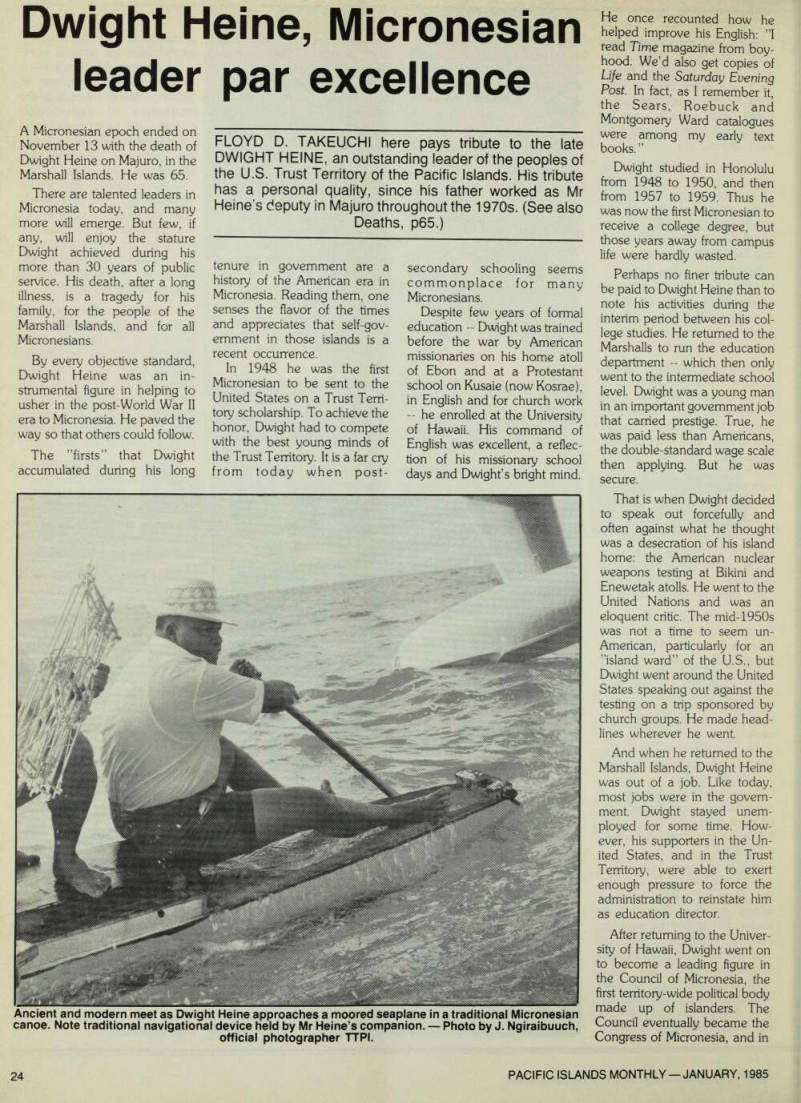
Ancient and modern meet as Dwight Heine approaches a moored seaplane in a traditional Micronesian canoe. Note traditional navigational device held by Mr Heine’s companion. Photo by J. Ngiraibuuch, official photographer TIPI.
1965 when legislators first met on Saipan, Dwight was elected speaker of the General Assem bly.
In that same year, Dwight made history again when he was named the first Microne sian district administrator. His post was in the Marshall Islands.
It is hard today to understand the symbolism of the appoint ment: Micronesians are presi dents and governors of their own islands. But, at a time when almost all islanders were under-studies of Americans, the thought of a Micronesian head ing an entire district was ex traordinary indeed.
In 1968, Dwight was named to a new post: Special Consul tant to the High Commissioner.
It was a promotion of sorts.
There was some disenchant ment with his tenure as district administrator, given his stature in Micronesia and Washington ... Dwight had been kicked upstairs.
It says much for Dwight that, rather than turn bitter, he made much of the new job. He became, in effect, the Trust Territory’s foreign minister, rep resenting the administration at Pacific and Asian conferences, including the South Pacific Conference. He also served as an all-purpose trouble-shooter, a minister without portfolio who used his connections through out the territory to good effect. (I must mention here that during the 12 years Dwight served as Special Consultant, my father was his deputy.
Theirs was a relationship based on mutual respect and admira tion, and a personal friendship that went back to the 1950 s when we lived on Majuro).
Dwight Heine was many things: philosopher, raconteur, educator, political leader and administrator. His educational service was recognised in many ways, including the honorary doctorate he received from Oakland City College in the U.S. He was also fiercely inde pendent. One of the stories he enjoyed recounting was when he represented the Trust Terri tory at Fiji’s independence celebrations. Ratu Mara met him with a broad smile and: “Hello, my fellow rebel.”
It was a most fitting tribute to Dwight Heine from one of the South Pacific’s leading statesmen.