challenge
pp. 22-23 · Read in the full issue
Solomons rumbles
Sir Peter faces Kwaio challenge
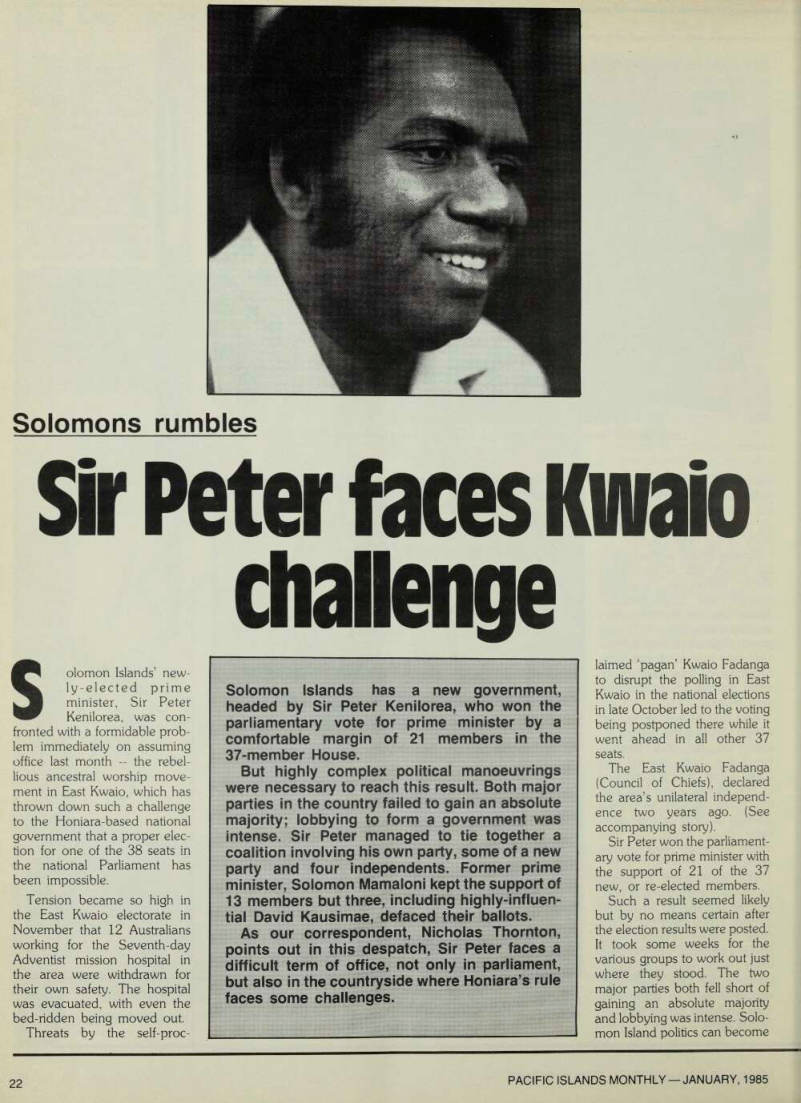
Solomon Islands’ new ly-elected prime minister, Sir Peter Kenilorea, was con fronted with a formidable prob lem immediately on assuming office last month -- the rebel lious ancestral worship move ment in East Kwaio, which has thrown down such a challenge to the Honiara-based national government that a proper elec tion for one of the 38 seats in the national Parliament has been impossible.
Tension became so high in the East Kwaio electorate in November that 12 Australians working for the Seventh-day Adventist mission hospital in the area were withdrawn for their own safety. The hospital was evacuated, with even the bed-ridden being moved out.
Threats by the self-proc-
Solomon Islands has a new government, headed by Sir Peter Kenilorea, who won the parliamentary vote for prime minister by a comfortable margin of 21 members in the 37-member House.
But highly complex political manoeuvrings were necessary to reach this result. Both major parties in the country failed to gain an absolute majority; lobbying to form a government was intense. Sir Peter managed to tie together a coalition involving his own party, some of a new party and four independents. Former prime minister, Solomon Mamaloni kept the support of 13 members but three, including hlghly-influen tial David Kausimae, defaced their ballots.
As our correspondent, Nicholas Thornton, points out in this despatch, Sir Peter faces a difficult term of office, not only in parliament, but also in the countryside where Honiara’s rule faces some challenges.
laimed ‘pagan’ Kwaio Fadanga to disrupt the polling in East Kwaio in the national elections in late October led to the voting being postponed there while it went ahead in all other 37 seats.
The East Kwaio Fadanga (Council of Chiefs), declared the area’s unilateral independ ence two years ago. (See accompanying story).
Sir Peter won the parliament ary vote for prime minister with the support of 21 of the 37 new, or re-elected members.
Such a result seemed likely but by no means certain after the election results were posted.
It took some weeks for the various groups to work out just where they stood. The two major parties both fell short of gaining an absolute majority and lobbying was intense. Solo mon Island politics can become
bewilderingly complicated and clarity (for the outside obser ver), is not helped by factors such as a sitting minister stan ding for the major opposition party, and winning, as the police and justice minister, Mr Alan Qurusu did.
Sir Peter eventually tied to gether a coalition made up of 13 members of his own United Party, four members of the newly-emerged SAS (Solo mone Agu Sogu Fenua) party, and four independents.
The former prime minister, Mr Solomon Mamaloni, was supported by 13 members while three votes were declared invalid the members defac ing their ballot papers.
The vote is secret, but by the time the parliament sat down to elect the prime minister, divi sions within Mr Mamaloni’s People’s Alliance Party were so well known that it was widely speculated that the party’s other strongmsn, David Kausi mae, was one of the three who invalidated their votes.
Mr Kausimae re-entered parliament after an absence of four years, securing 33 per cent of the vote in West Are Are and defeating the sitting United Party member by 34 votes.
Prior to the 1980 elections, Kausimae merged his Rural Alliance Party with Mamaloni’s People’s Progressive Party to form the People’s Alliance, but whether the merger sticks with both Mamaloni and Kausimae in the parliament remains to be seen.
An Opposition leader in the House had not been declared by late November.
Two interesting features of the election were the emerg ence of SAS and the rout of NADEPA (the National Demo cratic Party).
NADEPA, which only a year ago seemed to be strongly on the come-back trail, was re duced to one seat and its leader, former finance minister, Mr Bart Ulufa’alu, could run only third in East Honiara with 21 per cent Ulufa’alu built up a solid reputation as a tough and reli able finance minister, despite many early fears among foreign
and local businessmen about his trade union past and alleged radical, left-wing, ideals. He was one of the few ministers in the former government who had won a good reputation throughout the South Pacific region.
His major failing may have proved to be working so hard at his portfolio that he neglected the minor matters that might have kept sufficient electors on the western side of Honiara town behind him.
SAS formed in the run-up to these elections by a few members of past parliaments, and a number of well-educated, but disaffected, young public servants - polled surprisingly well.
They picked up four seats, threw in their lot with Sir Peter and have been rewarded with three quite important domestic portfolios, including Agriculture and Lands, which has gone to the party’s parliamentary lead er, Mr Sethuel Kelly.
Three of the four indepen dents who voted for Sir Peter Kenilorea have also been made ministers.
It appears that the precedent set by Mr Mamaloni of having 14 ministers in a 38-member parliament is going to be hard to break. Sir Peter has announced the abolition of the five provincial ministries, but he has kept the total cabinet size at 14. Solomon Islands civil ser vants are in for another period
of readjustment as portfolio re sponsibilities are worked out.
For instance, Immigration a section always prominent in Solomon Islands because of the frequency of deportation notices - has been moved from the ministry of Police and Jus tice to a new department of Immigration and Labor.
Despite losing the prime ministership, Mr Mamaloni’s PAP increased its numbers in the parliament. It now has 11 members and won nationally 23 per cent of the popular vote.
Sir Peter Kenilorea’s United Party won 22 per cent.
Once again there was a big turnover in sitting members. No fewer than 19 members were replaced. Because two mem bers did not, or could not, stand (one was in jail), and East Kwaio is still undecided, 54 per cent of the former sitting mem bers can be judged to have been rejected by the electorate.
The new foreign minister is Mr Paul Tovua, 44, who was a minister in Sir Peter’s earlier government. MrTovua did his secondary schooling at Camp belltown in New South Wales and he has travelled widely.
Sir Peter Kenilorea was prime minister at independence in 1978 and he emerged again as prime minister after the last elections in 1980. He lost the job to Mr Mamaloni in 1981 after defections from the gov ernment deprived him of a majority. He is a lay pastor who puts emphasis on what he describes as strong Christian leadership.
One of Sir Peter’s first announcements as prime minis ter was that a brewery, planned for Solomon Islands, will not be going ahead. The proposed brewery (to have been part owned by West Germany’s Brauhaase) became an election issue with church groups lob bying strongly against it.
But Sir Peter’s more immedi ate problem is how to restore national government authority in East Kwaio. As November ended he had called the Kwaio Fadanga chiefs to Honiara for talks, with no great certainty
about the outcome.
Nich
olas Thornton.