nine-year-old girl took the situa-
pp. 20-21 · Read in the full issue
nine-year-old girl took the situation beyond the previous record of solitary women being attacked on lonely roads leading out of town. It also drove home the point that today’s law-breakers in PNG are hunting in packs, almost always with weapons, and with a great deal more knowledge of police patterns than the last generation had.
The government’s shopping list of anti-crime measures in-
eludes a recommendation to crack down on films and books emphasising crime and vio lence. Most agree it is a good idea, produced much too late.
PNG’s modern youth are already well-acquainted with, and attracted by, such en tertainment and it is dolefully predicted that the imminent introduction of local broadcast television will only accelerate the spread of such attitudes.
Government health minister,
Mr Martin ToVadek, stepping down from his post to devote more time to his Gazelle Penin sula electorate, blasted the gov ernment for the introduction of television, saying his Cabinet and party colleague, tele communications minister, Mr Roy Evara, had not told the truth about television. Mr ToVadek said television would lead to more crime and the destruction of local culture.
Prime Minister Somare said
television was already in PNG via the overhead satellites and said the country could not ignore world-wide trends; it had to learn to cope with them, he seemed to suggest.
In fact the Somare govern ment is faced with a quandary of many facets.
Crime is entrenched in PNG and is digging deeper into the society. The forces at the gov ernment’s disposal to combat this are, largely, demoralised.
Police, the legal services and the prisons service are staffed by people who are under-paid, often poorly housed, and lack ing in firm leadership. The spen ding of extra money will not correct the depression of the officers.
Two reports furnished to the government documented the many problems. One of these, produced by a group headed by Australian criminologist, Wil liam Clifford, was well-received and acknowledged to have summarised the situation im maculately. The other, written soley by retired Defence Force colonel, lan Glanville, appears to have been swept under the carpet after its contents were leaked to the Post-Courier.
Mr Glanville went through the Corrective Institutions Service in fine detail, showing why morale in the CIS was rock-bottom and why criminals escaped almost at will, with warders in effect turning their backs on the runaways.
The only sign of recognition for the prisons system is the Cabinet’s recommendation that a study be done of the need for a remote, sea-surrounded pris on - a ’’Devil’s Island” for the really hard cases.
Prison warders in their grass thatched houses, lowly-paid, poorly led, vastly outnumbered by prisoners, see little of direct benefit to them. So far, all attention seems to have gone to the prisoners for whom Cabinet offered alternatives like parole, probation, prison farms and separate juvenile jails.
Residents of the towns get some prospects of relief, with news of more suburban police
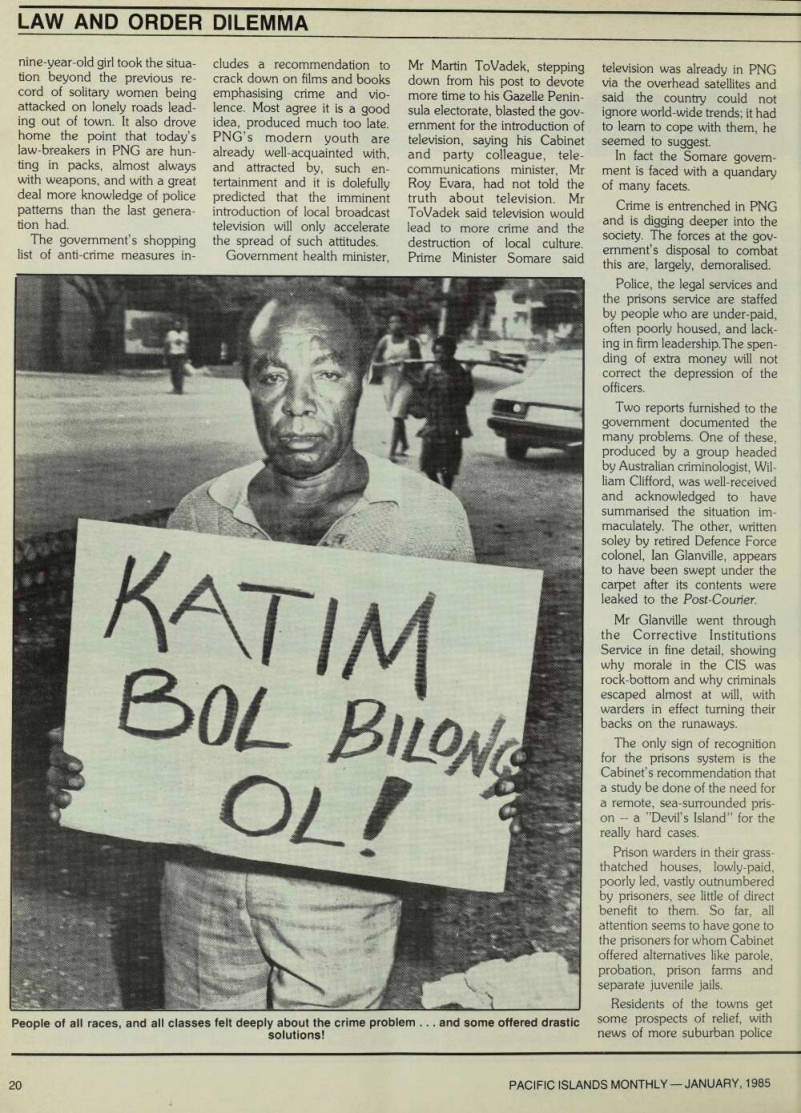
People of all races, and all classes felt deeply about the crime problem ... and some offered drastic solutions!
stations, the moving of married police out of barracks and into the community,and the setting up of boom-gates on the out skirts of the main centres.
Among foreign workers cock tail circuit talk is no longer about barbecues, boarding schools, and fringe benefits.
These days it is the high cost of security doors, and what keeps guard dogs alert. Papua New Guineans look for better locks and brighter lights, and try to avoid looking conspicuous in their life-style.
And, despite everything, and notwithstanding the current re lative lull, the only possible conclusion both groups can make is that crime is increasing in Port Moresby and Lae, and that there are signs of trouble growing in other centres, espe cially those served by new roads to other parts of the country.
The government is deeply concerned, and is doing its best.
But the portents so far remain gloomy. They have yet to get their program together and PNG residents, black and white, poor and prosperous, continue to look over their shoulders as they make sure they get home before dark.
Noel Pascoe.
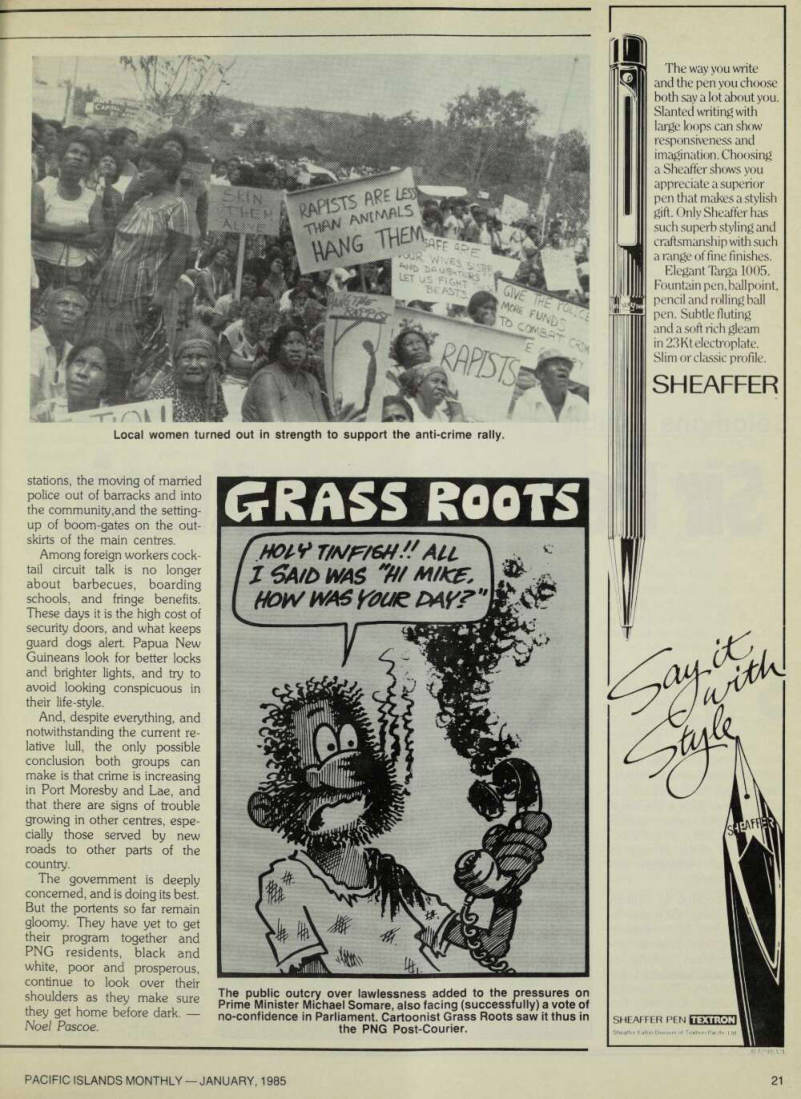
Local women turned out in strength to support the anti-crime rally
The public outcry over lawlessness added to the pressures on Prime Minister Michael Somare, also facing (successfully) a vote of no-confidence in Parliament. Cartoonist Grass Roots saw it thus in the PNG Post-Courier.