Crime waves bog PNC Progress
pp. 18-19 · Read in the full issue
Law And Order Dilemma
Papua New Guinea is impaled firmly on the horns of a dreadful dilemma: the desire to ’’develop” and the task of cop ing with the crime spin-off of that program.
Both elements are on a para llel course, and accelerating.
The government of Michael Somare has taken urgent action to quell the law-and-order problems, but nobody is predic ting that the rash of crimes of violence will disappear over night.
Crime was a nagging worry to residents of the capital, Port Moresby, but took over the public consciousness with a vengeance in September when
A violent pack rape of a group of women, including a nine-year-old schoolgirl, brought to an outraged head the growing public disquiet in Papua New Guinea over the spread of lawless ness within the community.
For years now residents of the bigger towns, and‘particularly Port Moresby, have fenced themselves into their houses against marauding groups of bush lads attracted by the bright lights of modern living. Advertisements seeking expatriate, and local, executives have come to include guard dogs, ”Stalag lights” and high barbed-wire fences as inducements ranked alongside school fees and generous leave.
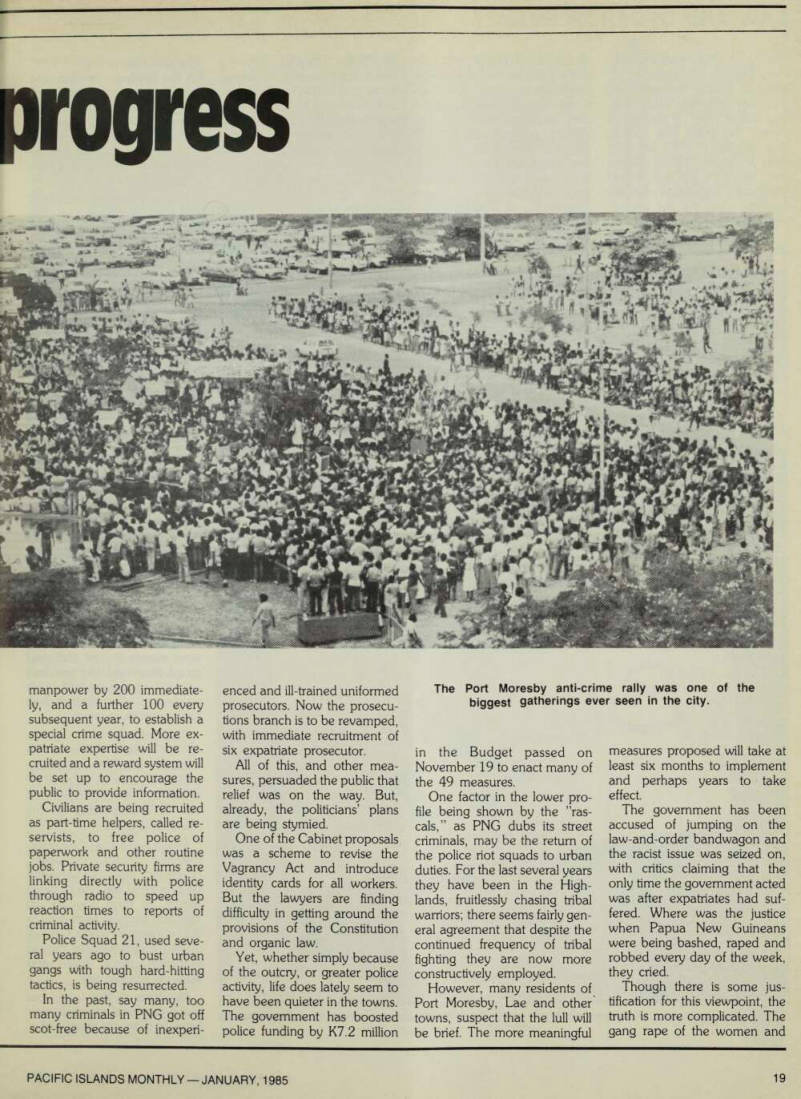
The rape produced one of the largest public demonstrations thus far seen in Port Moresby, with citizens of all races parading with signs demanding castration for rapists and reintroduction of the death penalty.
The government responded swiftly but, as this report from Noel Pascoe, supplemented with material by PIM staff writers, shows, Prime Minister Somare, his Cabinet and his law enforcement officers have a huge, continuing task ahead of them.
a pack of youths slipped past security guards, over a wire fence, past neighbors, and into a house where they terrorised two women and a girl.
The victims were raped re peatedly, including the girl who was of only primary school age.
A Pack rapes of that descrip- Hon are not unknown in W the big cities of Western T countries, where the jungles B are made of concrete and the W animals stalk prey of their own species. But they are very much a jolt in PNG. The nation rose up in anger and indignation. The Pnme Minister himself joined the outcry,
speaking of the alarm felt about leaving a wife and children alone in such surroundings.
Waves of protest rolled through Fort Moresby society, crossing racial and economic strata. A crowd estimated at up to 25,000 people marched to the seat of PNG’s government, at Waigani, and angrily called on Mr Somare and the govern ment to do something about the society that had created such criminals.
Mr Somare told the crowd he favored hanging for pack rap ists. Clearly moved by the public outrage, the level of which had not previously been seen in Port Moresby, the prime minister called into action a committee of top public ser vants and leaders of business and community groups to give him an emergency plan.
After working day and night they produced a list of 23 measures to put before Cabi net. The Cabinet met, approved some, ignored others, and added their own to come up with a law-and-order campaign of 49 steps.
Hanging, much-favored by some sections of the commun ity, was not among them, although it was listed as a possibility if the 49 steps did not produce the desired effect.
But convicted rapists, and other violent criminals, will be flogged, in public, as happens in Tonga. Defence Force sol diers will be called out to help police if they are needed, and the importation of guns will be banned.
To catch the criminals Cabi net decided on boosting police
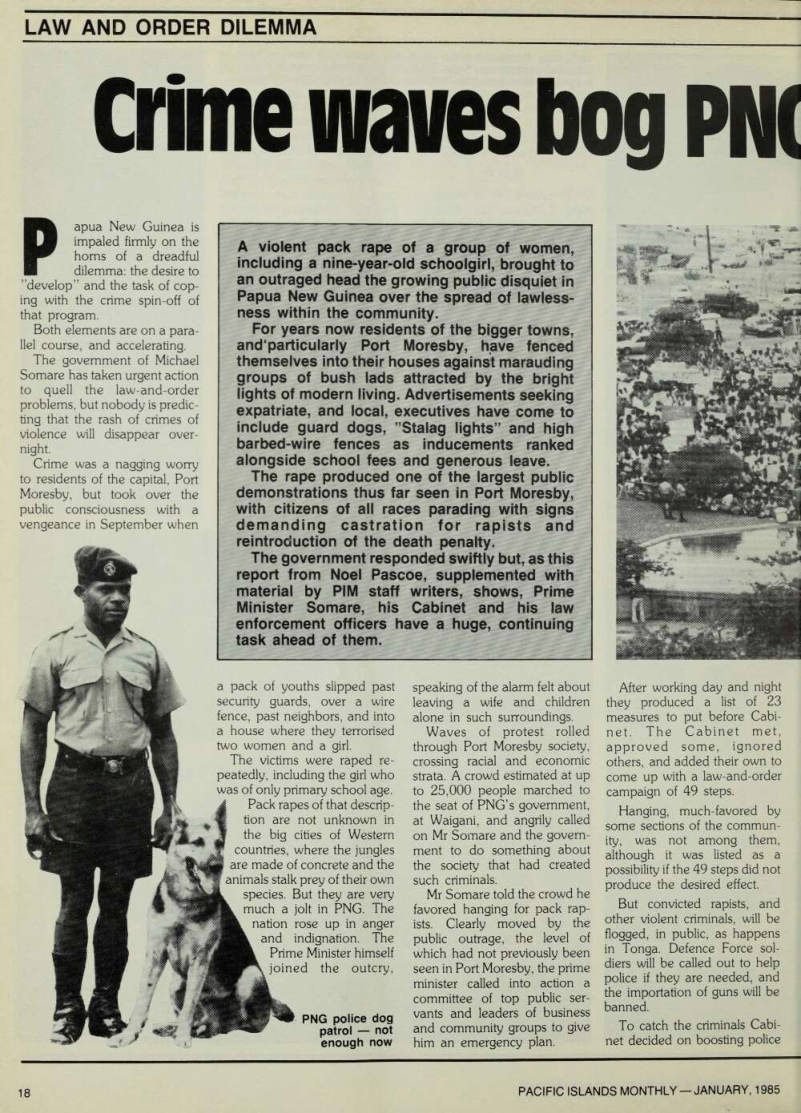
PNG police dog patrol not enough now
manpower by 200 immediate ly, and a further 100 every subsequent year, to establish a special crime squad. More ex patriate expertise will be re cruited and a reward system will be set up to encourage the public to provide information.
Civilians are being recruited as part-time helpers, called re servists, to free police of paperwork and other routine jobs. Private security firms are linking directly with police through radio to speed up reaction times to reports of criminal activity.
Police Squad 21, used seve ral years ago to bust urban gangs with tough hard-hitting tactics, is being resurrected.
In the past, say many, too many criminals in PNG got off scot-free because of inexpert
enced and ill-trained uniformed prosecutors. Now the prosecu tions branch is to be revamped, with immediate recruitment of six expatriate prosecutor.
All of this, and other mea sures, persuaded the public that relief was on the way. But, already, the politicians’ plans are being stymied.
One of the Cabinet proposals was a scheme to revise the Vagrancy Act and introduce identity cards for all workers.
But the lawyers are finding difficulty in getting around the provisions of the Constitution and organic law.
Yet, whether simply because of the outcry, or greater police activity, life does lately seem to have been quieter in the towns.
The government has boosted police funding by K 7.2 million
in the Budget passed on November 19 to enact many of the 49 measures.
One factor in the lower pro file being shown by the ’’ras cals,” as PNG dubs its street criminals, may be the return of the police riot squads to urban duties. For the last several years they have been in the High lands, fruitlessly chasing tribal warriors; there seems fairly gen eral agreement that despite the continued frequency of tribal fighting they are now more constructively employed.
However, many residents of Port Moresby, Lae and other towns, suspect that the lull will be brief. The more meaningful
measures proposed will take at least six months to implement and perhaps years to take effect.
The government has been accused of jumping on the law-and-order bandwagon and the racist issue was seized on, with critics claiming that the only time the government acted was after expatriates had suf fered. Where was the justice when Papua New Guineans were being bashed, raped and robbed every day of the week, they cried.
Though there is some jus tification for this viewpoint, the truth is more complicated. The gang rape of the women and
The Port Moresby anti-crime rally was one of the biggest gatherings ever seen in the city.