Rapanui
pp. 54-55 · Read in the full issue
Modern times hit Rapanui
Grant McCall attended the First International Congress on Easter Island and Eastern Polynesia held on Easter Island in September and reported on by Bengt Daniels son in PIM November. Here Dr McCall records his personal impressions of the contemporary scene on the island, where he and his family spent almost two years in the early 19705.
Ten years is a long time to be away from any place and my return to Rapanui, as the Easter Islanders call themselves, their language and their island, in September, 1984, provided me with a number of surprises.
When I left Rapanui on the last day of January 1974, peo ple were scared. There had been a violent coup in Chile in September of the previous year, and government em ployees had been brusquely shipped off the island, to be replaced by junta sympathisers.
The week before my departure, two young Rapanui men, whose only crime was to read some poetry in their own lan guage, had been hustled into a plane to the mainland, to be interviewed, who knew, by the infamous security police?
Chile, then, was an unhappy country and Rapanui was a tiny, scared little corner of it.
One arrives on the island from Tahiti early on a Saturday
morning after a late night de parture. My arrival was compli cated by my bringing with me a Model 1020 photocopier, don ated by Rank-Xerox (Australia) to the local museum. That minor inconvenience (for me) aside, I was taken around by car on the roads that I had not seen for over a decade. What I felt was not exactly “jet lag,” but something akin to it, perhaps due to the flood of half-familiar faces and old memories.
Some people had aged, others appeared not to have.
Children were now adults. The new airport terminal was taking on the appearance of any such structure anywhere in the Paci fic. My initial disorientation was complicated by feelings about what I would find. Though I receive letters from friends on the island all the time, I still did not know what to expect.
Instead of a few vehicles, there was a row of buses, and
the buzz of motor bikes; the bumpy roads were the same, but there were more of them.
Solid cement houses have slowly given way to a more graceful, but still amateurish, architecture. Public buildings, previously dilapidated and ter mite-ridden, have been re placed by modern structures.
The Rapanui were still the favored minority in Chile. Since 1966, when Rapanui gained full civil status within the Chi lean state, it has received more government support per head of population than any other part of Chile, particularly so in the last few years.
Modem times have hit the island in a big way over the last few years, with more than 200 motor cars and buses, and an amazing 255 motor bikes, each with a special Rapanui licence plate, though traffic jams are rare still. One hundred tele phones connect both private individuals and offices. One phones for an appointment.
The local radio station, still volunteer, is now on FM and in the evening about 100 house holds have television, many in color. Video recorders are be ginning to make an appear ance, along with a few home computers.
At five separate points around the town, there are
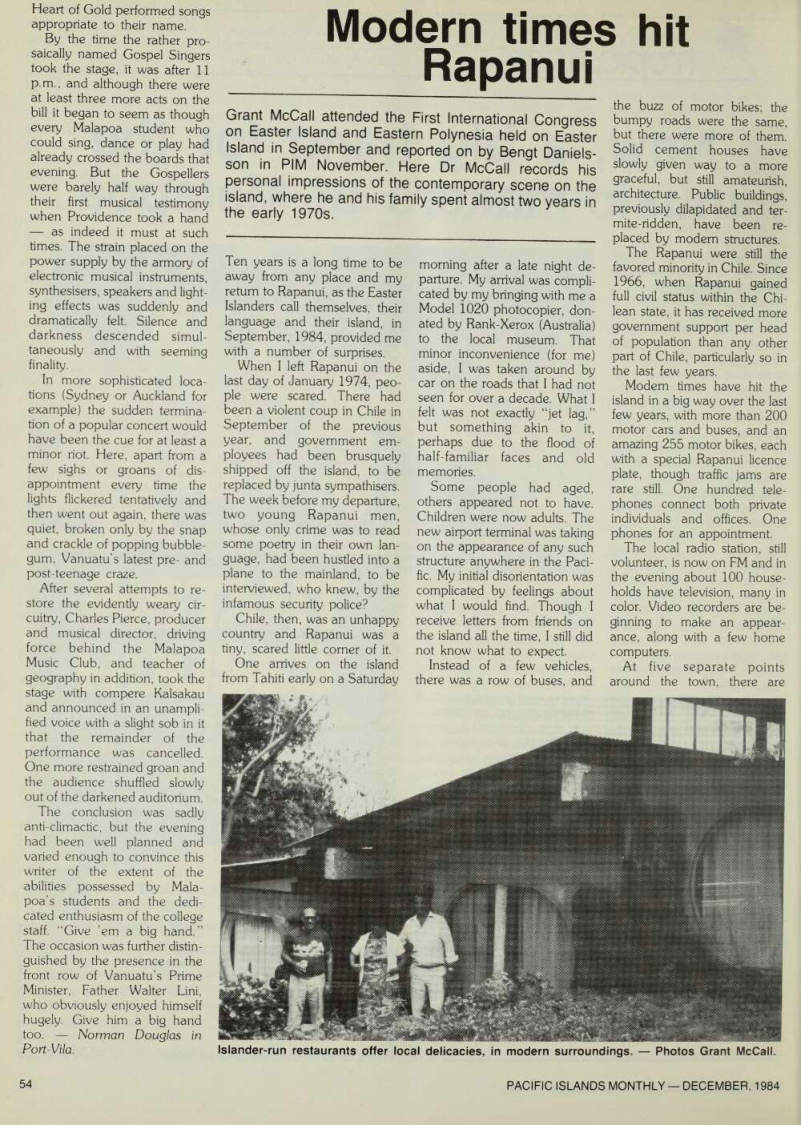
Islander-run restaurants offer local delicacies, in modern surroundings.-Photos Grant McCall.
tennis courts, and the finishing touches are just being put on a new multi-purpose gymnasium, all built with Chilean govern ment money.
Perhaps the most dramatic change is that the governor, like all in Chile appointed from the capital, is Sergio Rapu, the first islander to hold the position.
I had the opportunity to talk to a number of islanders about contemporary development, so evident in the number of shops, private restaurants, and small guest houses.
As in other parts of Chile, there is unemployment. Public service opportunities are few.
But, on the plus side, more Rapanui are turning to their land, producing food both for local consumption and possible export.
Rapanui entrepreneurs, and there are about 30 of them so identified, are not your stereotyped sleepy Polynesian.
They are vigorous and active, and seem to have government support. Even those who have not been successful made it clear that they do not want to be victims of progress, but to manage, even control, deve lopment on their island. This same hard business edge, inci dentally, was the subject of much foreign visitor comment ary in the last century, as my own presentation at the cpn gress documented.
So far, local Rapanui deve lopers have been successful in keeping modernisation in their own hands. The slightly ailing tourism industry is entirely Rapanui-controlled, as is busi ness. When tourists see non-
Rapanui running shops, they don’t realise that the owner of the business is an islander, the mainland Chilean merely an employee.
At least one local opinion wants to urge Rapanui to scorn paid employment, in favor of family based enterprise and a couple of concrete schemes are on offer, the most promising of which seems to be castor oil production, with coffee and pineapple production as secondary possibilities.
The main barrier to such development at present is the presence of a moribund, semi state farm, which occupies a large chunk of the island’s interior.
I cannot judge the accuracy of reports from mainland Chile, but government intentions on Rapanui seem to be willing to accommodate local aspirations to a large degree. As evidenced by extensive public works, the plan for a new port, more telephones, and direct satellite contact between the island and Santiago by the end of the year, central government concern for the Rapanui seems exemplary.
Unlike other parts of Polynesia, local language and history are fostered in the schools and there is, considering Chile’s own modest economy, an ex tensive program of scholarships for islanders who wish to con tinue their education.
Some of this concern may derive from the visit of the Chilean head of state to the island in 1977. Augusto Pinochet was the first president of the republic ever to visit the island during his term of office.
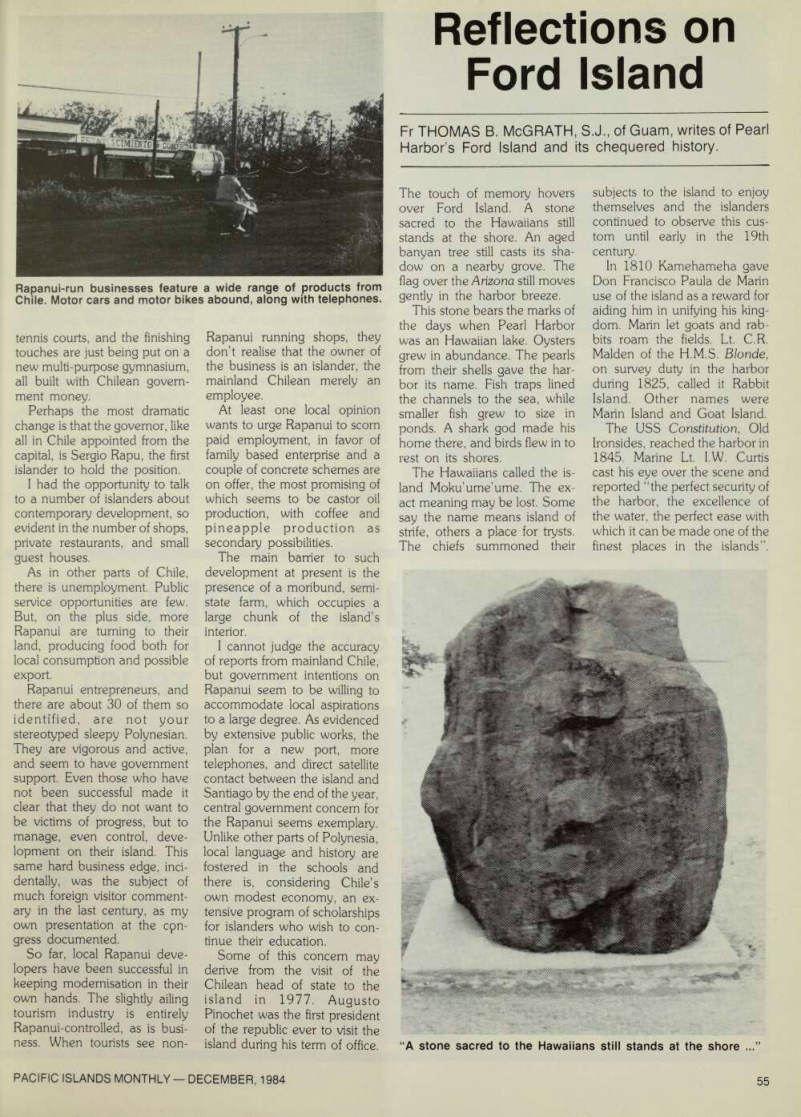
Rapanui-run businesses feature a wide range of products from Chile. Motor cars and motor bikes abound, along with telephones.