Reflections on Ford Island
pp. 55-58 · Read in the full issue
Ford Island
Fr THOMAS B. McGRATH, S.J., of Guam, writes of Pearl Harbor's Ford Island and its chequered history.
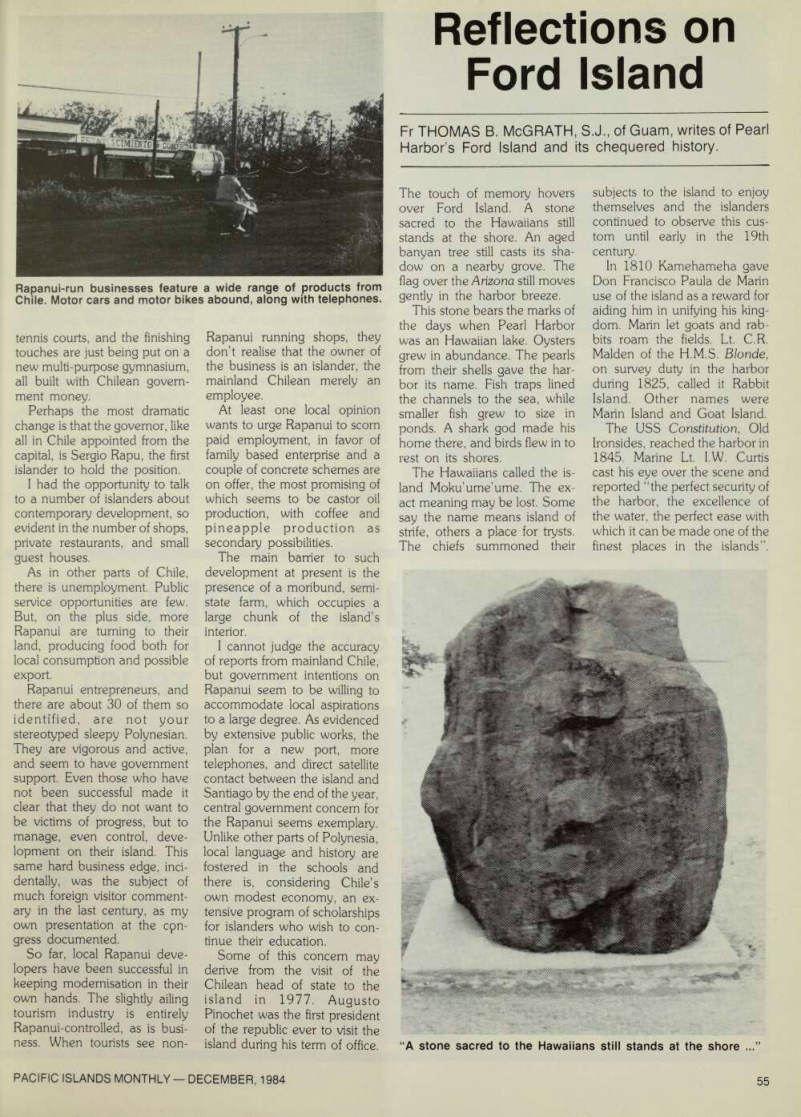
The touch of memory hovers over Ford Island. A stone sacred to the Hawaiians still stands at the shore. An aged banyan tree still casts its sha dow on a nearby grove. The flag over the Arizona still moves gently in the harbor breeze.
This stone bears the marks of the days when Pearl Harbor was an Hawaiian lake. Oysters grew in abundance. The pearls from their shells gave the har bor its name. Fish traps lined the channels to the sea, while smaller fish grew to size in ponds. A shark god made his home there, and birds flew in to rest on its shores.
The Hawaiians called the is land Moku’ume’ume. The ex act meaning may be lost. Some say the name means island of strife, others a place for trysts.
The chiefs summoned their
subjects to the island to enjoy themselves and the islanders continued to observe this cus tom until early in the 19th century.
In 1810 Kamehameha gave Don Francisco Paula de Marin use of the island as a reward for aiding him in unifying his king dom. Marin let goats and rab bits roam the fields. Lt. C.R.
Malden of the H.M.S. Blonde, on survey duty in the harbor during 1825, called it Rabbit Island. Other names were Marin Island and Goat Island.
The USS Constitution, Old Ironsides, reached the harbor in 1845. Marine Lt. I.W. Curtis cast his eye over the scene and reported “the perfect security of the harbor, the excellence of the water, the perfect ease with which it can be made one of the finest places in the islands”.
“A stone sacred to the Hawaiians still stands at the shore ..."
Everything pointed to a future naval base. Curtis drew up the plans and passed them up the chain of command to the admi rals of his day. In the next century other admirals read them, grasped Curtis’s vision, and carried it out to the letter.
In 1865 James I. Dorsett bought the island at public auction for $lO4O. He owned it for three months, and then sold it to a recently widowed woman with a tiny son. Dr Seth Porter Ford, Sr. a physician at the naval hospital in Honolulu, the father of the boy, died in 1866.
He left his wife Caroline and Seth, Jr., without support.
Dorsett left the island to the mother in trust for the boy.
Dr Ford had arrived from Boston aboard the R.B. Forbes in 1851 and took up his duties in Honolulu. During his second year he went out to inspect the Charles Mallory, which arrived from the west coast flying a yellow flag. He confirmed the suspicions of the harbor pilot
and the crew that smallpox was aboard. The city received the news with great alarm, while the medical community took what steps it could to ward off an epidemic. Ford was assigned to Kalihi Hospital. He served there and wherever needed during the crisis. After the dis ease subsided he continued to work without reserve in Hon olulu until his untimely death at the age of 48.
The Hawaiians, after his death, called the island, Poka Ailina. Poka may be derived from Ford’s middle name Por ter rather than from the usual meaning of “bullet” or “can nonball”. Ailina is a translitera tion from English into Hawaiian of the word island. Still others call it Ford Island, which is the name that survives today, In 1891 the son sold his island to C.A. Brown, owner of the Hawaiian Plantation. He grew sugar cane on it and kept a small plot of land for his home. Life flowed to the
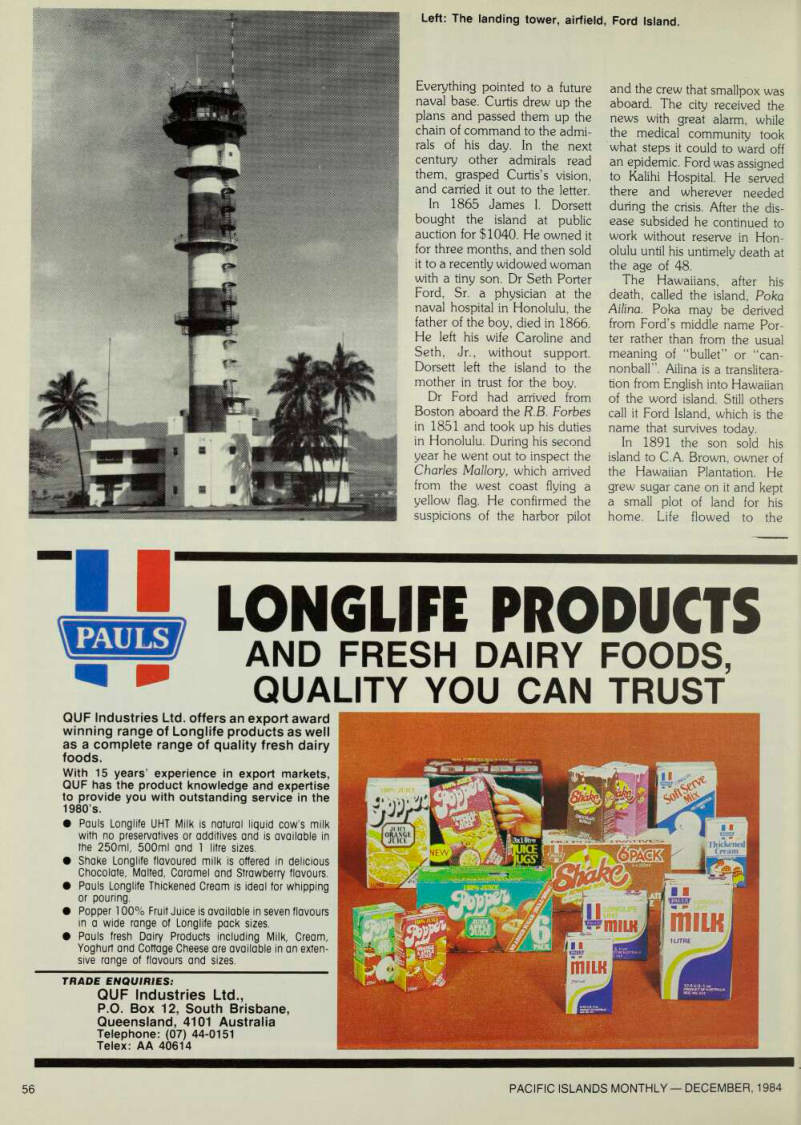
Left: The landing tower, airfield, Ford Island.
rhythm of the cane-growing seasons.
Another rhythm more orien tal in tempo began to be heard in Washington. Congress wanted trade with China. When the Spanish-American War be gan in the Caribbean Dewey sailed from Hong Kong and seized Manila. The navy took Guam and Hawaii as stepping stones to keep the lifeline to Manila open.
The Curtis plan received additional support from the re commendations of Cdr. S.F.
Dupont in 1851, Curtis himself in 1864, Colonel J.M. Schofield in 1870, and the final survey at the turn of the century. It took final shape when the navy cut the reef at Pearl Harbor to admit deep-draft ships. The gunboat Patrol passed first through the new channel. The opening of the reef marked the transformation of the harbor into a naval base, and Ford Island into an air station.
In 1909 the navy started a dry dock opposite Ford Island.
The workers felt danger at the site. After delays a kahuna, or expert in Hawaiian ritual, was called in to look at the site. He quickly saw the place was sacred to the shark god of Pearl Harbor. The navy continued the work and tested the dry dock.
W.S. Lee described the scene when they pumped the dry dock dry. “As if a captive god had put a shoulder to the underside of the massive floor and given a mighty heave, the expanse of concrete errupted in a thunderous explosion. The floor disintegrated like tiny kindling; geysers shot up: work men barely escaped alive.”
The navy took two steps. The engineers decided the only way a concrete slab 80 feet thick could explode was hydrostatic pressure. They went back to the drawing board. The admirals located another kahuna who performed the propitiation ceremonies in view of all.
The work proceeded without any unusual delays. In 1919 they pumped the dry dock again. Some say they found the skeleton of a 14-foot shark on the floor . . . The kahuna today has passed from living memory, and the shipyard continues to service the fleet without in terruption.
Ford Island became an air
facility in 1917. The army took over the field and named it after Lt. Frank Luke. Two years later the navy flew in the first flying boats.
The navy made flights in 1934 from Ford Island to John ston Island, French Frigate Shoals, and Midway Island.
This opened the air route to French Frigate Shoals, with its 17 miles of calm, quiet waters.
The next year Pan American began a trans-Pacific service to Hawaii and beyond. Captain Edwin Musick with Fred Noonan as navigator flew the first survey flight in the spring of 1936 from Alameda to Pearl Harbor. Noonan returned in 1937 with Amelia Earhart and Paul Mantz. Earhart completed the first leg of a round-the world flight and was scheduled to continue across the Pacific.
Mantz had the plane moved to Ford Island because of the rough runway at Wheeler Field, where she first landed. The plane was damaged in the attempted takeoff from Ford Island and the flight plans com pletely changed.
Noonan and Earhart later took off from Florida to fly around the world. They left Lae, New Guinea, but failed to arrive at the next scheduled stop in the Pacific.
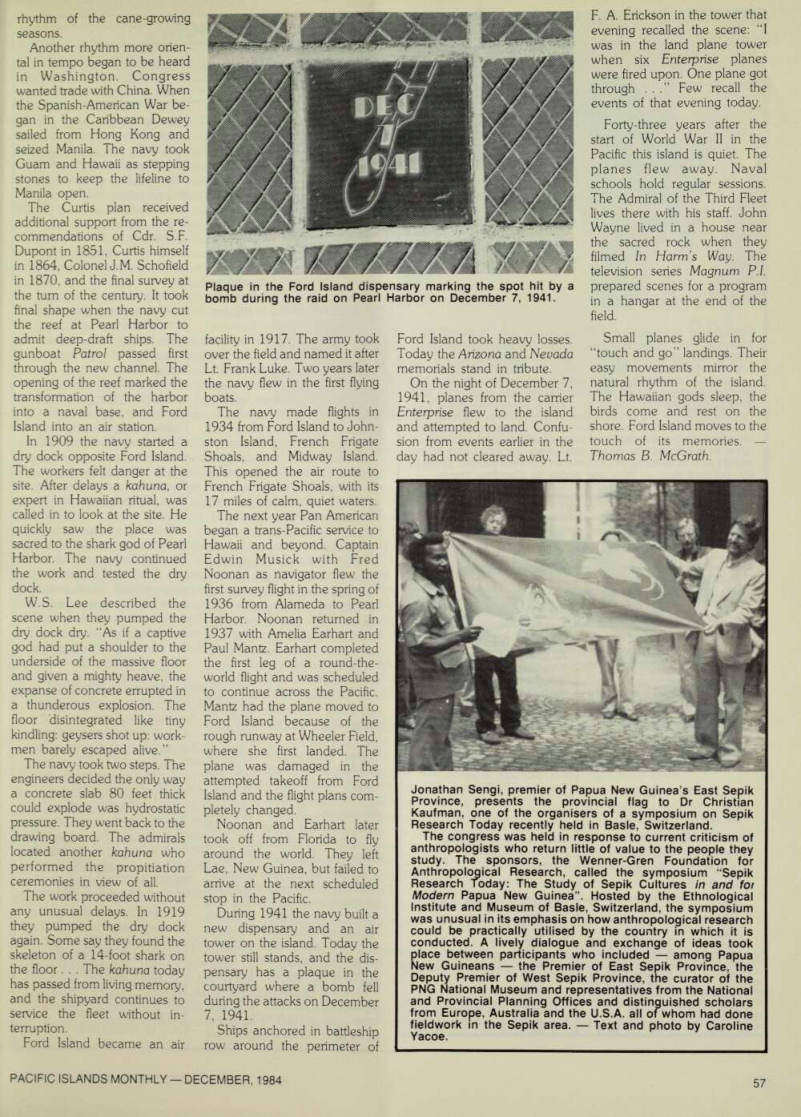
During 1941 the navy built a new dispensary and an air tower on the island. Today the tower still stands, and the dis pensary has a plaque in the courtyard where a bomb fell during the attacks on December 7, 1941.
Ships anchored in battleship row around the perimeter of
Ford Island took heavy losses.
Today the Arizona and Nevada memorials stand in tribute.
On the night of December 7, 1941, planes from the carrier Enterprise flew to the island and attempted to land. Confu sion from events earlier in the day had not cleared away. Lt.
F. A. Erickson in the tower that evening recalled the scene: “I was in the land plane tower when six Enterprise planes were fired upon. One plane got through ...” Few recall the events of that evening today.
Forty-three years after the start of World War II in the Pacific this island is quiet. The planes flew away. Naval schools hold regular sessions.
The Admiral of the Third Fleet lives there with his staff. John Wayne lived in a house near the sacred rock when they filmed In Harm’s IVay. The television series Magnum P.I. prepared scenes for a program in a hangar at the end of the field.
Small planes glide in for “touch and go” landings. Their easy movements mirror the natural rhythm of the island.
The Hawaiian gods sleep, the birds come and rest on the shore. Ford Island moves to the touch of its memories.
Thomas B. McGrath.
Plaque in the Ford Island dispensary marking the spot hit by a bomb during the raid on Pearl Harbor on December 7, 1941.
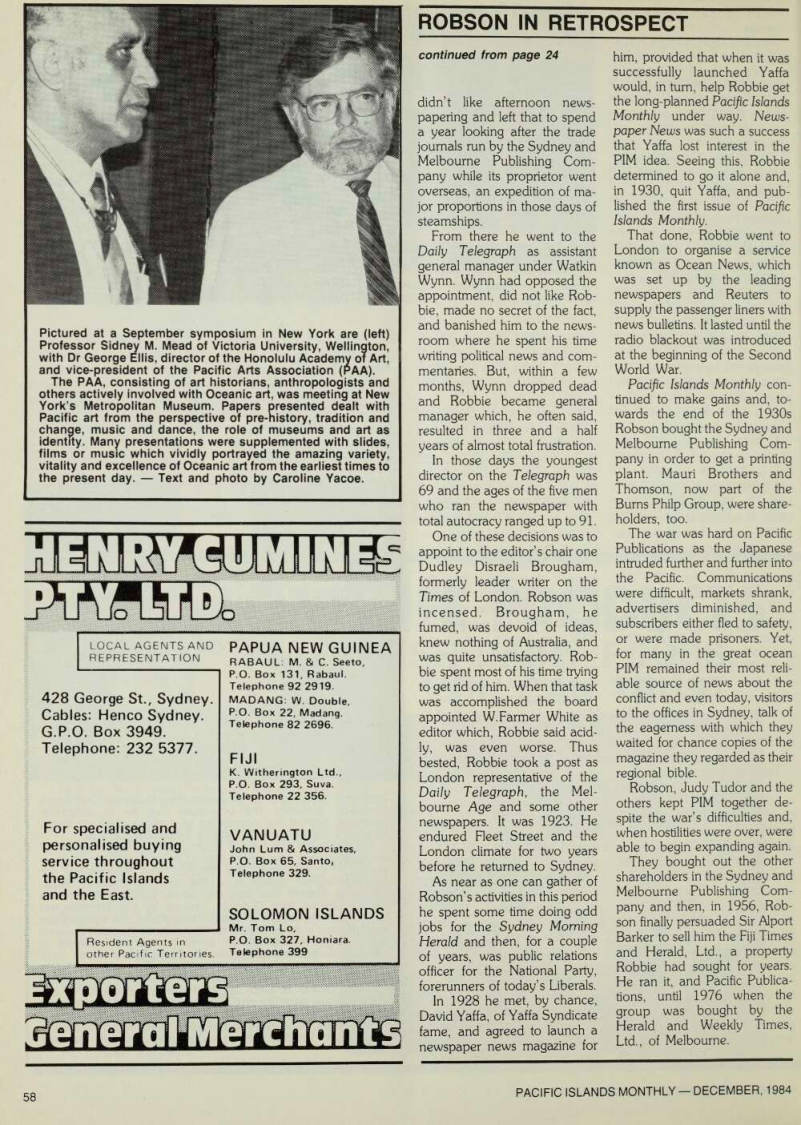
Jonathan Sengi, premier of Papua New Guinea’s East Sepik Province, presents the provincial flag to Dr Christian Kaufman, one of the organisers of a symposium on Sepik Research Today recently held in Basle, Switzerland.
The congress was held in response to current criticism of anthropologists who return little of value to the people they study. The sponsors, the Wenner-Gren Foundation for Anthropological Research, called the symposium “Sepik Research Today: The Study of Sepik Cultures in and for Modern Papua New Guinea Hosted by the Ethnological Institute and Museum of Basle, Switzerland, the symposium was unusual in its emphasis on how anthropological research could be practically utilised by the country in which it is conducted. A lively dialogue and exchange of ideas took Rlace between participants who included among Papua ew Guineans the Premier of East Sepik Province, the Deputy Premier of West Sepik Province, the curator of the PNG National Museum and representatives from the National and Provincial Planning Offices and distinguished scholars from Europe, Australia and the U.S.A. all of whom had done fieldwork in the Sepik area. Text and photo by Caroline Yacoe.
Pictured at a September symposium in New York are (left) Professor Sidney M. Mead of Victoria University, Wellington, with Dr George Ellis, director of the Honolulu Academy of Art, and vice-president of the Pacific Arts Association (PAA).
The PAA, consisting of art historians, anthropologists and others actively involved with Oceanic art, was meeting at New York’s Metropolitan Museum. Papers presented dealt with Pacific art from the perspective of pre-nistory, tradition and change, music and dance, the role of museums and art as identity. Many presentations were supplemented with slides, films or music which vividly portrayed the amazing variety, vitality and excellence of Oceanic art from the earliest times to the present day. Text and photo by Caroline Yacoe.