tropicditigs
pp. 53-54 · Read in the full issue
Now, a big hand for the music-makers of Malapoa
“1984 Malapoa Music Night” read the roneoed ticket, and even more appropriately “Naet Blong Singsing Mo Danis Blong Malapoa.” 200 Vatu (about SA2) was the “Praes Blong Go Insaed. ” This was surely the best bargain in Port-Vila. No fewer than 27 advertised musi cal groups or soloists at Mala poa College’s Sixth Annual Soiree Musicale. The adminis trators of the College, an Eng lish-medium secondary school situated on an attractive arm of Vila’s harbor, are clearly of the view that education should not consist exclusively of academic pursuits.
Equally clear is the fact that Malapoa’s students possess considerable talent and inclina tion for music-making, even if the results are a trifle raw at times. They also display an imaginative use of names for their groups. Thus, the program got under way no more than half an hour behind schedule with the Trumps who turned up regularly throughout the night as accompanists to various other performers.
The presentation side by side of the sacred and the profane which so often characterises music in the South Seas was early to the fore. The second group on the bill, Kaiasa, an 11-member female aggregation which presented carefully re hearsed religious material was followed immediately by Doc tor Lennon (an amalgam of Doctor Hook and John Lennon perhaps?), who flung himself vocally and physically into Mick dagger’s “Honky Tonk Woman,” maintaining an erra tic beat with his pelvis to squeals of appreciation from the audience. The doctor, a slender youth of 19 or 20, resurfaced a short while later in the program, playing a discreet
ukulele with a string band from Pentecost Island the Eastern Stars. “Give ’em a big hand,” instructed the stentorian-voiced young M.C. after every num ber, in a pitch which suggested he might have spent a lot of time on voice modulation and relatively little on his patter.
It soon became apparent that, despite the variety of group names on the bill, several individuals were doing service with more than one combina tion. Thus, three Trumps be came Drifters for a couple of numbers, while two of those were later to be seen in the esoterically named Reeves Blaauwilde-Beestefontaine Band. “A group from South Africa,” declared the announ cer with more optimism than accuracy; “give ’em a big hand.” Of the female perfor mers Aileen Sam was variously a member of Kaiasa, a Fearless Sister and a Vuna Sister, though the latter group never actually performed, while Rosie Buie was a Lonely Sister in addition to two other singing
roles. Vivian Kwevira sang as one of Two Sisters and danced as one of the Seelie Girls.
“Notice,” said the M.C. Ishmael Kalsakau (now, there’s a Ni- Vanuatu name to reckon with), “that they are the Seelie Girls and not the Si//y Girls, so give ’em a big hand.”
In the concert’s first half, the Drifters had given way to (or perhaps become) the Prisoners and presented two delightful songs in Bislama about the girls of Honiara and Santo Town respectively. The connotations were not lost on the audience which howled its delight after almost every line, having earlier fidgeted through a competent but chilly set by a duo of flute and recorder. An interesting touch of professionalism in the form of the Fatuana String Band also helped to enliven the first half of the show.
Fatuana, internationally the best known of the many Vanuatu string bands, consisted in this manifestation of nine pieces, including six guitarists, a tea chest bassist and a ukulelist
who looked all of eight years old and flailed his instrument with exceptional vigor.
Fatuana’s chief asset, however, is the remarkable “Foivai Piano,” a series of bottles filled with water to various levels, each an accurate musical pitch, and played in the manner of a marimba or xylophone.
For any but the most confi dent amateur, they must surely be a hard act to follow but undaunted, perhaps even in spired, the Criminals, a rock group which curiously didn’t include one Prisoner, got the second half underway. They were followed aptly by the Fearless Sisters whose reper toire clearly suggested that God was on their side. “Give ’em a big hand.” Florence Toka, The Loner, sang of the tribulations of a woman in love and looked convincingly sophisticated in black matadors. The Lonely Sisters’ condition was assuaged by the accompaniment of the persistent Trumps, whose lead guitarist and singer could well develop into a real talent, and
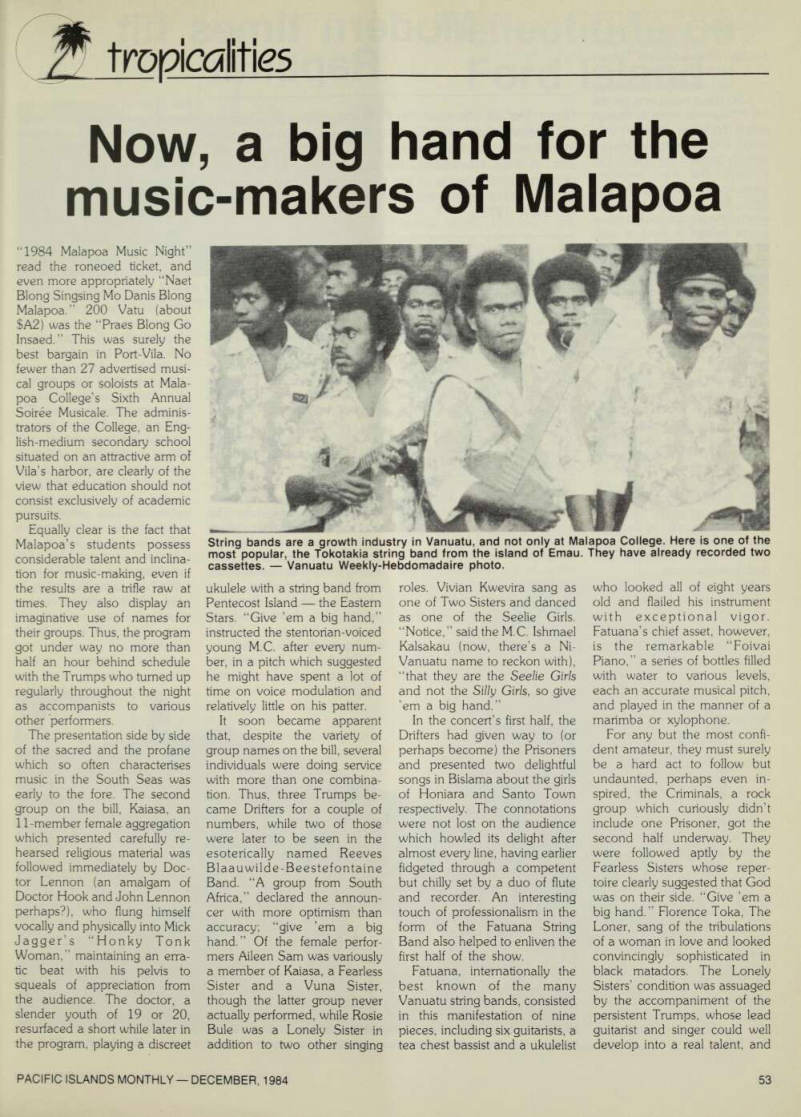
String bands are a growth industry in Vanuatu, and not only at Malapoa College. Here is one of the most popular, the Tokotakia string band from the island of Emau. They have already recorded two cassettes.-Vanuatu Weekly-Hebdomadaire photo.
Heart of Gold performed songs appropriate to their name.
By the time the rather pro saically named Gospel Singers took the stage, it was after 11 p.m., and although there were at least three more acts on the bill it began to seem as though every Malapoa student who could sing, dance or play had already crossed the boards that evening. But the Gospellers were barely half way through their first musical testimony when Providence took a hand as indeed it must at such times. The strain placed on the power supply by the armory of electronic musical instruments, synthesisers, speakers and light ing effects was suddenly and dramatically felt. Silence and darkness descended simul taneously and with seeming finality.
In more sophisticated loca tions (Sydney or Auckland for example) the sudden termina tion of a popular concert would have been the cue for at least a minor riot. Here, apart from a few sighs or groans of dis appointment every time the lights flickered tentatively and then went out again, there was quiet, broken only by the snap and crackle of popping bubble gum, Vanuatu’s latest pre- and post-teenage craze.
After several attempts to re store the evidently weary cir cuitry, Charles Pierce, producer and musical director, driving force behind the Malapoa Music Club, and teacher of geography in addition, took the stage with compere Kalsakau and announced in an unampli fied voice with a slight sob in it that the remainder of the performance was cancelled.
One more restrained groan and the audience shuffled slowly out of the darkened auditorium.
The conclusion was sadly anti-climactic, but the evening had been well planned and varied enough to convince this writer of the extent of the abilities possessed by Mala poa’s students and the dedi cated enthusiasm of the college staff. “Give ’em a big hand.”
The occasion was further distin guished by the presence in the front row of Vanuatu’s Prime Minister, Father Walter Lini, who obviously enjoyed himself hugely. Give him a big hand
too.
Norman Douglas in
Port-Vila.