riding bareback on Tanna
pp. 47-52 · Read in the full issue


From boar-hunting on Santo to riding bareback on Tanna
From the Solomons we con tinue our journey through Melanesia by going to Vanuatu.
Port-Vila is certainly one of the most Westernised towns we have seen in Melanesia. For five days we run from one place in the city to another, trying to put together as much information as possible.
The island of Espiritu Santo seems to offer, especially in the interior, interesting stories.
The interior of this island, active centre of the rebellion led by Jimmy Stevens during the months preceding national in dependence in 1980, is still very isolated and partly inha bited by bush people living in the traditional way.
We learn that only recently the Church of England started making contact with those Malo-Malo people who live in the villages nearest the island’s north coast. Still, many of them live far removed from any ex ternal influence.
To enter their territory, one has to go as far north as Big Bay, and from there proceed through the mountains, rising steeply towards the interior.
Crossing the Jordan River to get into Big Bay wasn’t easy.
The rains of this time of the year have swollen the river, and it has been impossible to ford it by jeep for about three months.
It’s dangerous even to cross it on foot and without baggage. I (Roberto) was carried away by the current and finished up against a tree that lay sideways in the river. I nearly drowned. I was squashed against the trunk underwater, but out of pure luck found a way under it and managed to come out with the last air I had in my lungs.
We get to Nauelala covered in mud, bare-chested and with leeches on our feet, after a day walking in the bush. We im mediately explain the reason for our coming to Robert, the young chief, to Father Wilfred, to the catechists and several local people, lest we be taken for young priests, or
In this final instalment of their Melanesian Diary, the brothers ROBERTO and MARCO PETTINI, tell of their visits to Vanuatu’s Santo and Tanna Islands.
anthropologists, or slave trad ers, or politicians, or naturalists, or government officers, or something else . . . After smok ing and listening to our story the chief explains to us how difficult it is to be accepted by the Malo-Malo from the mountain villages. Where the Church hasn’t arrived, the people have
remained “bush people inside and out” that is, reserved, suspicious and averse to white people. White men were known as slave traders, thieves of land, and people to keep away from as much as possible.
“Most probably, when you reach any of the custom villages people will run away and it will
be unlikely that they will let you stay with them longer than a few days ...”
From these words, it may seem that the chief Robert is also opposed to our visit, but it’s not so. He understands the spirit of our journey but he knows only too well the mental ity of his people, and his power as a chief is confined to the Christianised villages. The others are not even villages, or conglomerations of people from the same clan, but family units where each patriarch is the chief. They are scattered, often several hours walk away from each other. Anyway, we got permission to “try,” and Robert himself finds a guide prepared to lead us further into the interior. • • • Five huts made of wood, leaves and bamboo. Three families, obviously related to each other, two domesticated wild oxen, three pigs, a few chickens, many dogs, and plenty of bush all around. This is Malzia. We chatted, explained, told stories until late. But people were still rather reserved, looking at us with suspicion. Men only wear a piece of calico between their legs, held by a string that also holds the pipe and the smoke bag; women instead have their sex covered by fresh branches of leaves, have custom tattoos on their faces, and a mother-of pearl dagger inserted in their noses.
The chief is not here and will be back tomorrow. It’s obvious that we will only know whether we can stay or not after having talked to him.
He arrived late in the mor ning, with his wife and children.
Teuoti is smaller, more frail and older than the others; he lis tened to our words, translated into the local language by his brother Sempai, who speaks a broken Bislama (the Vanuatu form of Pidgin) that he learned God knows how . . .
Then the chief wants to know
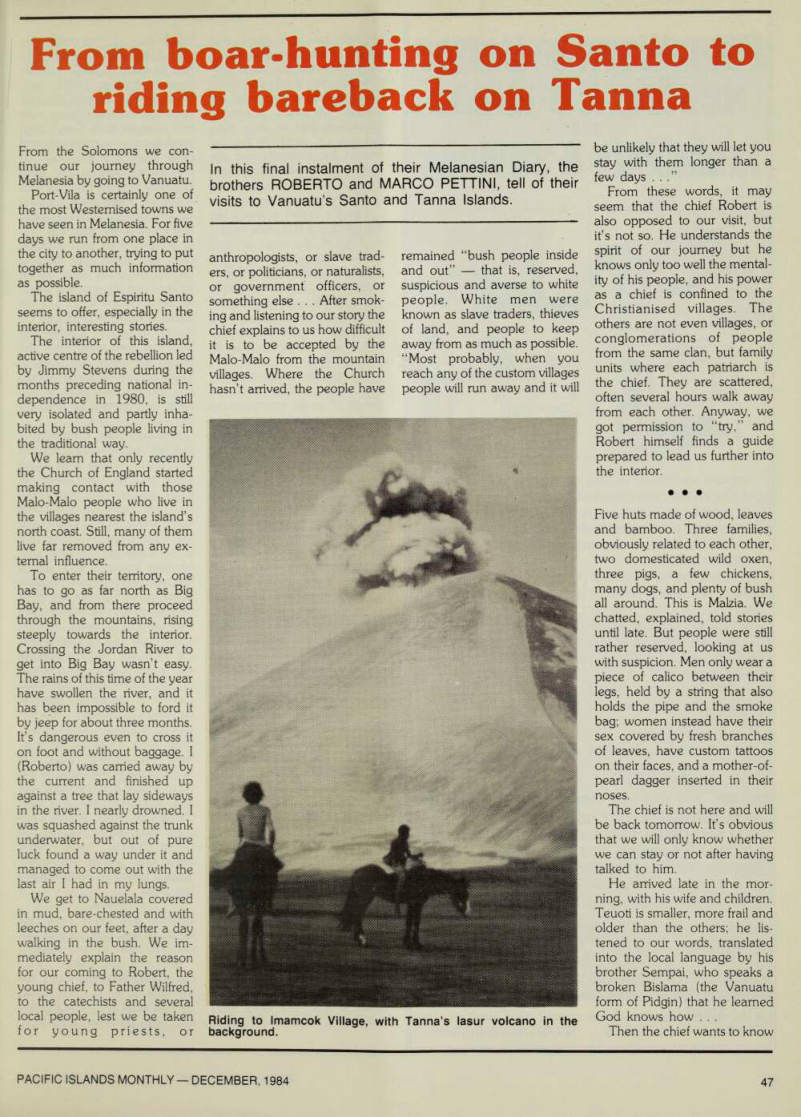
Riding to Imamcok Village, with Tanna’s lasur volcano in the background.
precisely how many and what are the presents we have in our bags. How big the pipes are, how long are the bush-knives, how the sharpening stones are made. He then solemnly announces that we may stay, but only on condition that we respect his authority and the custom of the place, emphasis ing that we must not dig the soil or photograph the women.
Teuoti’s verbal consent has the effect of a favorable verdict in a court. As soon as he’s finished talking we see the people of Malzia relax and their expressions are immediately more friendly. Then someone runs to get a few pieces of kava and someone else has already arrived with bamboo canes fil led with water.
Here the juice of kava roots is the custom drink, and the means of social entertainment most appreciated by men. The Malo-Malo each chew a piece of root, then they all spit it in the same bag and filter it with a little water, until a whole bowl is filled. One person at a time drinks the kava, trying to swal low at one gulp the whole contents of the only mug, which each time is filled to the brim. It tastes like muddy water and its effect if you drink a lot of it and if it’s filtered with little water is definitely more potent than betel nut. Tonight we’ve been drinking it for hours; be tween mugs we talk, joke and smoke, go for a piss, and return to drink more, until the bowl is empty and we can hardly walk. • • • Hunting, to the Malo-Malo, is a matter of everyday existence.
The sun is still behind the mountains but Cray is already up and from the top of the hill he looks around him in silence.
While he’s up there “smelling the weather,” the other men and boys of Malzia sharpen the blades of their spears and bush knives. Soon we are all walking in single file, walking fast along the track leading to the river and on the other side zigzags up the mountain to the next valley, hunting ground of the local people.
Along the way we don’t talk or take rests, we run up and downhill after the dogs who continue to bark excitedly. At
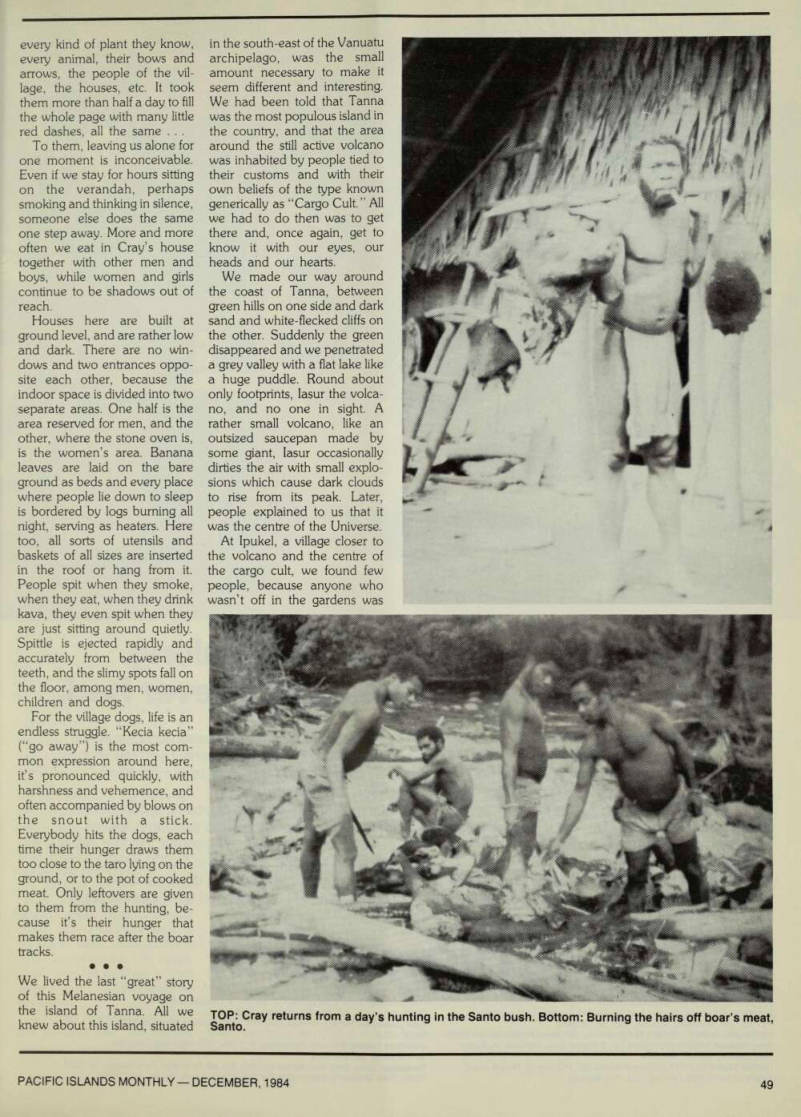
the bottom of the valley we split: Ansen and his dogs go in one direction, Sampai and two boys in another, while Cray, Marco and I walk some distance upstream along the stony river and enter the bush. Cray’s dogs smell the prey immediately and from then on it’s only an exhausting race in the thick greenery until we catch up with a pair of boars already trailed by the dogs. Cray pierces them in the throat with precision, one at a time, then with extreme calm guts them, cuts them in halves and hangs them on the ends of two short poles. When we return to the bottom of the valley nobody is back yet. So it’s for us to light the fire and bum the hair away from the pieces we have just caught.
Then, as soon as some embers are formed, we roast a few strips of meat and have break fast.
Between bites, Cray tells us that this bush is full of boars and wild oxen. “There is as much meat as you want here, as much as you can take home ...” He also says that boars rarely move around alone, and that it’s often possible to catch a whole family on only one hunt.
Hunting however isn’t always such an easy matter because boars, when they are big, must be pierced several times before they die and between hits they chase their attackers quite fast.
It’s up to the hunter’s reflexes and agility to grab the first tree branch within reach, and from there to hit the beast again as it continues infuriated to run around the tree. “Once a boy from Buria, a big, tall fellow at least your size, didn’t have time to climb out of the way and the boar struck him between the legs, made him fall, and then charged him again, killing him. ”
At some stage, we see the others coming back. Some have one, some two boars already gutted Sampai even has three . . . • • • Cicadas and birds here are heard all day and the huts are the only trees without leaves.
We got out paper and colored felt pens and today, for the first time in their lives, Sampai and Cray made a draw ing. They put everything in it:
every kind of plant they know, every animal, their bows and arrows, the people of the vil lage, the houses, etc. It took them more than half a day to fill the whole page with many little red dashes, all the same . . .
To them, leaving us alone for one moment is inconceivable.
Even if we stay for hours sitting on the verandah, perhaps smoking and thinking in silence, someone else does the same one step away. More and more often we eat in Cray’s house together with other men and boys, while women and girls continue to be shadows out of reach.
Houses here are built at ground level, and are rather low and dark. There are no win dows and two entrances oppo site each other, because the indoor space is divided into two separate areas. One half is the area reserved for men, and the other, where the stone oven is, is the women’s area. Banana leaves are laid on the bare ground as beds and every place where people lie down to sleep is bordered by logs burning all night, serving as heaters. Here too, all sorts of utensils and baskets of all sizes are inserted in the roof or hang from it.
People spit when they smoke, when they eat, when they drink kava, they even spit when they are just sitting around quietly.
Spittle is ejected rapidly and accurately from between the teeth, and the slimy spots fall on the floor, among men, women, children and dogs.
For the village dogs, life is an endless struggle. “Kecia kecia” (“go away”) is the most com mon expression around here, it’s pronounced quickly, with harshness and vehemence, and often accompanied by blows on the snout with a stick.
Everybody hits the dogs, each time their hunger draws them too close to the taro lying on the ground, or to the pot of cooked meat. Only leftovers are given to them from the hunting, be cause it’s their hunger that makes them race after the boar tracks. • • • We lived the last “great” story of this Melanesian voyage on the island of Tanna. All we knew about this island, situated
in the south-east of the Vanuatu archipelago, was the small amount necessary to make it seem different and interesting.
We had been told that Tanna was the most populous island in the country, and that the area around the still active volcano was inhabited by people tied to their customs and with their own beliefs of the type known generically as “Cargo Cult.” All we had to do then was to get there and, once again, get to know it with our eyes, our heads and our hearts.
We made our way around the coast of Tanna, between green hills on one side and dark sand and white-flecked cliffs on the other. Suddenly the green disappeared and we penetrated a grey valley with a flat lake like a huge puddle. Round about only footprints, lasur the volca no, and no one in sight. A rather small volcano, like an outsized saucepan made by some giant, lasur occasionally dirties the air with small explo sions which cause dark clouds to rise from its peak. Later, people explained to us that it was the centre of the Universe.
At Ipukel, a village closer to the volcano and the centre of the cargo cult, we found few people, because anyone who wasn’t off in the gardens was
TOP: Cray returns from a day’s hunting in the Santo bush. Bottom: Burning the hairs off boar’s meat, Santo.
attending a “custom congress” at a nearby village. Chief Mellis was also at the meeting which will end tomorrow after a night of traditional dances.
It is a real pleasure to sit with the local “meri” because they look you in the eye and speak to you with amazing sincerity and openness. They seem just like our mothers and sisters . . .
Maybe this is just the right time for us to try to move a little closer to their dimension as women.
Ipukel is in a small bay called Sulphur Bay. The square shaped village is a line of huts along the inner edge of a long palisade, like a picture frame made of vertical stakes firmly planted in the earth. If you clamber over the palisade by the sea you find yourself on the beach of dark sand; on either side, the mountains which form the valley rise steeply; but if you go out the front, through the gate, you cross a stretch of bush full of orange, mandarine and lemon trees and arrive right at the foot of the volcano. It is in the thicker parts of this bush that you find, well hidde from the eyes of the women, the Nakamals, huts reserved for certain special rites where every evening at sunset the men gather to drink kava. At Ipukel there are six of them, in six different locations. For some weeks, one of them has housed a pair of boys who will come back to live in the village tomorrow. We were told that since the day of their circumci sion they have had to live on their own and wait for the wounds of the operation to heal. Tomorrow the end of the isolation period will be cele brated.
Chief Mellis, a tall thin man with white hair and beard, went away again as soon as he had heard us. He will send us his final answer as to whether or not we can stay tomorrow. Why not straight away? Because Mellis looks and listens but doesn’t speak his mind straight away. When he goes back to his hut he lies down and thinks over the words he has heard.
That way he can tell if they were true or not,” explained his nephew.
The two boys ran to wash in the sea and then, still hidden,
they were smeared with coco nut oil, their faces were painted and they were dressed in two new pieces of calico. After their return to the village the celebra tion proper took the form of a slow and calm sharing out of the pile of yams, kava, pork and colored straw skirts amongst the members of the boys’ clans.
The fun started in the evening, after drinking kava, when the dancing got going just outside the gate. Each dance was very similar, a continuous stamping of feet and jumping, full of shouts and enjoyment. But we were told repeatedly that when the “full custom” is followed that is when the boy has been circumcised with a piece of bamboo the celebrations are unforgettable. • • • Who was John Frum, the tall young man dressed in white who arrived one day in 1942 in the same bay where James Cook had landed? Here in Sulphur Bay they tell us that he was a good and just man, a white man who spoke “streit.”
He told his “Melanesian brothers” that soon would come the day when they too would be able to build the big boats, the radios and the other things the white man has but that they would lose “the power of their customs” if they didn’t do all they could to preserve them. Then John Frum taught them how to pray in a simpler way, singing with flowers in their hands in front of a red
painted cross, and he promised to return with a cargo of all God’s gifts. But he never came back.
There are 26 “John Frum” villages around the volcano (as well as a few more in other parts of the island), and once a week they come together for a celebration. Each village has its own group of musicians and while these alternate through the night all the participants enjoy themselves dancing.
How? The men close together over on one side as if they were on their own in a night club, and the women on the other swinging their hips and moving along as if in a fashion parade. • • • Marco is as white as death, his face is twisted and all he does is scrape his tongue with his teeth.
For three days he has had the “cold-cold” (malaria) back, and for three days there have been going around “all sorts of pos sible reasons” for his condition, and “all sorts of possible advice” for curing him.
Benjamin, the chief s young est brother and our next door neighbor, tried to cure him this evening by spraying kava spit in his face. Marco was drinking just at that moment and very nearly responded in kind. • • • We went to look for flying foxes in the bush; me, Marco, four boys and a rifle. During the day the flying foxes hang from the branches of the highest and leafiest trees and sleep head
down wrapped in their large wings like black sheets. When you see them at sunset flying in search of fruit they remind you immediately of vampires, but today, when I saw them up close for the first time, I felt a fondness for them. But this is the time of the year when they are nice and fat and have not yet started making pikininis.
One shot brought down eight of them. Five were roasted for dinner with bananas, and three ended up in the village cooking pots.
We’ve been here for 10 days now, yet every morning when I get down to the beach I find something new to marvel at.
Either the tide is out and the evaporation of the water from the hot springs which empty into the sea makes the place look magical; or the tide is in and the waves seem to wash the beach with their white foam; or because you get a composite picture of someone paddling off in a canoe, a group of children drawing in the sand with their toes, and a group of women dressed in rags carrying other rags to be washed.
You bathe, do your washing and draw water from amongst the volcanic boulders at the end of the beach. That’s where the biggest springs are and one of these is so hot you can cook in it.
How many Nakamals would there be here on Tanna? Today we found out that some of the ones around the island are
John Frum believers pray in front of the red cross, Tanna Island, Vanuatu.
reserved for “special func tions.” Some are for “yams nomoa” (only yams), some for taro, or bananas, or cut-nuts, or flying foxes, or kava, or, we were told, for all the other different sorts of kai-kai (food), animal or vegetable, which are to be found on the island.
There are even some for “con trolling” the weather and the sea.
This is because everything, as well as every living being, has its own spirit here on Tanna. It is said that a long time ago lavei, the strong, hairy man down there who makes the volcano explode, came out to help the people of Tanna to live more comfortably. To the males of each clan he gave a magic stone connected to a special spirit and he showed them the correct way of using it.
Thus, at certain times of the year, during sowing or in a dry period, the magic stones are unearthed and used by the direct descendants of the men who received them from lavei.
Even today these stones co vered with custom leaves and kava spit are taken as the
explanation for the arrival of propitious rain or an abundant harvest, and, more generally, for the fertility of the volcanic soil of this island.
On the island there is a place full of wild horses. Whoever wants one goes there, chooses one, and takes it. Here at Sulphur Bay there are only six or seven which wander freely about, and every now and then the children mount them for fun. Today we went for a great ride with Kannowi (the flying fox hunter) as far as the house of the man who can talk with lavei, on the other side of the volcano. We didn’t find him there, but everybody we saw on the way had a good laugh when they saw iis hanging on to the necks of the horses, imagining, I suppose, what our backsides would feel like after the bareback ride.
Today there was a double “swap” of people at Enumakel, one of the villages just beyond Sulphur Bay. Two members of the same family, a brother and a sister, got married and, as is the custom on Tanna, their father had to give a daughter to
the family from which the son took his wife and at the same time he received a new girl from the family into which his daugh ter married. On this island every female who leaves the clan must be replaced by another, and there is no bride price which could be considered of equivalent value.
'... a marvellous voyage, lived intensely...'
We should mention kava again. As time goes on, we become more and more aware of the importance of kava in the lives of these people. Kava has been drunk on Tanna “since always” and is the method used for getting in touch with that world of forces from which help may be obtained. This means help in the most general sense of the word: from the recovery of a lost piglet which has wan dered into the bush to saving the life of a dying man; from the smallest and most personal de sires to the most collective. This contact is called “temafa” and is manifested after having drunk a whole coconut shell full of kava in one draught, while spitting out the last bit. There are a mass of rules concerning the preparation, drinking and spit ting of kava. For example, the chewn part of the root may be touched only by circumcised boys who have not yet begun to grow whiskers, because it is only in that arc of time that their hands do not come into contact with the hands of women dir tied by menstrual b100d... As soon as the drinking has begun you must stop talking, and if you must say something you say it in a whisper so as not to disturb the others who are “listening to the kava”.
Women may not even glance in the direction of the Nakamal when they pass nearby. If they do they are immediately chased by the men and struck on the head with a kava root. Why?
Because the plant was bom from a woman and the men would never allow a woman to watch while they cut it, chew it, spit it and drink it.
We went with Kannowi to the top of the volcano. What a place! You look around you and you see an expanse of green which stretches as far as the sea; you look down and you see a motionless lake amid dark sand; look into the dist ance and you see more islands and more sea; look directly down and you see a cone which ends in five holes shoot ing out fire and smoke. The explosions are sudden jets of incandescent lava which roll, stretch and break into pieces before falling back in. Kannowi described it as he watched fascinated for the umpteenth time: “Look, look at that piece of fire coming out. It moves like a piece of paper, like the wings of the flying foxes, but when it falls it has already become a rock”. The mouths alternate jets of smoke and jets of fire; today while one was exploding, another was giving off white smoke, another black smoke and two seemed extinct. God only knows how the people of Tanna can believe that inside there there are a man and two women who make puddings The farewells this time were particularly painful. For three whole days we were invited to lunches and dinners in our honor, and we were made aware that our close friends were really sorry that we were leaving.
“We won’t wash the mats you slept on so that they will keep your smell,” Margaret said.
“Plant these kava roots in my garden with your own hands and when they are ready we will drink it and think of you,” was Isaac’s comment. “But why don’t you stay?” asked Lesbit with surprise, “you could get married here, have your own piece of garden, your own house, and we would all be happy to have you here with us.”
For our part we wanted to say goodbye to Ipukel in the most “custom” way possible: offering kava and drinking it with the villagers in the Naka mal near the gate.
The last temafa made a few hours before our departure was the simplest of all: we thanked the spirits for having helped us to live this marvellous voyage so intensely.