The new alchemy: Diesel
p. 37 · Read in the full issue
trade winds
The new alchemy: Diesel fuel from coconuts
Alchemists tried for cen turies to fabricate gold in their laboratories, not knowing it was an ele ment. Thus we got brass. Mod ern chemists have labored just as hard, but with much greater knowledge, to turn freely-avail able materials into engine fuels.
Some have succeeded. Thus we may save brass.
For the Pacific islands the discovery of a local source of diesel fuel, readily processable, has implications beyond the machinations of OPEC and the wrangle about world petroleum prices. For almost every one of the island nations, the cost of transportation of petrol and oil is a serious burden and a major handicap to the development of their industries. For some, just getting a tanker to call, let alone paying the price of the gallons it brings, is a continuing, major problem.
Now an Australian chemical engineering company has pro duced a transportable system capable of turning raw coconuts into high grade diesel fuel.
Indeed, it will make such fuel from any oil-bearing seed as well as from coconuts and, in the process, produce as a by product, high-grade protein flakes useful as animal feed.
In Australia, where the machines, each made up of two trailer-mounted units, are already operating out in the field, most work has been done with oilseeds like sunflower, soya and safflower. But coco nuts have been tested as well, and have produced a very high grade of diesel fuel, judged by chemists to be rather more efficient than many petroleum derived distillates.At present, according to Max Strong, man aging director of the makers, Bio-Energy (Australia) Pty Ltd., of Kirrawee, New South Wales, the price per litre of diesel fuel produced from his machines
may not be cheaper than distil late at the pump in Australia, if in calculating price one uses market prices for raw materials.
In Australia cost of oil extraction from seed seems to average about Aust $l2 per tonne.
Processing and refining of the oil, including the cost of the catalyst, costs 13.4 cents per litre.
But, users in remote areas, be they in the Islands, or the rural zones of Australia, don’t necessarily calculate that way.
They produce their own oil seed, or coconuts, says Mr Strong, and, with a Bio-Energy module working away, virtually unattended and automatically, could have a constant source of fuel for tractors, cars, trucks, generators and other farm machinery.
Diesel engines require no modification to use Bio-Diesel fuel which may, if necessary, be mixed with standard diesel dis tillate if necessary. Bio-Diesel fuel from a variety of sources may also be mixed.
In the Pacific the obvious advantage is that oil is constant ly available from copra which, although enjoying relatively good prices at present, is noto rious for its fluctuations and, in any event, is as expensive to ship out as diesel fuel is expen sive to ship in. ’’Home-brewed” diesel fuel released remote us ers from dependence upon suppliers, truckers and ship pers.
The machine in its present form costs a little over $40,000, ex-works Sydney, and is cap able of producing a continuous supply of 1000 litres of diesel fuel a day from about three quarters of a tonne of raw material (seed or coconut).
The economics of it all de pend, of course, upon the price of regular diesel fuel in the particular location, and the value of the raw material. For
remote users there is possible added advantage in having a regular and reliable source of diesel fuel on site.
Bio-diesel compared well with petroleum-based fuel, Mr Strong said. It had no wax, no sulphur, and no phosphorus, it left less carbon as a deposit in the cylinders, and produced less carbon monoxide in the exhaust fumes. It also provided upper cylinder lubrication.
The process is handled by two modules. The first of these, named the X2so,is a sophisti cated, though small, oil press mill capable of handling about three-quarters of a tonne of oilseed or copra per day. It works with a hopper-feed so requires a minimum of atten tion. The crusher is driven by an electric motor which may be powered from a small diesel engined generator, burning fuel produced by the modules.
Quantity of oil produced de pends upon the raw material.
The second module, the PlOOO, is the oil refinery. It also requires electricity from a gen erator to run its pumps and heaters. Each of the modules may be trailer-mounted so that they may be towed by a light utility truck to the site of the vegetable oil source, i.e. a cop ra plantation.
Alternatively, several of the X 250 modules, which process the raw material, may be used to supply a single PIOOO mod ule, positioned at a central point. The PIOOO module is semi-automated and in a 24hour period will process 1000 litres of raw oil through ester ification, and, then, refining.
Using vegetable oils to run diesel engines is not a new idea.
It has been the subject of sporadic attention among en gineers around the world since about 1900. Until now all of these trials ended in relative failure. The principal problem
was the high viscosity of the oils used, which caused difficulty in starting from cold, clogging of filters and massive carbon de posits inside the engines. Most trials ended with scientists re treating disconsolately from within huge clouds of pungent smoke.
More recent research has shown that if a suitable catalyst is dissolved in an alcohol such as methanol, and then mixed with the vegetable oil, the result is an ester fuel with viscosity similar to that of petroleum based distillate. Thus was the carbon problem beaten.
Several catalysts were found capable of doing this trick, but all of them produced serious corrosion on engine and fuel injector parts. Bio-Energy (Aust) Pty Ltd’s achievement has been to overcome this problem by developing a method of removing the catalyst after the ester fuel has been produced.
Independent assessment of the fuel produced has shown that engine power from the ester fuels is virtually identical in both torque and power. Ther mal efficiency has been shown to be slightly higher from the ester fuel, and exhaust smoke levels lower. Fuel consumption, on the basis of kilometres per 100 litres, is fractionally higher.
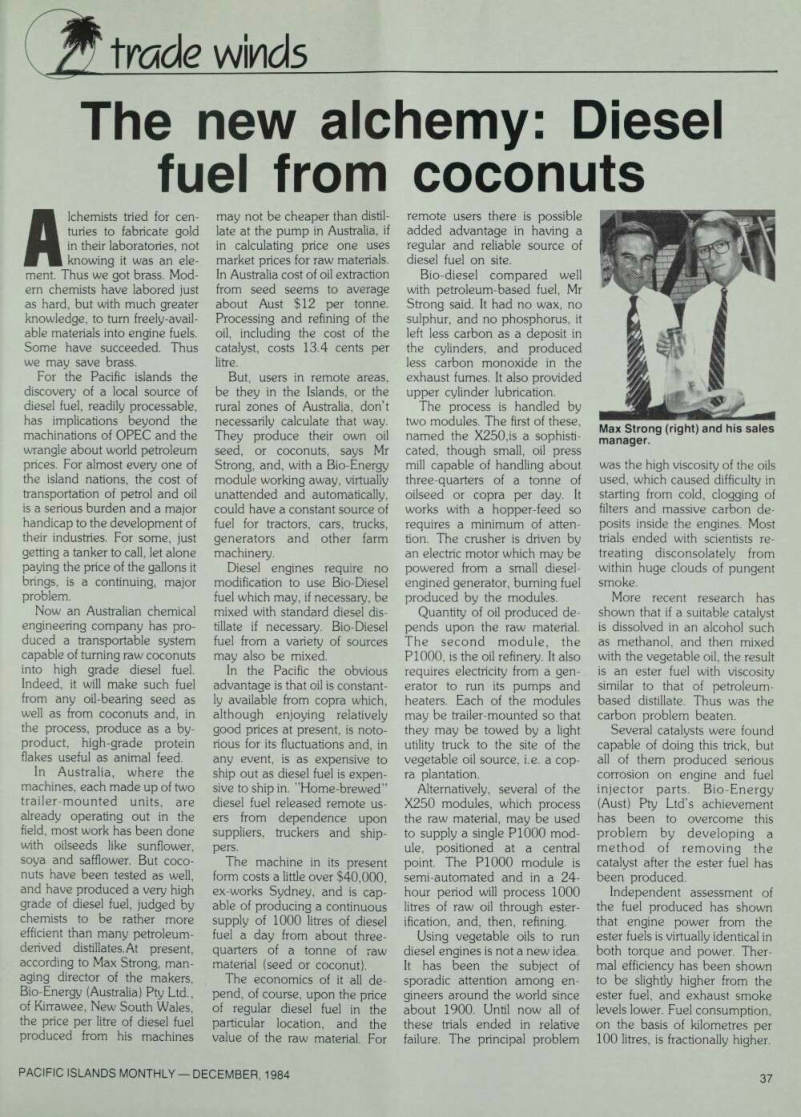
Max Strong (right) and his sales manager.