ship is the star
pp. 33-35 · Read in the full issue

“Bounty” film: A ship is the star
Dino de Laurentiis’s super-col ossal (one is almost tempted to say dinosaurian) remake of the Bounty saga reached Papeete in early October, and is still playing to packed houses. This does not mean that it has met with universal approval, but simply that local people, under standably enough, are very cu rious about a picture shot in such familiar surroundings as Moorea, and often with them selves or their friends as extras.
In addition, the leading lady is a local vahine. This propensity for seeing the picture through Tahitian lenses also applies to us, your PIM chroniclers.
What we are most inclined to criticise from our geographical and anthropological vantage
point is the film’s rather disdain ful use of everything Tahitian solely to create an exotic back ground and atmosphere for the dramatis personae, all of whom are Europeans. Most regret table is the relegation of the leading Tahitian chief at the time of Bligh’s visit, “King” Tu (or Pomare I), to the minor role of master of ceremonies. In any case, the film’s Tahitian ele ments are of very dubious authenticity.
For example, the great “orgy,” which is supposed to epitomise the lasciviousness and sexual freedom for which Tahiti quickly achieved renown, is more like a modern Waikiki floor show than anything else.
And why couldn’t they have
used more authentic and taste ful props? It should have cost no more to copy a few of the many beautiful and often quite spectacular Tahitian art objects found in anthropological
Postmark Papeete
Marie-Therese and Bengt Danielsson
museums throughout the world than to hire a third-rate artist to turn out hideous junk. With a budget of S(JS2S million, the movie-makers could well have afforded better stuff.
Now the producer and his men will laugh at such objec tions and patiently explain to us once more that their aim was not to make an accurate recon struction of pre-European Tahi tian society, but simply to turn out an entertaining movie that would make money. We per sonally see nothing wrong with such a hard-headed business like attitude. But the point is, have they achieved their aim?
We definitely think not. This new version directed by Roger Donaldson is no doubt less boring than the 1962 MGM picture with Trevor Howard as Captain Bligh and Marlon Brando as Fletcher Christian.
But only because it is shorter two hours instead of three and a half.
In no way does it match the excellence of the classic 1935 Bounty film with the incompa rable Charles Laughton in the leading role. From the historical and anthropological points of view, the 1935 version was of course all wrong. But it had a dramatic intensity which held the interest of the spectator from beginning to end. In other words, it had great (commer cial) entertainment value.
Unfortunately, this is simply not the case with the latest remake, and the main fault lies with the script. Yet it was written by Robert Bolt, who rightly shares with David Lean much of the praise heaped on such post-war successes as The Bridge on the River Kwai, Doc tor Zhivago, and Lawrence of Arabia. In the new film, the story of what happened on the Bounty and to its crew rapidly disintegrates into a great num ber of episodes, involving diffe rent people in different places.
Bolt has made the mistake of trying to include all these dispa rate episodes, creating a mosaic, with flashbacks within flashbacks, which is extremely confusing. Another cause of irritation is that the length of the various episodes is often incom patible with their intrinsic im portance. For instance, one of the longest sequences shows in great detail how Bligh and his
loyal companions were attack ed during their brief stay at Tofua by a bunch of Tongan warriors who, incidentally, look like Goroka mudmen. On the other hand, we are offered only a few glimpses of the 3600-mile voyage in the launch to Timor, which represents Bligh’s most tremendous achievement.
Another problem is the cas ting. In a praiseworthy attempt to avoid false stereotypes, Bolt has not portrayed Bligh, as is usually done, as an ill-tempered martinet and inveterate sadist.
But instead of going all the way and presenting him as the com petent and ambitious comman der, with a decidedly scientific turn of mind, that he was, Bolt has only managed to make poor Anthony Hopkins behave like a befuddled nincompoop, which Bligh most certainly wasn’t. As could be expected, the movie-makers were unable to resist the temptation to throw in the usual flogging scenes bathed in gallons of red paint, although they are totally incon gruous on a voyage with such a mild-mannered captain as Anthony Hopkins in command. (Incidentally, on this voyage the real Captain Bligh, right up to the mutiny, had ordered only 11 floggings, with a total of 229 lashes. This is an incredibly low figure by the standards of the late 18th century.)
Without a tyrannical com mander to revolt against, Fletcher Christian becomes a mere shadow boxer, and the mutiny breaks out with the same unaccountable sudden ness as a smallpox epidemic. It is difficult in these circumst ances to blame Mel Gibson for his uninspired performance.
But somebody should at least have told him not to stare constantly at the empty heavens. Or perhaps he was keeping a watchful eye on the coconuts at the top of the palm trees for fear of being hit on the head?
That it was not possible to find a better partner for him than a giggling Tahitian school girl is perhaps a sign of the times. When the MGM com pany shot its remake in Tahiti in 1960-62, Tarita, a strikingly beautiful Tahitian woman with out any previous acting experi ence, played the leading female part so well by simply being herself that she captured the heart of Marlon Brando, and eventually became his wife and the mother of their two now grown-up children. But alas, the young uahines of today have spent all their childhood indoors, bent over school books, and have thus lost the noble bearing and graceful stance of their great-great great-grandmothers. so much
admired by the Bounty men.
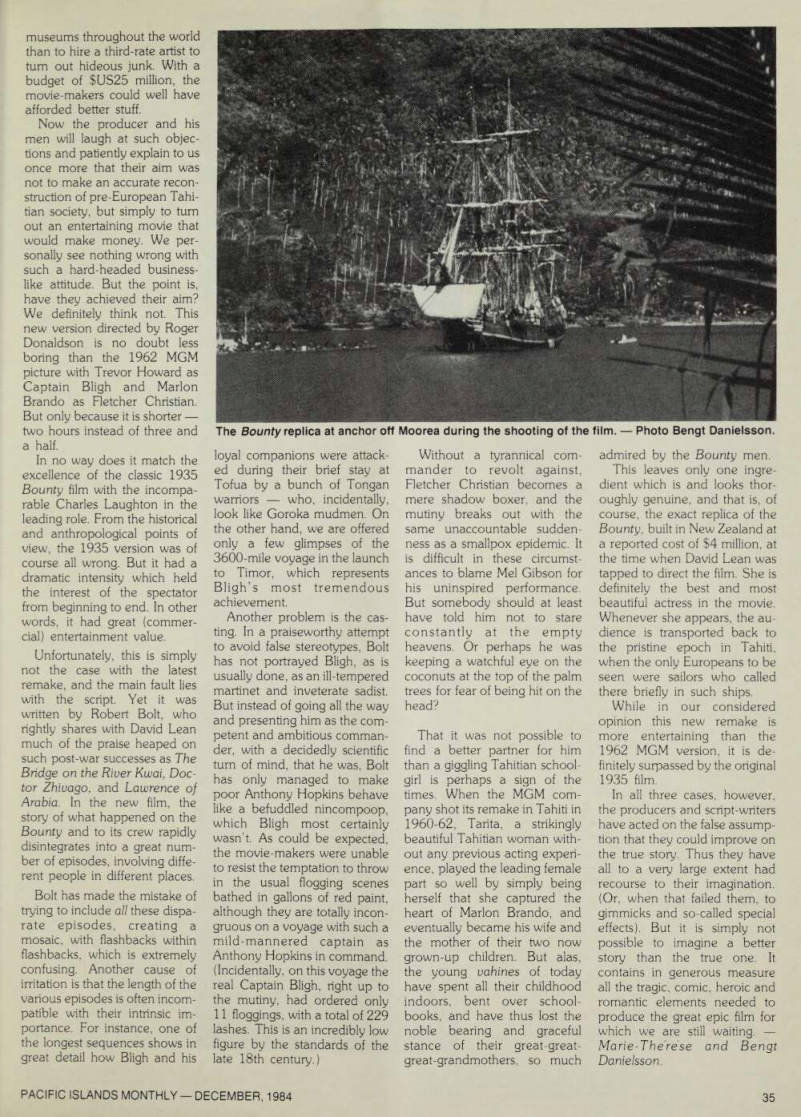
This leaves only one ingre dient which is and looks thor oughly genuine, and that is, of course, the exact replica of the Bounty, built in New Zealand at a reported cost of $4 million, at the time when David Lean was tapped to direct the film. She is definitely the best and most beautiful actress in the movie.
Whenever she appears, the au dience is transported back to the pristine epoch in Tahiti, when the only Europeans to be seen were sailors who called there briefly in such ships.
While in our considered opinion this new remake is more entertaining than the 1962 MGM version, it is de finitely surpassed by the original 1935 film.
In all three cases, however, the producers and script-writers have acted on the false assump tion that they could improve on the true story. Thus they have all to a very large extent had recourse to their imagination. (Or, when that failed them, to gimmicks and so-called special effects). But it is simply not possible to imagine a better story than the true one. It contains in generous measure all the tragic, comic, heroic and romantic elements needed to produce the great epic film for which we are still waiting.
Mahe-There'se and Bengt Danielsson.
The Bounty replica at anchor off Moorea during the shooting of the film.-Photo Bengt Danielsson.