Educator ahead
pp. 31-33 · Read in the full issue
of his time
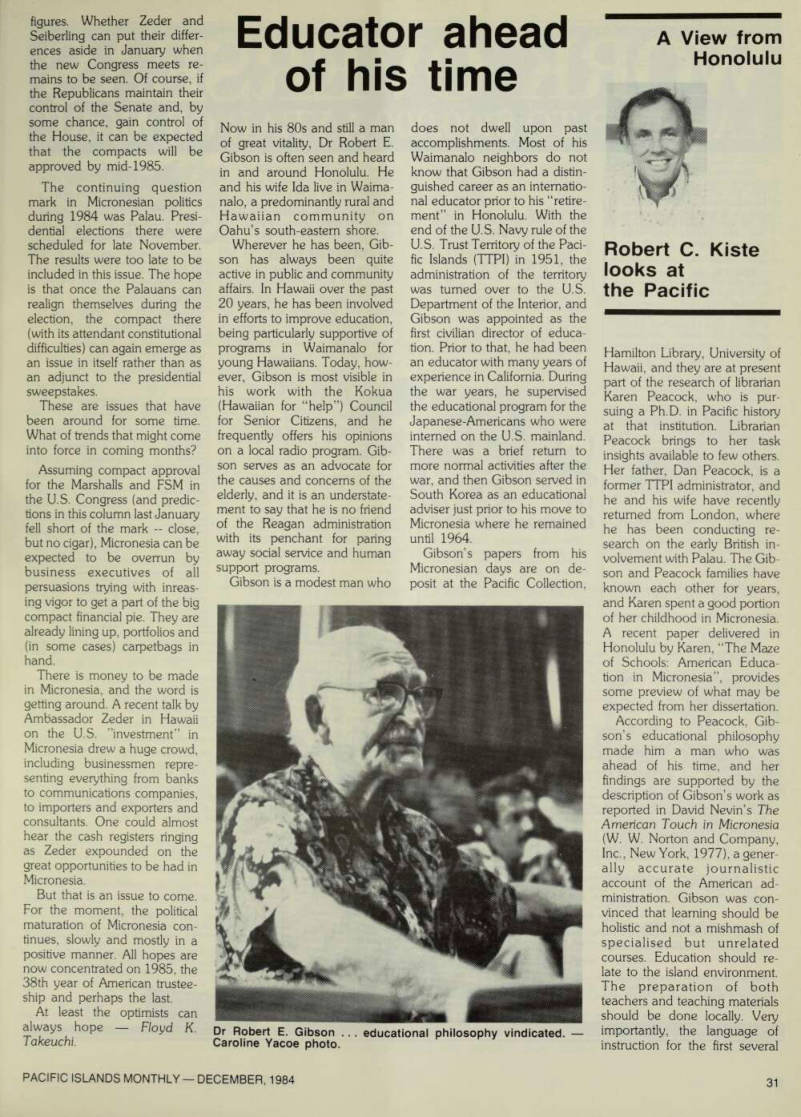
Now in his 80s and still a man of great vitality, Dr Robert E.
Gibson is often seen and heard in and around Honolulu. He and his wife Ida live in Waima nalo, a predominantly rural and Hawaiian community on Oahu’s south-eastern shore.
Wherever he has been, Gib son has always been quite active in public and community affairs. In Hawaii over the past 20 years, he has been involved in efforts to improve education, being particularly supportive of programs in Waimanalo for young Hawaiians. Today, how ever, Gibson is most visible in his work with the Kokua (Hawaiian for “help”) Council for Senior Citizens, and he frequently offers his opinions on a local radio program. Gib son serves as an advocate for the causes and concerns of the elderly, and it is an understate ment to say that he is no friend of the Reagan administration with its penchant for paring away social service and human support programs.
Gibson is a modest man who
does not dwell upon past accomplishments. Most of his Waimanalo neighbors do not know that Gibson had a distin guished career as an internatio nal educator prior to his “retire ment” in Honolulu. With the end of the U.S. Navy rule of the U.S. Trust Territory of the Paci fic Islands (TTPI) in 1951, the administration of the territory was turned over to the U.S.
Department of the Interior, and Gibson was appointed as the first civilian director of educa tion. Prior to that, he had been an educator with many years of experience in California. During the war years, he supervised the educational program for the Japanese-Americans who were interned on the U.S. mainland.
There was a brief return to more normal activities after the war, and then Gibson served in South Korea as an educational adviser just prior to his move to Micronesia where he remained until 1964.
Gibson’s papers from his Micronesian days are on de posit at the Pacific Collection,
Hamilton Library, University of Hawaii, and they are at present part of the research of librarian Karen Peacock, who is pur suing a Ph.D. in Pacific history at that institution. Librarian Peacock brings to her task insights available to few others.
Her father, Dan Peacock, is a former TTPI administrator, and he and his wife have recently returned from London, where he has been conducting re search on the early British in volvement with Palau. The Gib son and Peacock families have known each other for years, and Karen spent a good portion of her childhood in Micronesia.
A recent paper delivered in Honolulu by Karen, “The Maze of Schools: American Educa tion in Micronesia”, provides some preview of what may be expected from her dissertation.
According to Peacock, Gib son’s educational philosophy made him a man who was ahead of his time, and her findings are supported by the description of Gibson’s work as reported in David Nevin’s The American Touch in Micronesia (W. W. Norton and Company, Inc., New York, 1977), a gener ally accurate journalistic account of the American ad ministration. Gibson was con vinced that learning should be holistic and not a mishmash of specialised but unrelated courses. Education should re late to the island environment.
The preparation of both teachers and teaching materials should be done locally. Very importantly, the language of instruction for the first several
Dr Robert E. Gibson ... educational philosophy vindicated.- Caroline Yacoe photo.
A View from Honolulu
Robert C. Kiste looks at the Pacific
years should relate to the island environment. The preparation of both teachers and teaching materials should be done local ly. Very importantly, the lan guage of instruction for the first several years should be the vernacular. Lastly, there should be strong indigenous participa tion by means of village meet ings and school boards, and there should be local support for elementary shcools through taxation.
In the 19505, there was almost universal education at the elementary level (grades one through six); the salaries of teachers and the provision of school buildings (often thatched shelters) were the responsibili ties of local communities. With one exception, each admi nistrative district in the TTPI had a government supported intermediate boarding school (grades seven, eight and nine).
For the elite few who were selected, there was one govern ment supported high school (through grade 12) in the terri tory. A few mission schools supplemented the system of public education.
At the elementary level, a core curriculum concentrated first on the familiar and pro ceeded to the unfamiliar. In the area of social studies, for exam ple, the family and local village were studied first. Next came an examination of the districts of the TTPI and the territory itself, and eventually students went on to look at the larger Pacific and the rest of the world. The vernacular language was the language of instruction during the first four years, and English was introduced as a second language in the fifth and sixth years. The intermediate schools stressed the teaching of English, and it was the only language of instruction at the single high school.
The philosphy behind Gib son’s approach is that students learn best, achieve most, and develop a confidence in their learning abilities when they are first taught in their own lan guage. It is believed that teaching new subjects and reading in the local language facilitates early learning. A skill such as reading is transferable when English is introduced as a second language, and as more instruction begins to occur in English.
In the late 19505, changes began to occur which were not to Gibson’s liking. The High Commissioner of the TTPI in sisted on a more traditional American curriculum at the high school level. In the early 1960 s and with the beginning of the Kennedy administration, the period of large budgets and many special programs for the territory began. Outside experts denied the value of the use of local languages, and American teachers were recruited to intro duce the English language to the entire educational system.
In the face of criticism from the United Nations that very little had been accomplished during the first decade and a half of American rule, officialdom in Washington, D.C., wanted im mediate results and there was a great sense of urgency, so much so that Gibson began to refer to the “hurry-up boys” from the nation’s capital. By 1964, Gibson had had enough, and he retired from the TTPI but not from an active life.
The view of educators who believed in an accelerated Eng lish instruction program had won the day. Also, like peoples elsewhere in the Pacific, it has to be recognised that Microne
sians wanted their children to acquire a greater command of the English language. A good knowledge of English and Western-style education in gen eral were seen as tickets to jobs and high status.
The use of English at the expense of or to the exclusion of the local tongues did not work as well as anticipated, however, and by 1967 a re valuation occured. The vernaculars were once again used as the intial languages of instruction and children were first taught to read in their own languages. English was again taught as a second language.
The Peace Corps trained its many volunteers in this method, and with federal fun ding, Micronesians and linguists at the University of Hawaii collaborated to develop orthog raphies, dictionaries, and gram mars.
Thus educational programs and philosophies in the TTPI had almost come full circle.
There was grudging recognition that the Gibson model had its merits and that attempts to replace indigenous tongues in the classroom are unwarranted for a number of reasons. The latter strategy did not prove
viable in the TTPI, and it is extremely ethnocentric to pre sume that English should be the only language of instruction.
What is one to make of all of this? As has been observed earlier in this column (PIM Oct. ’B3), from the end of World War II until the early 19605, the United States had no overall policy about what future course should be charted for the TTPI.
The American military was con tent as long as other powers were denied access to the is lands. Most others, especially officialdom in Washington D.C., were content to let the TTPI drift along with low budgets and no real sense of direction. This cannot be said of education under Gibson’s ad ministration within the territory.
He was attempting to imple ment an educational program which incorporated a respect for indigenous languages and cultures and which embodied a language policy which appears to have been pedagogically sound. In Karen Peacock’s opinion: “. . . The years from 1951-1961 saw some of the most innovative and creative thinking yet applied to educa
tion in Micronesia.”
Robert
C. Kiste.