'84: A time to test
pp. 29-31 · Read in the full issue
test the waters
December is a time for reflection, and so it is with Micronesia. This has been an eventful, if outwardly quiet, year. No splashy headlines, no fast-changing events to keep
the gossip mills operating at full force.
But the trend of the past two years or so of the slow matura tion of the Micronesian political scene has continued, in most part with good effect. Govern ments in all areas except Palau have moved ahead in spurts and fits, trying to establish themselves without the heavy hand of Washington to show them the way. It has been a time of testing the waters, at home and abroad.
One need look only at the number of foreign contacts these new governments are making to get a feel for the changing expectations of local leaders. Japan is emerging as a major political and economic partner, and that relationship can be expected to be strengthened in coming years.
Certainly Tokyo has been more than willing to look south and offer help. That is good politics, especially considering Japan’s ill-conceived plans to dump low-level nuclear wastes near the Northern Marianas, and good ecomomics given the con
siderable Japanese fishing in terests in Micronesia and else where in the Pacific.
Island leaders in 1984 con tinued their practice of travel ling to other Asian destinations for regional conferences and similar sessions. The impact, while perhaps difficult to gauge in the short term, may be felt over time as these new govern ments introduce themselves as players in their own right with out Uncle Sam prodding them on.
But if Micronesian eyes are turning with more frequency towards the Asian region, there is no doubt that the leaders of the Marshall Islands, the Feder ated States of Micronesia, Palau (and the U.S. Commonwealth of the Northern Marianas), know in their hearts that Washington, D.C., is where the power and the money are. That has not changed.
In that regard, perhaps the biggest disappointment of this rapidly concluding year is the failure of the U.S. Congress to approve the Micronesian free association compacts. The Sen ate came close, very close. But in the waning days of the congressional session (assum ing President Reagan does not call a lame duck session), the compacts were shoved aside for more pressing matters, such as
the federal budget.
The relationships (at least for the Marshalls and FSM), made some progress in the House of Representatives, but there they eventually ran aground on the shoals of partisan politics. A nasty and deeply personal feud has become evident between the chief U.S. negotiator, Fred M.Zeder 11, and the representa tive with the most interest in the Micronesian situation, John Seiberling.
The Micronesian govern ments, understandably, have run for cover, not wanting to get caught in the heavy cross fire between these two powerful
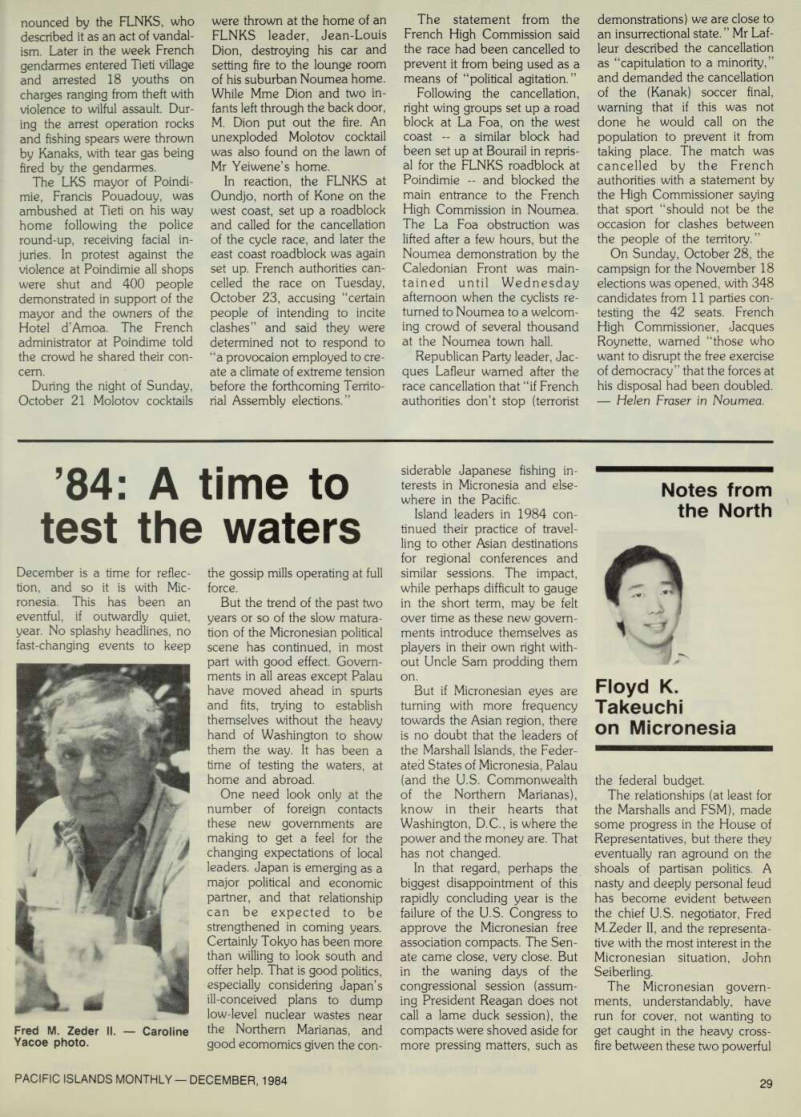
Fred M. Zeder 11. Caroline Yacoe photo.
Notes from the North
Floyd K.
Takeuchi on Micronesia
figures. Whether Zeder and Seiberling can put their differ ences aside in January when the new Congress meets re mains to be seen. Of course, if the Republicans maintain their control of the Senate and, by some chance, gain control of the House, it can be expected that the compacts will be approved by mid-1985.
The continuing question mark in Micronesian politics during 1984 was Palau. Presi dential elections there were scheduled for late November.
The results were too late to be included in this issue. The hope is that once the Palauans can realign themselves during the election, the compact there (with its attendant constitutional difficulties) can again emerge as an issue in itself rather than as an adjunct to the presidential sweepstakes.
These are issues that have been around for some time.
What of trends that might come into force in coming months?
Assuming compact approval for the Marshalls and FSM in the U.S. Congress (and predic tions in this column last January fell short of the mark — close, but no cigar), Micronesia can be expected to be overrun by business executives of all persuasions trying with inreas ing vigor to get a part of the big compact financial pie. They are already lining up, portfolios and (in some cases) carpetbags in hand.
There is money to be made in Micronesia, and the word is getting around. A recent talk by Ambassador Zeder in Hawaii on the U.S. ’’investment” in Micronesia drew a huge crowd, including businessmen repre senting everything from banks to communications companies, to importers and exporters and consultants. One could almost hear the cash registers ringing as Zeder expounded on the great opportunities to be had in Micronesia.
But that is an issue to come.
For the moment, the political maturation of Micronesia con tinues, slowly and mostly in a positive manner. All hopes are now concentrated on 1985, the 38th year of American trustee ship and perhaps the last.
At least the optimists can
always hope
Floyd K.
Takeuchi.