Pacific development
pp. 41-42 · Read in the full issue
ESCAP aims to boost Pacific development
Development of the Pacific Is lands is now attracting a good deal more interest than pre viously from major agencies around the world. Where, once, the occasional adminis trator would wander in from his headquarters in one of the more fashionable capitals, sur vey the scene and depart, there are now resident offices and locally-based experts. The latest of the international agencies to move is ESCAP, the United Nations Economic and Social Commission for Asia and the Pacific.
Fiji, with its good com munications and comfortable living conditions, has always had a fairly large share of international attention but now, Vanuatu is joining it.
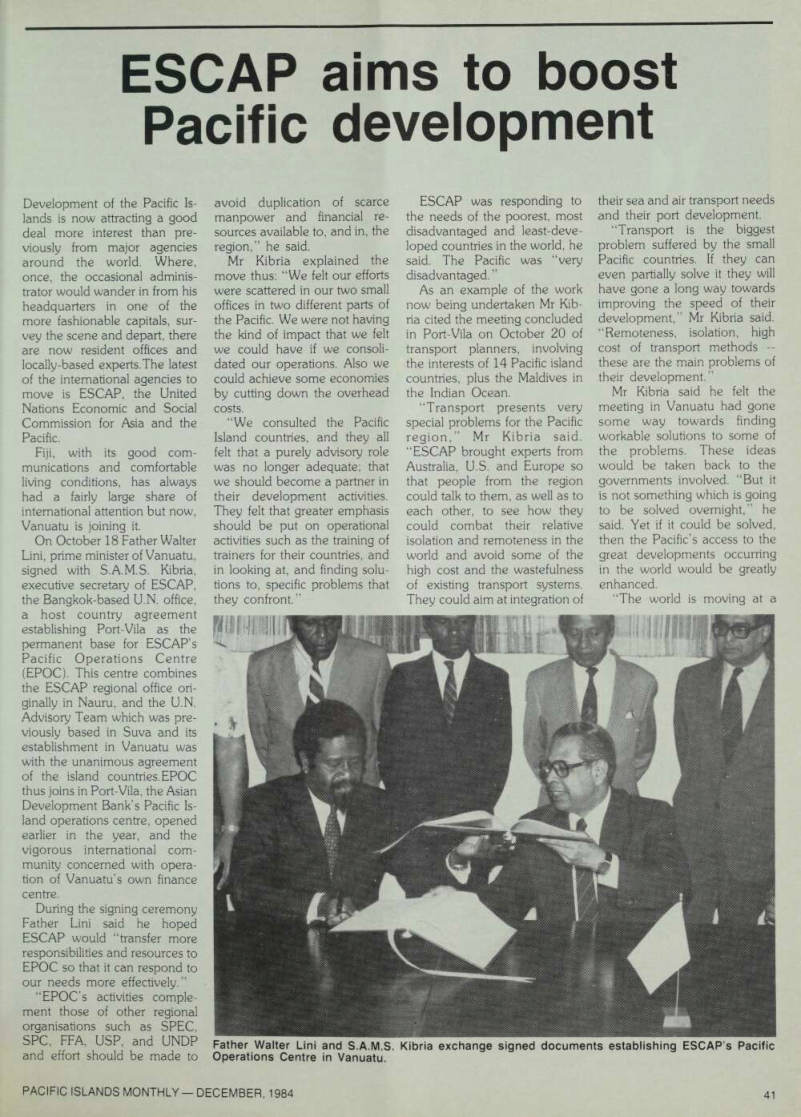
On October 18 Father Walter Lini, prime minister of Vanuatu, signed with S.A.M.S. Kibria, executive secretary of ESCAP, the Bangkok-based U.N. office, a host country agreement establishing Port-Vila as the permanent base for ESCAP’s Pacific Operations Centre (EPOC). This centre combines the ESCAP regional office ori ginally in Nauru, and the U.N.
Advisory Team which was pre viously based in Suva and its establishment in Vanuatu was with the unanimous agreement of the island countries. EPOC thus joins in Port-Vila, the Asian Development Bank’s Pacific Is land operations centre, opened earlier in the year, and the vigorous international com munity concerned with opera tion of Vanuatu’s own finance centre.
During the signing ceremony Father Lini said he hoped ESCAP would “transfer more responsibilities and resources to EPOC so that it can respond to our needs more effectively.”
“EPOC’s activities comple ment those of other regional organisations such as SPEC,
Spc, Ffa, Usp, And Undp
and effort should be made to
avoid duplication of scarce manpower and financial re sources available to, and in, the region,” he said.
Mr Kibria explained the move thus: “We felt our efforts were scattered in our two small offices in two different parts of the Pacific. We were not having the kind of impact that we felt we could have if we consoli dated our operations. Also we could achieve some economies by cutting down the overhead costs.
“We consulted the Pacific Island countries, and they all felt that a purely advisory role was no longer adequate; that we should become a partner in their development activities.
They felt that greater emphasis should be put on operational activities such as the training of trainers for their countries, and in looking at, and finding solu tions to, specific problems that they confront.”
ESCAP was responding to the needs of the poorest, most disadvantaged and least-deve loped countries in the world, he said. The Pacific was “very disadvantaged.”
As an example of the work now being undertaken Mr Kib ria cited the meeting concluded in Port-Vila on October 20 of transport planners, involving the interests of 14 Pacific island countries, plus the Maldives in the Indian Ocean.
“Transport presents very special problems for the Pacific region,” Mr Kibria said.
“ESCAP brought experts from Australia, U.S. and Europe so that people from the region could talk to them, as well as to each other, to see how they could combat their relative isolation and remoteness in the world and avoid some of the high cost and the wastefulness of existing transport systems.
They could aim at integration of
their sea and air transport needs and their port development.
“Transport is the biggest problem suffered by the small Pacific countries. If they can even partially solve it they will have gone a long way towards improving the speed of their development,” Mr Kibria said.
“Remoteness, isolation, high cost of transport methods these are the main problems of their development.”
Mr Kibria said he felt the meeting in Vanuatu had gone some way towards finding workable solutions to some of the problems. These ideas would be taken back to the governments involved. “But it is not something which is going to be solved overnight,” he said. Yet if it could be solved, then the Pacific’s access to the great developments occurring in the world would be greatly enhanced.
“The world is moving at a
Father Walter Lini and S.A.M.S. Kibria exchange signed documents establishing ESCAP’s Pacific Operations Centre in Vanuatu.
fantastic speed in the area of communications and transport,” he said. “The Pacific islands start with a disadvantage. and unless they plan well and ahead of time they will continue to be a long way behind the others. So we in ESCAP are playing a very important catalytic role by bringing them together, trying to create an awareness in the governments, trying to do a bit
of planning and eventually in fluence their decisions.”
Promoting regional and sub regional cooperation was the most basic mandate of ESCAP, said Mr Kibria. “The Pacific Island countries must help each other, must develop self-re liance, must establish mechan isms and institutions which will facilitate cooperation among themselves, “But, and it is a big but, I do
not believe that the Pacific Island countries should be bot tled up in a little enclave, in a large space, of course, but remote from the rest of the world. That is not the way of progress. While regional cooperation must develop in as many fields as possible, these countries must become a part of the mainstream of life in Asia and the international scene generally. And that mainstream is not standing still.
“The only way the small nations of the Pacific can achieve this initially is by associating more and more with the countries of Asia, Australia, New Zealand, Japan, and then, with them, entering fully into international life,” he said.
ESCAP offered a vehicle for achieving this jump, Mr Kibria said, because it embraced not only all of the countries of Asia and the Pacific, but also five non-regional countries as full members; U.S., France, U.K., the Netherlands and the U.S.S.R. These developed countries played a supportive role, provided resources and allowed ESCAP greater range in its activities.
“We also get substantial sup port from Australia which has
been very supportive from the beginning,” he said. Japan had done much and so had New Zealand, although the latter had put most of its effort into the Pacific rather than extending into Asia. The Netherlands and also the Federal Republic of Germany which was not a member of ESCAP both were very generous with their funds and support. So, too, were France, Norway, the U.K. and the U.S.
“All of this represents a pleasant departure from the usual antagonism, Mr.Kibria said. “In ESCAP there is a spirit of cooperation and partnership which is our greatest asset. We do not vote. We decide by consensus and we avoid politi cal controversies.”
ESCAP was the only regional organisation which brought all of the Asia-Pacific countries to gether, he said. “Global forums do not serve the same purpose, because they are dominated by the great powers and any re gion’s problems are seen in the context of their interests in Europe, or the Soviet Union or Africa or the Americas. But in ESCAP nothing is too small and their special problems are very important to us.”
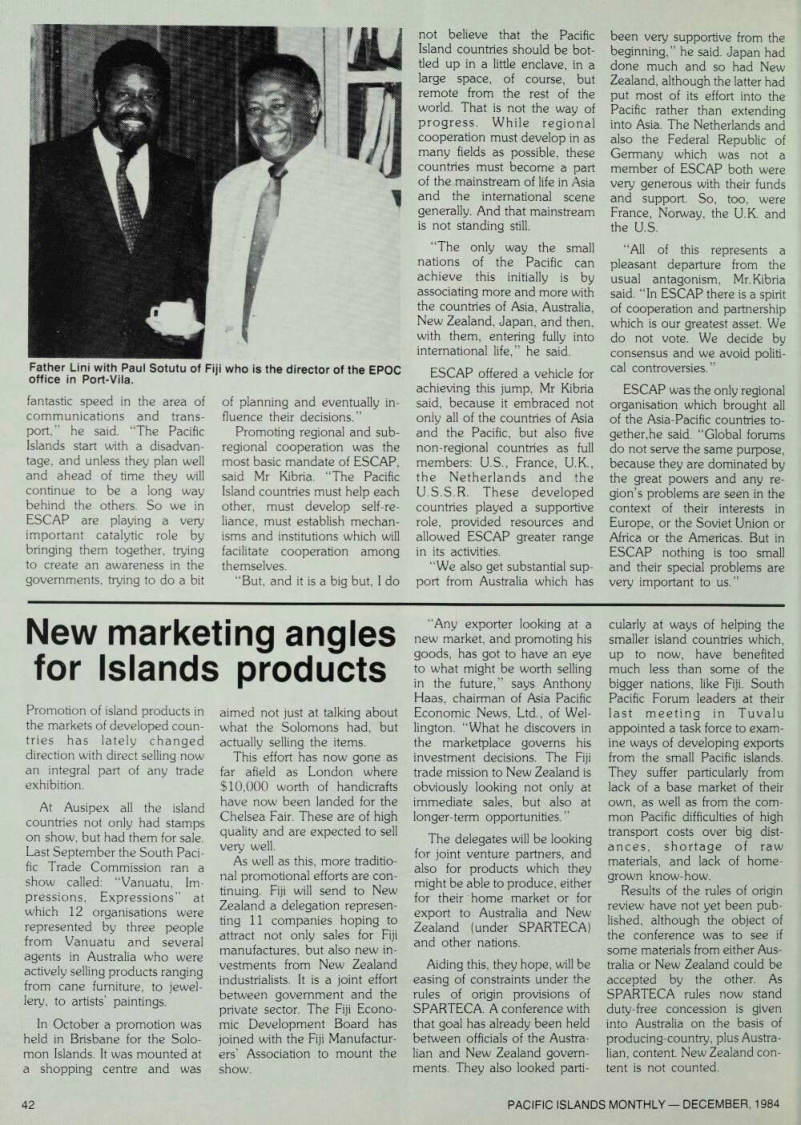
Father Lini with Paul Sotutu of Fiji who is the director of the EPOC office in Port-Vila.