Santo Town Sunday
pp. 55-56 · Read in the full issue

tropicalities
Making the most of a Santo Town Sunday
A South Seas Sabbath, unless one is a committed member of one of the dozens of variants of Christianity practised in the is lands, is not every traveller’s idea of a good time. Cruise boats, and some regional air lines, are inclined to omit Sun day from their landing sche dules, and tired jokes “I was in Nukualofa (or Apia or Port Vila. . .) one Sunday, but it was closed” become still more weary with repetition. A Sun day spent in Luganville, or Santo Town, Vanuatu, then, promised to be dreary indeed.
But we were in Santo for four days three more than neces sary, said some and Sunday was one of them. How then to occupy it? Lacking the offices of the young guide who’d been empowered to “look after” us but had vanished immediately after first contact, we decided on the town tour and pro
ceeded to walk to the end of the apparently endless rue Higgin son or at least as far as seemed necessary to assess Santo Town’s character.
The main street was conspi cuous for its total lack of peo ple, and for the remarkable number of “Chinese” though some were Vietnamese shops which line each side.
We counted 33, many of them once ambitious, but now look ing dispossessed and dowdy.
Some were huge, almost caver nous, their dim lighting adding to the prevailing feeling of gloom. All were multi-purpose emporia like most Chinese en terprises in the islands seem to be: why concentrate on clo thing when a customer might need a can of mackerel and why on tinned fish when he may require a cane knife or a hurricane lamp? Their exclu sion from copra trading by new
government regulations, which require such trade to be in indigenous hands, means that the out-moded clothing and other junky trade goods which were once destined for remoter islands or villages remain in the stores, giving them an increasingly claustrophobic feeling.
Charter yachts Eye of the Wind and Congoola were both in the harbor, and both presumably containing divers.
Why else would one come to Santo except to “dive on” the President Coolidge or Million Dollar Point, that rusting monument to American notions of obsolescence?
Luganville gives no indication that Espiritu Santo was once thought, and still is by some, to be the economic heart of the country. “They ruined it you know. They should ask the French planters to come back,”
we were told often enough by people whose political sensibili ties struck me as strange, to say the least, But there are curious con tradictions. An apparent awakening of civic pride has resulted in the new sign-posting of every street running off the main thoroughfare. As a result the town is graced by names such as Bougainville, Cook, Dumont-d’Urville and La Perouse. De Gaulle and Chur chill are here too, as is Pasteur a contrast to the capital Port-Vila which contains no street signs at all. In Luganville rue Higginson has not yet be come Kumul Highway or Inde pendence Avenue, The only town map we were able to obtain was several years out of date and made the town seem like a far more significant commercial centre than it actually is. It did, however,
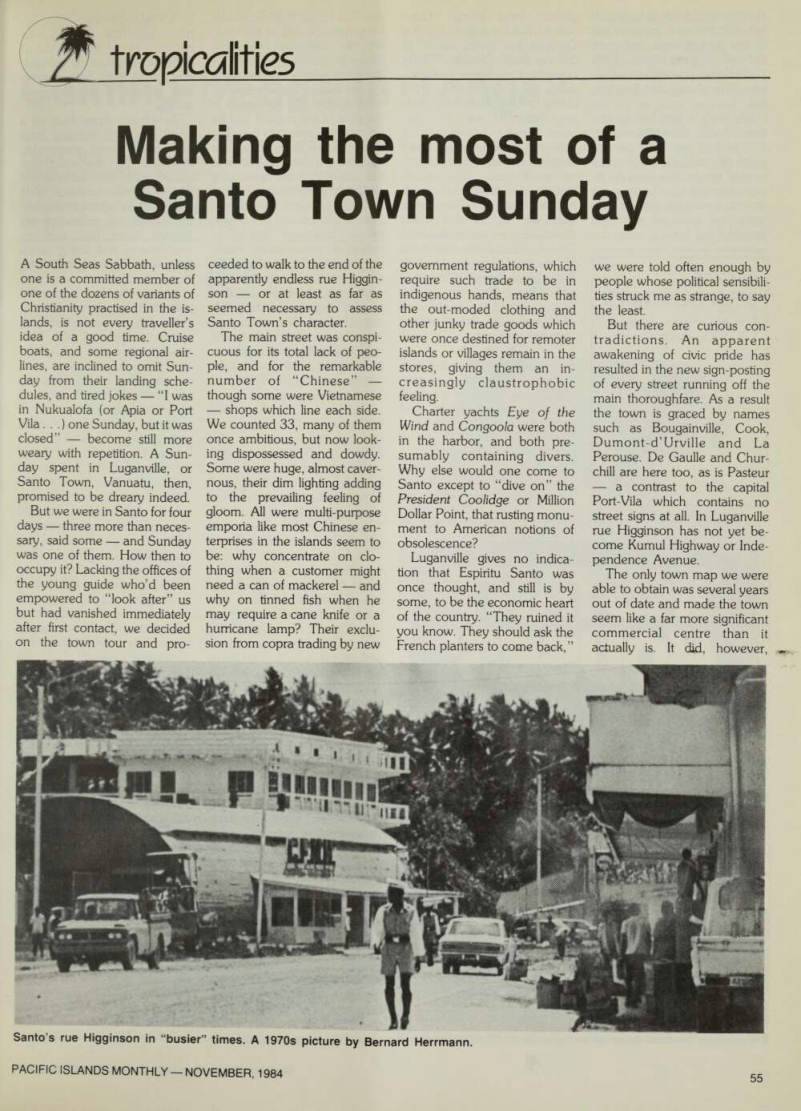
Santo’s rue Higginson in “busier” times. A 1970 s picture by Bernard Herrmann.
indicate that most of Luganvil le’s churches were more or less in one part of town, and there seemed no good reason, 1980 “rebellion” notwithstanding, why they should not be there still.
We were a day late for the Seventh-day Adventist service, and at least an hour late for some others. But there were still people around the large Angli can complex, chatting in groups, seemingly reluctant to leave and break off what was possibly the week’s most im
portant social contact. There was a small congregation in the Quonset hut which serves as the Apostolic Church. “Thirty committed members and hun dreds of nominal ones,” the chatty young Australian “hel per” informed me. Two mi nutes into the conversation he delivered his testimony like a Mormon missionary or a Jeho vah’s Witness. The older “traditional” churches, he said, had lost touch with the people, but God was now speaking directly to them in the Apostolic Church through his son Jesus Christ. (And how long before that church became “traditio nal”?) But I didn’t ask, feeling that it would never be big enough to settle into comfort able orthodoxy. • • • So many uses for Quonset huts in Santo. Beside the small one, which now began to reverber ate to an amplified guitar and some desultory hymn-singing, was one four times the size, a Burns Philp warehouse, or “dock” as it is often called here.
Around the comer another large Quonset hut served as
premises for the French printery Imprimerie Socom at one end, and the Holiness Fellowship Church at the other storefront religion indeed. One toddler among the overflowing congregation was so startled at the sight of my camera that he fell over attempting to flee. The small children, dragged by their mothers as a matter of course to the often long services, play outside or crawl restlessly about the aisle. They are always dres sed in flamboyantly bright, almost iridescent clothes of nylon or some other totally inappropriate Taiwanese synth etic. (In India last year we had decided that the Indian children in their brightly striped jump suits looked like humbugs.
Here, less co-ordinated, the kids looked like jelly beans, or perhaps like liquorice allsorts multi-colored in the centre and black at the extremities.) Further up the road the Catholic church was large of size but dull of service. The Assembly of God was open, but devoid of people. They were having a street meeting at 4 p.m., said the pastor, a tall, very black, fine-featured man who shook my wife’s hand and hoped God would bless her.
At 4 p.m. we went down to the designated place for the street meeting outside the Burns Philp store! This was surely the definitive South Seas encounter of God and Mam mon. The Assembly arrived and set up at 4.30. Two teen age boys played guitars through wildly distorted amplifiers, and a reverb switch made the two or three singing voices sound like a large congregation in a rail way tunnel. The effect, far from being pathetic was strangely moving, and made even more so by the fact that the two of us were the only audience in Luganville’s wide, limitless, main street.
The preaching and singing was, of course, in Bislama, and what an ideal language it is for this kind of exercise: simple, repetitive and containing the occasional illustrative phrase that turns it into rudimentary poetry. Converts from Rente cost!!) and Malakula spoke fervently and at length about their conversions; the former, Solomon, dressed rather like a color blind country and western singer, the latter a conservative
ly attired policeman who de nounced the power and authority of civil law in order to affirm the might of the spiritual, and broke into both English and French to get his point across.
To whom? Apart from us a small group of teenage boys had now gathered, presumably attracted by the electronic rather than the ecclesiastical quality of the occasion, and appeared considerably discom fited when the policeman in formed them that drinking, womanising and string bands were not the stuff of which life should consist.
Across the road, under the Asia Club Disco sign, a group of Gilbertese girls looked amused at the spectacle of us in such close proximity to the Assem bly. They were even more amused when we began to clap our hands in time to the Assem bly’s revivalist hymns.
Three untidy female tourists with grubby shorts and small backpacks glued to their spines wandered by, looked at the faithful and then at us, took a picture and departed. By this time I myself had taken several.
The brilliant white backdrop of BP’s roller doors seemed like the perfect setting for a black skinned and colorfully attired religious group. Had they chosen the location because it was central? Or because its shinier-than-pure whiteness turned the performance into such good theatre?
An hour after it began, it was over and after a short, silent prayer among themselves, the Assembly dispersed. The females withdrew to their chil dren, but the males in the group pastor, testifiers and musi cians came over and shook our hands, addressing us as “brother” and “sister. ” I offered the pastor a donation: “Mi givem smol moni long church blong yu. “That’s very kind of you,” he replied, in English far better articulated than my Bisla ma, and assured us that they had been delighted to see us there.
Not nearly as delighted as we had been, I thought . . . We walked off into the late afternoon, reflecting on the fact that, after all, a Sunday in the South Seas can still provide experiences of considerable in
terest.
Norman Douglas.