as they do in Rome . . .
pp. 51-54 · Read in the full issue

Look at no calendars, reason not as they do in Rome . . .
By now the sun is already down and it’s obvious that we won’t reach the sea before tomorrow.
I walk the last part held fast by the hand by Ben, who tows me and restrains me better than a crane.
We get to a group of houses where we ask for shelter for the night There is no problem, a place to sleep is found and we all eat together, sharing the food. Marco buys a chicken which is soon in the pot Two brothers and their re spective wives live here, and among the two couples they have 14 children, the eldest 14 years old. We chat the two men also speak English. Only our three travelling companions stay quiet in a dark comer, almost hidden. They are Kwaios and our three new friends are Kwarae, and their respective grandfathers used to kill each other . . .
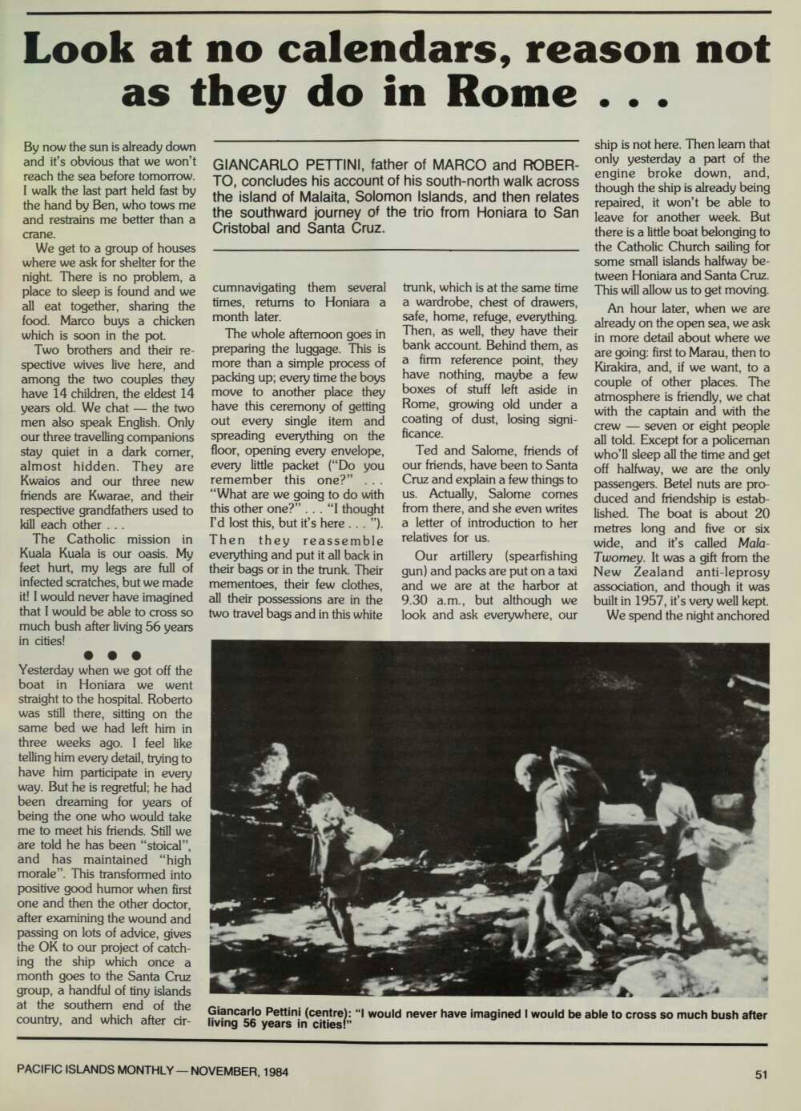
The Catholic mission in Kuala Kuala is our oasis. My feet hurt, my legs are full of infected scratches, but we made it! I would never have imagined that I would be able to cross so much bush after living 56 years in cities! • • • Yesterday when we got off the boat in Honiara we went straight to the hospital. Roberto was still there, sitting on the same bed we had left him in three weeks ago. I feel like telling him every detail, trying to have him participate in every way. But he is regretful; he had been dreaming for years of being the one who would take me to meet his friends. Still we are told he has been “stoical”, and has maintained “high morale”. This transformed into positive good humor when first one and then the other doctor, after examining the wound and passing on lots of advice, gives the OK to our project of catch ing the ship which once a month goes to the Santa Cruz group, a handful of tiny islands at the southern end of the country, and which after dr-
GIANCARLO PETTINI, father of MARCO and ROBER TO, concludes his account of his south-north walk across the island of Malaita, Solomon Islands, and then relates the southward journey of the trio from Honiara to San Cristobal and Santa Cruz.
cumnavigating them several times, returns to Honiara a month later.
The whole afternoon goes in preparing the luggage. This is more than a simple process of packing up; every time the boys move to another place they have this ceremony of getting out every single item and spreading everything on the floor, opening every envelope, every little packet (“Do you remember this one?” . . .
“What are we going to do with this other one?” ... “I thought I’d lost this, but it’s here . . . ”).
Then they reassemble everything and put it all back in their bags or in the trunk. Their mementoes, their few clothes, all their possessions are in the two travel bags and in this white
trunk, which is at the same time a wardrobe, chest of drawers. safe, home, refuge, everything.
Then, as weU, they have their bank account. Behind them, as r. , . . ,■* a firm reference point, they , ... u x ave no mg may e a ew boxes of stuff left aside in D , Rome, growing old under a coating of dust, losing signicance ' Ted and Salome, friends of our friends, have been to Santa Cruz and explain a few things to us. Actually, Salome comes from there and she even writes a letter of introduction to her relatives for us.
Our artillery (spearfishing gun) and packs are put on a taxi and we are at the harbor at 9.30 a.m., but although we look and ask everywhere, our
ship is not here. Then leam that only yesterday a part of the engine broke down, and, though the ship is already being repaired, it won’t be able to leave for another week. But there is a little boat belonging to the Catholic Church sailing for some small islands halfway be tween Honiara and Santa Cruz.
This will allow us to get moving.
An hour later, when we are already on the open sea, we ask in more detail about where we are going: first to Marau, then to Kirakira, and, if we want, to a couple of other places. The atmosphere is friendly, we chat with the captain and with the crew seven or eight people all told. Except for a policeman who’ll sleep all the time and get off halfway, we are the only passengers. Betel nuts are pro duced and friendship is estab lished. The boat is about 20 metres long and five or six wide, and it’s called Mala- Twomey. It was a gift from the New Zealand anti-leprosy association, and though it was built in 1957, it’s very well kept We spend the night anchored
Giancarlo Pettini (centre): “I would never have imagined I would be able to cross so much bush after living 56 years in cities!”
in the little bay of Here, and at dawn the boat penetrates a small group of islands, some of them quite tiny, in a sea as flat as a board. The tiny islands are green specks, with thick vegeta tion up to the point where the water starts, and short beaches of light-colored sand a few metres from the palms.
The big clouds are the color of lead, the sea is dark; in the early morning silence we can hear only the toof-toof of our motor (cruising speed 7.5 knots). After about two and half hours we are on Marau. At a short distance from the station, at the head of a placid bay, there is Makina Catholic Mis sion.
The priest is not there. He’s gone to Marau where a sports meeting starts today involving all the schools in the province, with competitions and so on . . . apparently a very important event.
As it happened, Father Da mian Everwin, called Tony, a German from the north, left everything and returned in a hurry as soon as he learned of
our arrival. He’s obviously happy to see us here, and overwhelms us with kindness, stuffing us with good things to eat. The nun “in charge” is a large Solomon Islander lady, with big lips and large round eyes. She is “as good as the bread” and has always been the housekeeper in charge of everything. She’s an exact copy of the “Mammy” from the American Deep South of the 1800 s, including the baritone voice. She always marches at the head of the single file of her three helpers, young girls who follow her in order of size, carrying on their heads trays with plates and food. The pro cession is repeated at breakfast, lunch and dinner: three times up, and three times down with empty plates. • • • Thirteen hours of navigation to get from Marau to Kirakira, San Cristobal Island, 13 hours of sea-sickness. As soon as it’s outside the lagoon, the boat starts pitching up and down, painfully, and in less than an hour the whole breakfast Father
Tony had lovingly prepared for us while it was still dark fried eggs, bread and butter, cake and coffee and milk ends up among the fish. It is already night when we arrive. In the dark, the dinghy breaks off from the boat and takes us and our luggage to the shore . . .
We are still in Kirakira, waiting for a boat to take us to Santa Cruz, and we don’t know when one will come the information we get is very vague.
Kirakira is the chief town of one of the eight provinces that make up the State of Solomon Islands. It’s an administrative centre rather than a small town, and you see around a few officials and clerks, in shirts and trousers, and very few children, Yet we feel cut off from the rest of the world; the island of San Cristobal is large but half deserted, there are no roads except a short stretch to some nearby village, and so there is practically no means of transport at all.
We spend much of our time in the rest-house, a large,
wooden, colonial style building, the only one in the station built in this manner. According to notes left by previous visitors in the faded visitors’ book, the ghost of a girl should be around. But up to now she has given no sign of her presence. A bald, toothless old man watches affectionately over all guests, He’s energetic and full of initia tive. His name is Andrew and on request he is porter-waiter manager-watchman-cook, re sponsible for everything. Al ways cheerful and ready, you can pass him a hundred times, and each time he’ll greet you in a loud voice, With his long arms, his hands look like canoe paddles, There’s a lighted pipe always in his mouth, and he always has something to do. If he’s not busy in the kitchen, there he is, energetically sweeping the hall, using the same big broom indis criminately first on the floor, then on the lounges, on the dining table, then on the walls and, finally, completing his rotating movement, on the ceiling.
More days go by in our passive stay, with nothing to do except go shopping, do the cooking, and wash our clothes.
The place offers no matter of interest, and the people seem not to have any desire to chat.
One afternoon, I tell my whole life story to my boys, starting from my childhood, and all I can remember of my parents’ life. It’s a handing down of memories orally, in the same fashion as the village elders do it. As for the rest, we try to accept the situation in the best possible spirit.
From the verandah we scan the deserted ocean like the character in “Madame Butter fly”, who waits for the “thread of smoke” of her lover’s ship • • • In the early years of this cen tury, in spite of the prohibition imposed by the British Pro tectorate in 1893, the slave trade was still practised. The ships came to the coast, the crews entered the villages, car ried off the local men, locked them in the ship’s hold and sailed off again towards the plantations in Australia and Fiji.
During one of these raids, a ship sank in a typhoon just as it was getting out into the open sea and two village chiefs who had been caught up in th group drowned with the men. The local people decided that they had to have the heads of two whites as compensation for the two drowned chiefs.
They waited one, two years, until a new ship came to recruit more- men. It was easy to lure the whites into the bush and to smash the heads of two of them. After a while, the govern ment sent an officer and a number of soldiers to catch the guilty person, who naturally ran away into the bush at the first hint of their arrival. The British officer installed himself on the coast, built his headquarters (which is now this rest-house), and waited. At some stage, tired of waiting, he captured the whole population of the “guilty” villages and had everyone deported to another island. When the killer saw his villages deserted, he decided he’d better give himself up. He was tried and hanged, and the population were allowed to re-
turn to their homes.
The station on the coast remained, however, as did the British officer, who married a local girl and lived the rest of his days in Kirakira. • • • In the meantime, slowly but surely, we realise that the mood of impatience is passing, the disappointment about our initial plans which had been stopped dead in their tracks is now tempered by the stillness around us. You realise that boredom is not a suitable coat to be worn here, and almost to your surprise you find yourself stripped of it. The dimensions of time, as you are used to measuring them have no more value; a week, a month count no more than an hour or a day it’s the same feeling I had in the bush in Malaita, the discov ery of being able to enter a world of different rhythms, and to begin to absorb them.
Up there, there was a sea of green, here there is an immense stretch of water, and the same palpable sense of eternity, alive but still. When confronted by that, to look at the calendar, or to reason with the mind of a Roman, is simply ridiculous. • • • After 10 days of waiting, the Church of England boat mira culously appears in the bay; it’s ready to take us on board, and tonight it will sail for the island of Santa Cruz.
Yesterday afternoon, after several nights of high tempera tures, I had a blood test and today, just before leaving, I am
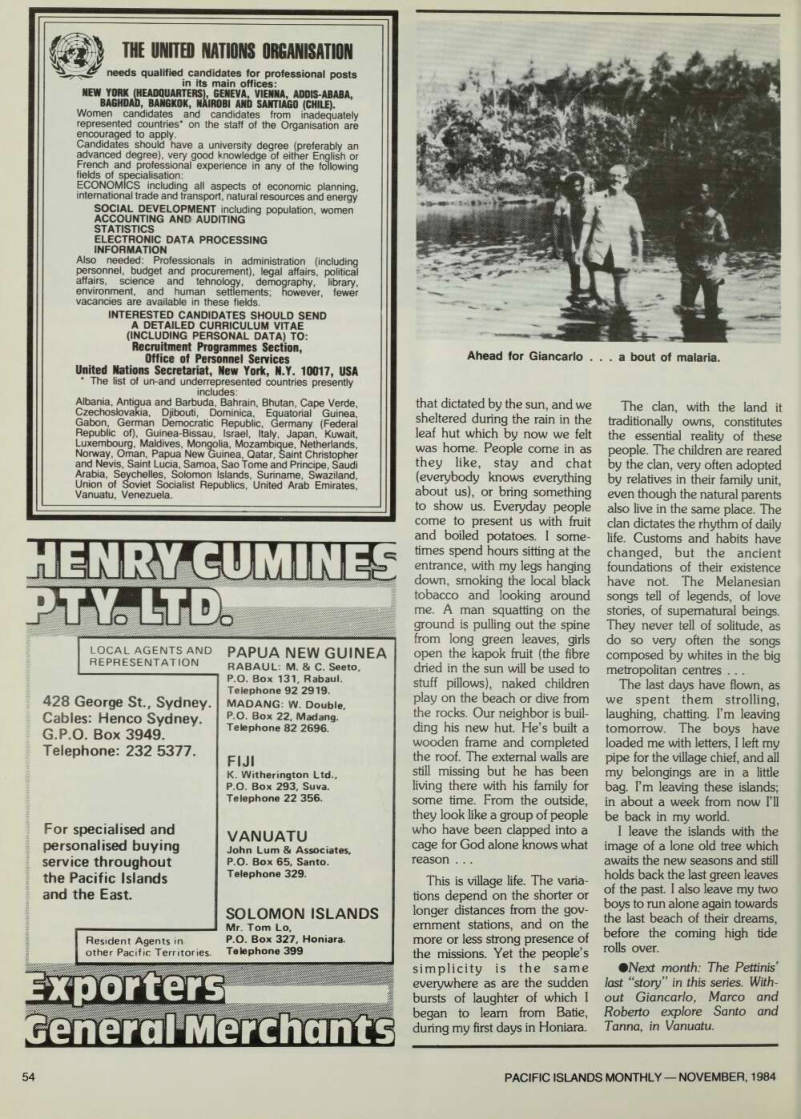
told that the fever has been due to bouts of malaria.
Forty-two hours without touching food, without drinking a drop of anything, without smoking, lying on a bench in the galley. All I had were the tablets given to me by the national anti-malaria service. I got up every now and then to urinate and to throw up. Two days and two nights of rough seas, rain and wind that was the voyage from Kirakira to Santa Cruz.
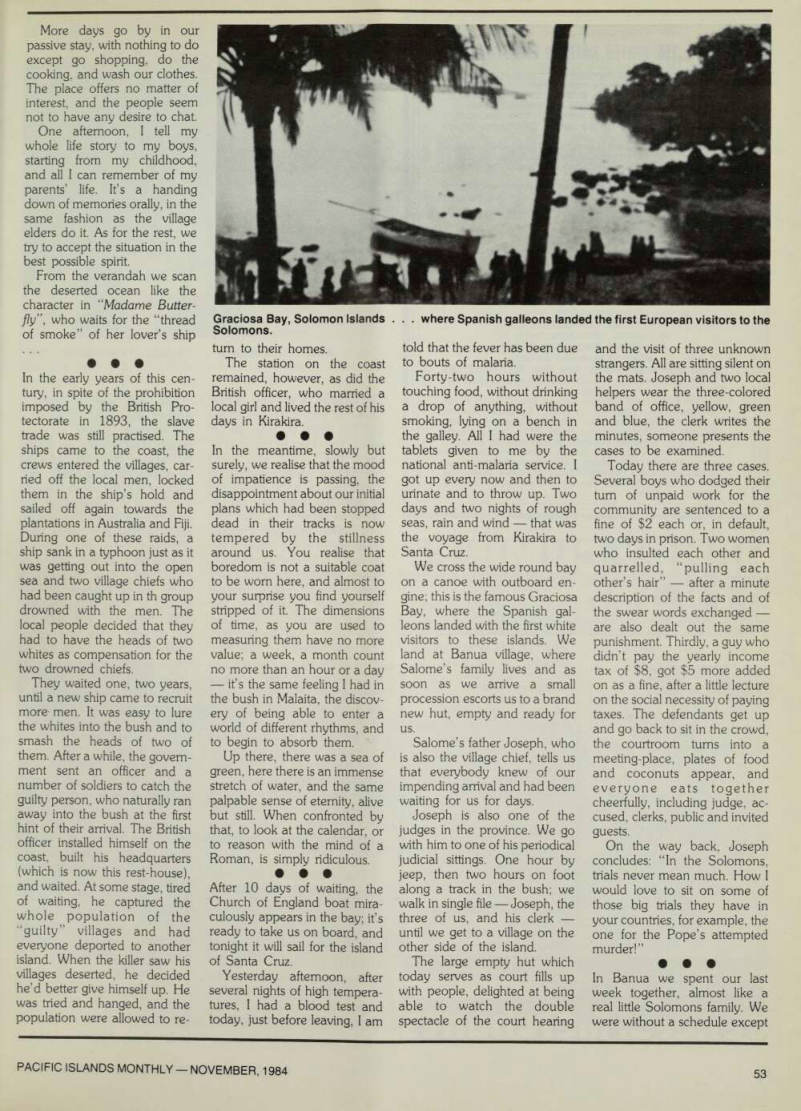
We cross the wide round bay on a canoe with outboard en gine; this is the famous Graciosa Bay, where the Spanish gal leons landed with the first white visitors to these islands. We land at Banua village, where Salome’s family lives and as soon as we arrive a small procession escorts us to a brand new hut, empty and ready for us.
Salome’s father Joseph, who is also the village chief, tells us that everybody knew of our impending arrival and had been waiting for us for days.
Joseph is also one of the judges in the province. We go with him to one of his periodical judicial sittings. One hour by jeep, then two hours on foot along a track in the bush; we walk in single file Joseph, the three of us, and his clerk until we get to a village on the other side of the island.
The large empty hut which today serves as court fills up with people, delighted at being able to watch the double spectacle of the court hearing
and the visit of three unknown strangers. All are sitting silent on the mats. Joseph and two local helpers wear the three-colored band of office, yellow, green and blue, the clerk writes the minutes, someone presents the cases to be examined.
Today there are three cases.
Several boys who dodged their turn of unpaid work for the community are sentenced to a fine of $2 each or, in default, two days in prison. Two women who insulted each other and quarrelled, “pulling each other’s hair” after a minute description of the facts and of the swear words exchanged are also dealt out the same punishment. Thirdly, a guy who didn’t pay the yearly income tax of $B, got $5 more added on as a fine, after a little lecture on the social necessity of paying taxes. The defendants get up and go back to sit in the crowd, the courtroom turns into a meeting-place, plates of food and coconuts appear, and everyone eats together cheerfully, including judge, ac cused, clerks, public and invited guests.
On the way back, Joseph concludes: “In the Solomons, trials never mean much. How I would love to sit on some of those big trials they have in your countries, for example, the one for the Pope’s attempted murder!” • • • In Banua we spent our last week together, almost like a real little Solomons family. We were without a schedule except
Graciosa Bay, Solomon Islands . . . where Spanish galleons landed the first European visitors to the Solomons.
that dictated by the sun, and we sheltered during the rain in the leaf hut which by now we felt was home. People come in as they like, stay and chat (everybody knows everything about us), or bring something to show us. Everyday people come to present us with fruit and boiled potatoes. I some times spend hours sitting at the entrance, with my legs hanging down, smoking the local black tobacco and looking around me. A man squatting on the ground is pulling out the spine from long green leaves, girls open the kapok fruit (the fibre dried in the sun will be used to stuff pillows), naked children play on the beach or dive from the rocks. Our neighbor is buil ding his new hut. He’s built a wooden frame and completed the roof. The external walls are still missing but he has been living there with his family for some time. From the outside, they look like a group of people who have been clapped into a cage for God alone knows what reason . . .
This is village life. The varia tions depend on the shorter or longer distances from the gov ernment stations, and on the more or less strong presence of the missions. Yet the people’s simplicity is the same everywhere as are the sudden bursts of laughter of which I began to learn from Batie, during my first days in Honiara.
The clan, with the land it traditionally owns, constitutes the essential reality of these people. The children are reared by the clan, very often adopted by relatives in their family unit, even though the natural parents also live in the same place. The clan dictates the rhythm of daily life. Customs and habits have changed, but the ancient foundations of their existence have not. The Melanesian songs tell of legends, of love stories, of supernatural beings.
They never tell of solitude, as do so very often the songs composed by whites in the big metropolitan centres . . .
The last days have flown, as we spent them strolling, laughing, chatting. I’m leaving tomorrow. The boys have loaded me with letters, I left my pipe for the village chief, and all my belongings are in a little bag. I’m leaving these islands; in about a week from now I’ll be back in my world.
I leave the islands with the image of a lone old tree which awaits the new seasons and still holds back the last green leaves of the past. I also leave my two boys to run alone again towards the last beach of their dreams, before the coming high tide rolls over. •Next month: The Pettinis’ last “story” in this series. With out Giancarlo, Marco and Roberto explore Santo and Tanna, in Vanuatu.
Ahead for Giancarlo ... a bout of malaria.