Coming of age in Tonga?
pp. 57-58 · Read in the full issue
The F.S.P.
Canon REX DAVIS, honorary secretary of the United Kingdom Foundation for the Peoples of the South Pacific (FSP), was in the South Pacific in September to witness the emergence of the “Tonga Covenant.” He explains in the following article he wrote for PIM.
September, 1984, saw the emergence of a new form of international development or ganisation in the South Pacific.
Called the “Tonga Cove nant” (the founding conference was held in Nukualofa) it repre sents a commitment by a num ber of small, young but energe tic development groups in the South Pacific island states to work together more co-oper atively. The text of their state ment reads; “We covenant to gether to work for a new structure within the Pacific to enhance the cooperation for human development with the peoples of the South Pacific.”
It was Tongan Roman Catholic Bishop Patelisio Finau who proposed the rather
Methodist-sounding word
“covenant.” Responding to a paper given at the conference by the Executive Director of the Foundation for the Peoples of the South Pacific (FSP), Dr S.
W. Hosie, Bishop Finau said that there could be tremendous power if the various aid and development groups could un ite and work together. There was, he said, a real need to listen to each other. “There is a soul to development,” he said “which involves the idea of community, of serving, of com mitment.” In that context he suggested that the time had come for some “covenant” to work together.
Perhaps the first of the mem ber organisations was the South Pacific Appropriate Technology Foundation proposed by Jean Kekedo, Pedi Anis and Tony Power at an FSP meeting on appropriate technology held in the 1970 s in Fiji. SPATF has emerged as a significant net work in Papua New Guinea, supported both by the govern ment and outside agencies, in
eluding FSP.
In Vanuatu the Nasonal Kommuniti Developmen Trust (NKDT) grew naturally out of an earlier initiative from Father Walter Lini and Sethy Regen vanu before independence. It was officially launched in 1980 with FSP as a partner agency providing training and technical assistance under a grant from the United States consortium, Private Agencies Collaborating Together (PACT).
The Fiji Community Deve lopment Trust was started in 1979 and formally registered in 1982 with Joseph Kamikamica, Serenade Vunibobo, and Sione Havea as the founding trustees.
The Solomon Islands Deve lopment Trust also took time to take shape, but this was formal ly registered in 1981 and since 1982 has grown rapidly. Asto nishingly, by 1984 it had a staff of 80, and is a major force in village development work in the Solomons. Again PACT gave support through FSP in the early years, but the Australian Development Assistance Bureau (ADAB) is now a major contributor.
The National Federation of Women of Kiribati (AMAK) grew during the 19705, with support from the Women’s Ex tension program of the govern ment of Kiribati. A USAID grant through FSP assisted AMAK in spreading its work, recruiting staff and building an important resource centre in Tarawa.
The Tonga Foundation for the Peoples of the South Pacific is the most recent national institution. Dr Sione Amanaki Havea, Bishop Patelisio Finau, and Mrs Papiloa Foliaki are its local trustees. Registered in De cember 1982 it also received core budget support from a
USAID grant to FSP.
While each of these trusts is autonomous, they have in some way or another been part of a loose family supported by FSP in New York. At the same time other autonomous trusts were set up according to re spective national laws, so that what had been an agency of the New York FSP in Australia became an autonomous trust as the Australian FSP in 1982.
The South Pacific Peoples
Foundation of Canada had ex isted before that. The United Kingdom FSP was set up in 1980.
The Tonga conference was a rare chance for these trusts and groups to meet together and sort out possible ways of work ing in the future. The “Tonga Covenant” comes at a crucial time. The Jackson Committee on Australian aid report may or may not be fully implemented, but the direction it takes indi cates that a greater proportion of Australian aid may find its way to the Pacific, and that voluntary agencies may be asked to take a greater load of it. This could be good and it could be bad. In any case, the stronger network foreseen by the Tonga Covenant will be
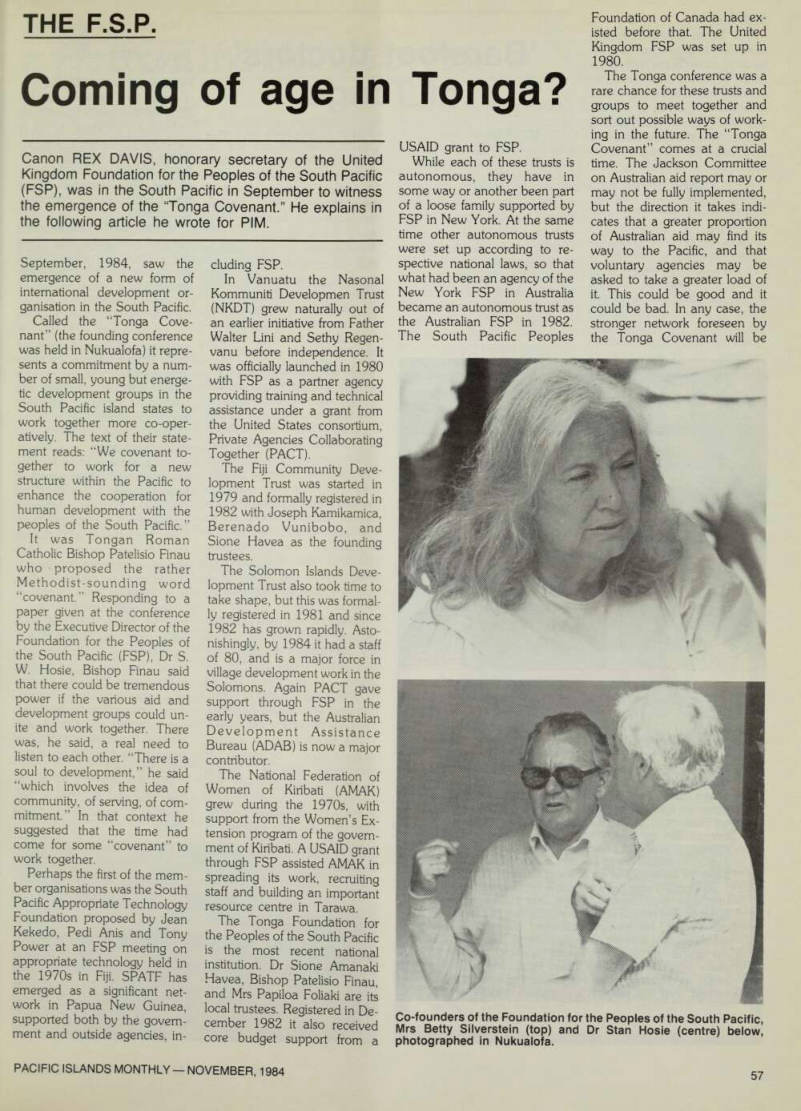
Co-founders of the Foundation for the Peoples of the South Pacific, Mrs Betty Silverstein (top) and Dr Stan Hosie (centre) below, photographed in Nukualofa.
important.
The Tonga Covenant argues now for a year-long process leading towards the setting up of an office for a co-ordinator, possibly based in Tonga, whose principal task will be to encour age and guide the participating trusts in their outside relations, and to be the chief negotiator with the metropolitan FSP trusts in guiding them on fund raising for the Pacific network.
This is, in one sense, the beginning of an important transfer of power, perhaps the birth of something quite new in the work of international deve lopment, a regional network which has direct and significant access to its partner fund-raising agencies. If this is the case, however long it takes to reach maturity, the Tonga Covenant will indeed mark the coming of age of the Foundation for the Peoples of the South Pacific.
Rex Davis.
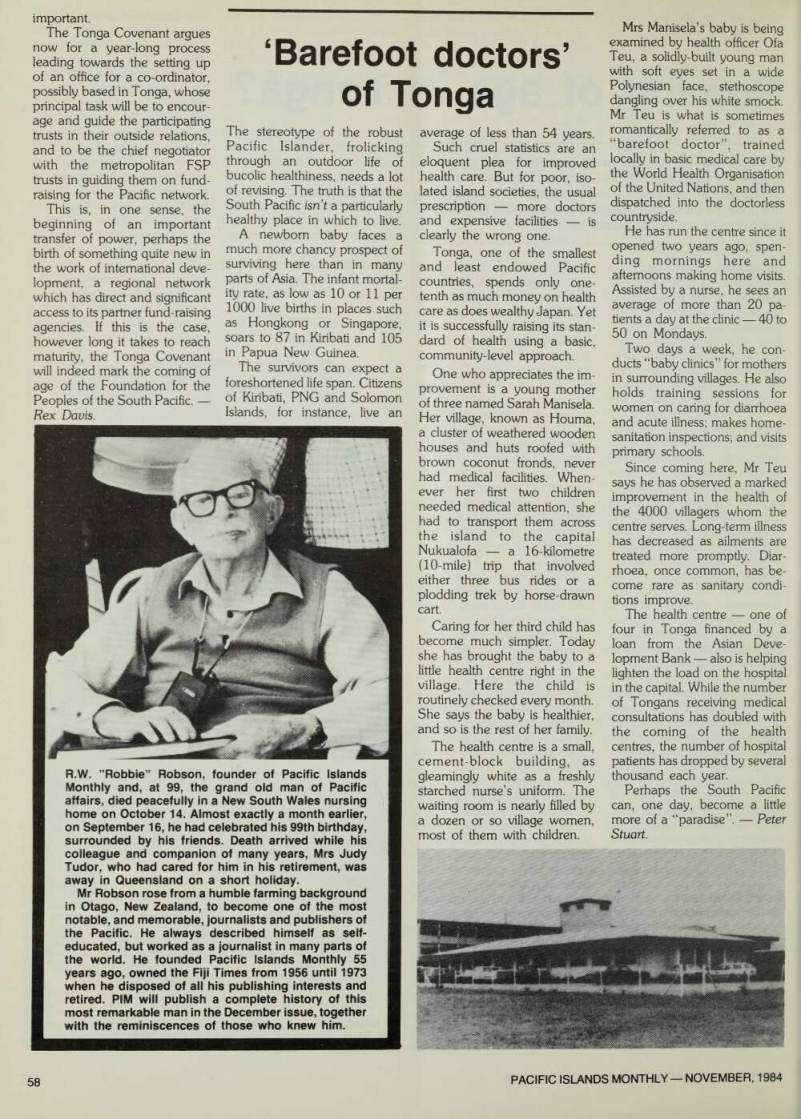
R.W. ’’Robbie” Robson, founder of Pacific Islands Monthly and, at 99, the grand old man of Pacific affairs, died peacefully in a New South Wales nursing home on October 14. Almost exactly a month earlier, on September 16, he had celebrated his 99th birthday, surrounded by his friends. Death arrived while his colleague and companion of many years, Mrs Judy Tudor, who had cared for him in his retirement, was away in Queensland on a short holiday.
Mr Robson rose from a humble farming background in Otago, New Zealand, to become one of the most notable, and memorable, journalists and publishers of the Pacific. He always described himself as self educated, but worked as a journalist in many parts of the world. He founded Pacific Islands Monthly 55 years ago, owned the Fiji Times from 1956 until 1973 when he disposed of all his publishing interests and retired. PIM will publish a complete history of this most remarkable man in the December issue, together with the reminiscences of those who knew him.