History, yes -
pp. 32-33 · Read in the full issue
History, yes and justice?
In three columns this year April, May and August the focus has been upon islanders of Hawaiian descent and their status, affairs, and concerns within the State of Hawaii. Only peripheral attention has so far been given to the position of the Hawaiians in the larger United States.
On the mainland, it has long been recognised that many treaties with American Indian nations have been broken, and that lands have been illegally seized by federal and state governments. As a consequ ence, financial compensation, most often in the form of land claim settlements, has been made to many tribal groups.
Most recently, the 1972 settle ment of Native Alaskan claims recognised that treaty violations occurred about 150 years ago, and compensation was made.
In contrast, there has been no official recognition by any seg ment of government that the peoples of Hawaii were also dispossessed, and there has been no consideration of com pensation.
In response to initiatives launched by Hawaii’s con gressional delegation, the Na tive Hawaiians Study Commis sion was created by the U.S.
Congress in late 1981. While this was long overdue, the cards
were stacked against Hawaiians from the outset. The commis sion has nine members, but no more than three can be from Hawaii. President Reagan appointed Ms Kina’u Boyd Kamali’i as chairperson and two others from Hawaii to the com mission. The other six were both mainlanders and members of the Reagan administration.
A woman in her early 50s Ms Kamali’i has a distinguished record in Hawaii. She has served in a variety of capacities in a number of civic organisa tions, and was a member of the State of Hawaii’s House of Representatives from 1976 to 1982. At the national level, and on two occasions, Kamali’i has served as a delegate to the Republican Party’s national convention, and during the cur rent election year she is honor ary chairman of the Reagan Campaign.
The Native Hawaiians Study Commission was given a year and a half to prepare a report on Hawaiians past and present, and provide recommendations on their needs and concerns. In a talk in Honolulu last May, Kamali’i reported that as the commission proceeded with its work, it became quite apparent that the majority of its members were determined to deny that there had been improper Amer-
ican involvement in the over throw of the Kingdom of Hawaii, and that there had been no irregularities when large quantities of land were acquired by the federal govem ment when Hawaii was annexed by the United States.
As the commission’s report took shape, Kamali’i indicated that it contained historical, legal, and ethical distortions designed to deny Hawaiian claims of injustice. In March, 1983, the three members from Hawaii voted against major portions of the report and all of its conclusions and recom mendations.
The Hawaiian contingent prepared a dissenting second volume of the report entitled “Claims of Conscience”. In Kamali’is own words, it “fo cuses on the validity of Hawaiian claims and the ethical imperative of providing con gressional action to meet these claims”. In June, 1983, the report was turned over to the appropriate congressional com mittees: the Senate Committee on Energy and Natural Re sources, and the House of Representatives Committee on Interior and Insular Affairs.
Kamali’i reported that she was confident that “an impartial ex amination of the two docu ments would vindicate the sub stance of” the second volume, and discredit the first.
In the early months of 1984, both congressional committees reviewed the case. In April, State of Hawaii Senator Matsu naga chaired the Senate Com mittee. He recommended rejec tion of volume one, and the committee’s staff was requested
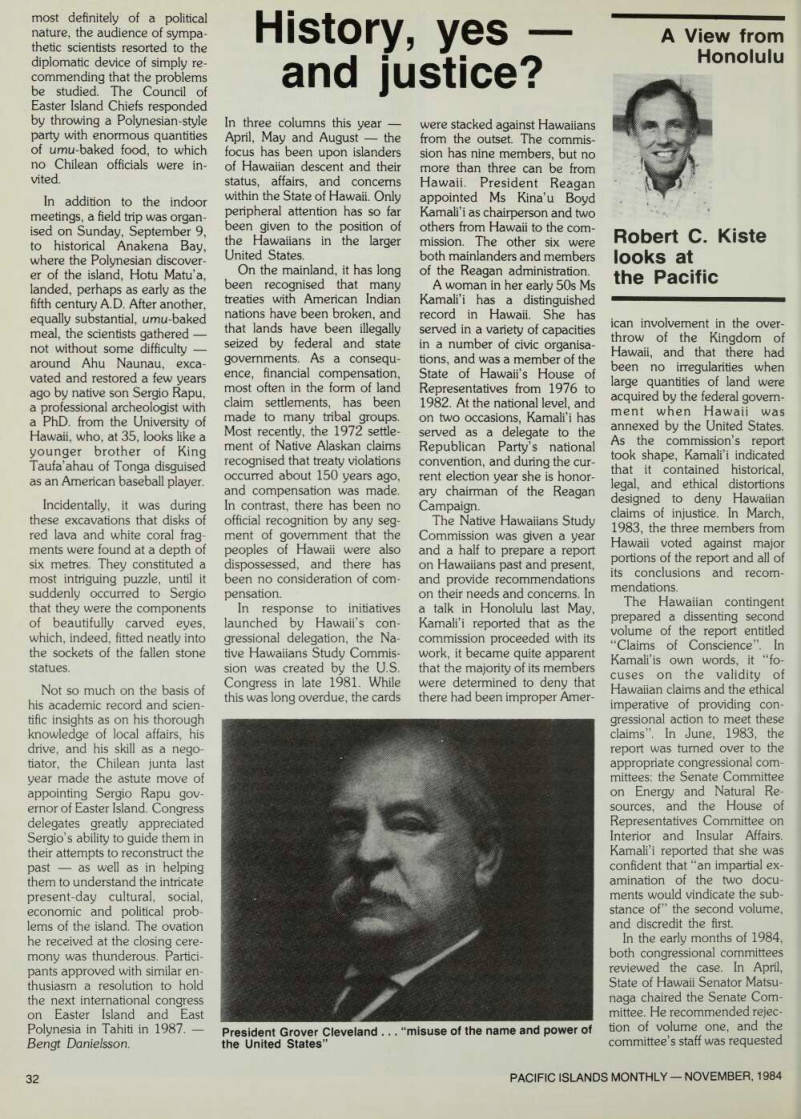
President Grover Cleveland . . . “misuse of the name and power of the United States”
A View from Honolulu
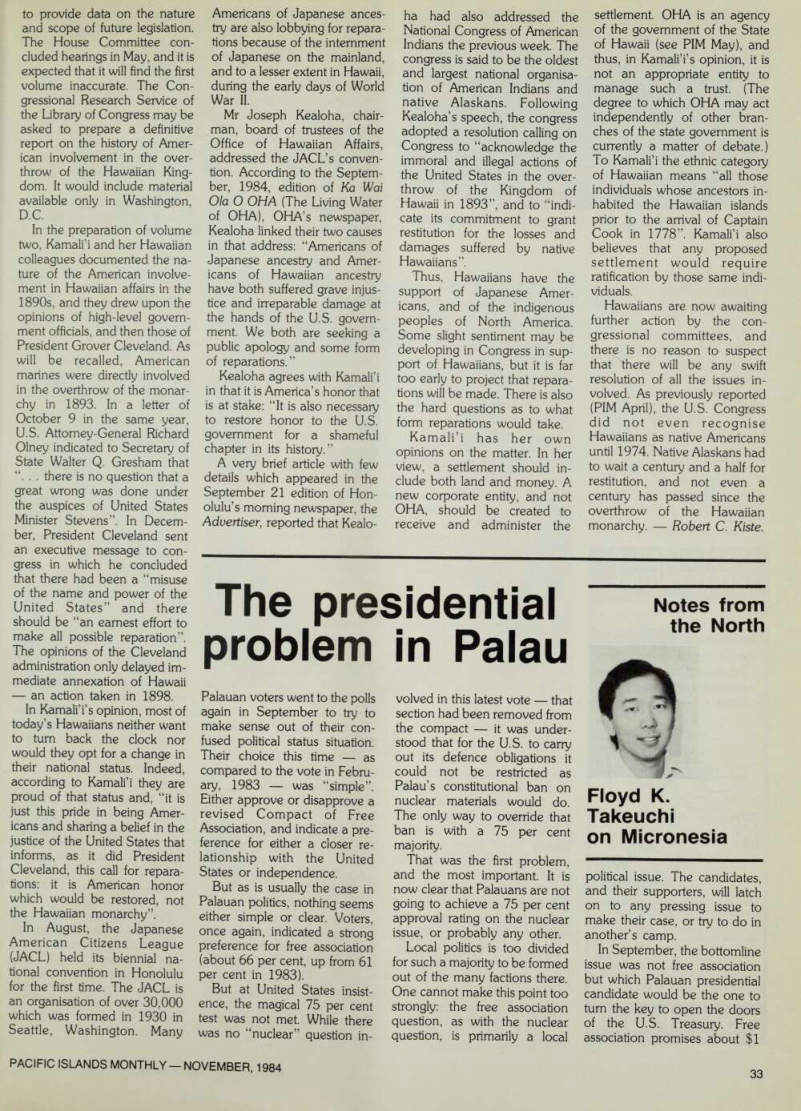
Robert C. Kiste looks at the Pacific
to provide data on the nature and scope of future legislation.
The House Committee con cluded hearings in May, and it is expected that it will find the first volume inaccurate. The Con gressional Research Service of the Library of Congress may be asked to prepare a definitive report on the history of Amer ican involvement in the over throw of the Hawaiian King dom. It would include material available only in Washington, D.C.
In the preparation of volume two, Kamali’i and her Hawaiian colleagues documented the na ture of the American involve ment in Hawaiian affairs in the 1890 s, and they drew upon the opinions of high-level govern ment officials, and then those of President Grover Cleveland. As will be recalled, American marines were directly involved in the overthrow of the monar chy in 1893. In a letter of October 9 in the same year, U.S. Attorney-General Richard Olney indicated to Secretary of State Walter Q. Gresham that • • there is no question that a great wrong was done under the auspices of United States Minister Stevens”. In Decem ber, President Cleveland sent an executive message to con gress in which he concluded that there had been a “misuse of the name and power of the United States” and there should be “an earnest effort to make all possible reparation”.
The opinions of the Cleveland administration only delayed im mediate annexation of Hawaii an action taken in 1898.
In Kamali’i’s opinion, most of today’s Hawaiians neither want to turn back the clock nor would they opt for a change in their national status. Indeed, according to Kamali’i they are proud of that status and, “it is just this pride in being Amer icans and sharing a belief in the justice of the United States that informs, as it did President Cleveland, this call for repara tions: it is American honor which would be restored, not the Hawaiian monarchy”.
In August, the Japanese American Citizens League (JACL) held its biennial na tional convention in Honolulu for the first time. The JACL is an organisation of over 30,000 which was formed in 1930 in Seattle, Washington. Many
Americans of Japanese ances try are also lobbying for repara tions because of the internment of Japanese on the mainland, and to a lesser extent in Hawaii, during the early days of World War 11.
Mr Joseph Kealoha, chair man, board of trustees of the Office of Hawaiian Affairs, addressed the JACL’s conven tion. According to the Septem ber, 1984, edition of Ka Wai Ola O OHA (The Living Water of OHA), OHA’s newspaper, Kealoha linked their two causes in that address: “Americans of Japanese ancestry and Amer icans of Hawaiian ancestry have both suffered grave injus tice and irreparable damage at the hands of the U.S. govern ment. We both are seeking a public apology and some form of reparations.”
Kealoha agrees with Kamali’i in that it is America’s honor that is at stake: “It is also necessary to restore honor to the U.S. government for a shameful chapter in its history.”
A very brief article with few details which appeared in the September 21 edition of Hon olulu’s morning newspaper, the Advertiser, reported that Kealo
ha had also addressed the National Congress of American Indians the previous week. The congress is said to be the oldest and largest national organisation of American Indians and native Alaskans. Following Kealoha’s speech, the congress adopted a resolution calling on Congress to “acknowledge the immoral and illegal actions of the United States in the overthrow of the Kingdom of Hawaii in 1893”, and to “indicate its commitment to grant restitution for the losses and damages suffered by native Hawaiians”.
Thus, Hawaiians have the support of Japanese Americans, and of the indigenous peoples of North America, Some slight sentiment may be developing in Congress in support of Hawaiians, but it is far too early to project that reparations will be made. There is also the hard questions as to what form reparations would take.
Kamali’i has her own opinions on the matter. In her view, a settlement should inelude both land and money. A new corporate entity, and not OHA, should be created to receive and administer the
settlement. OHA is an agency of the government of the State of Hawaii (see PIM May), and thus, in Kamali’i’s opinion, it is not an appropriate entity to manage such a trust. (The degree to which OHA may act independently of other bran ches of the state government is currently a matter of debate.) To Kamali’i the ethnic category of Hawaiian means “all those individuals whose ancestors in habited the Hawaiian islands prior to the arrival of Captain Cook in 1778”. Kamali’i also believes that any proposed settlement would require ratification by those same indi viduals.
Hawaiians are now awaiting further action by the con gressional committees, and there is no reason to suspect that there will be any swift resolution of all the issues in volved. As previously reported (PIM April), the U.S. Congress did not even recognise Hawaiians as native Americans until 1974. Native Alaskans had to wait a century and a half for restitution, and not even a century has passed since the overthrow of the Hawaiian
monarchy.
Robert C. Kiste.