The presidential
pp. 33-34 · Read in the full issue
problem in Palau
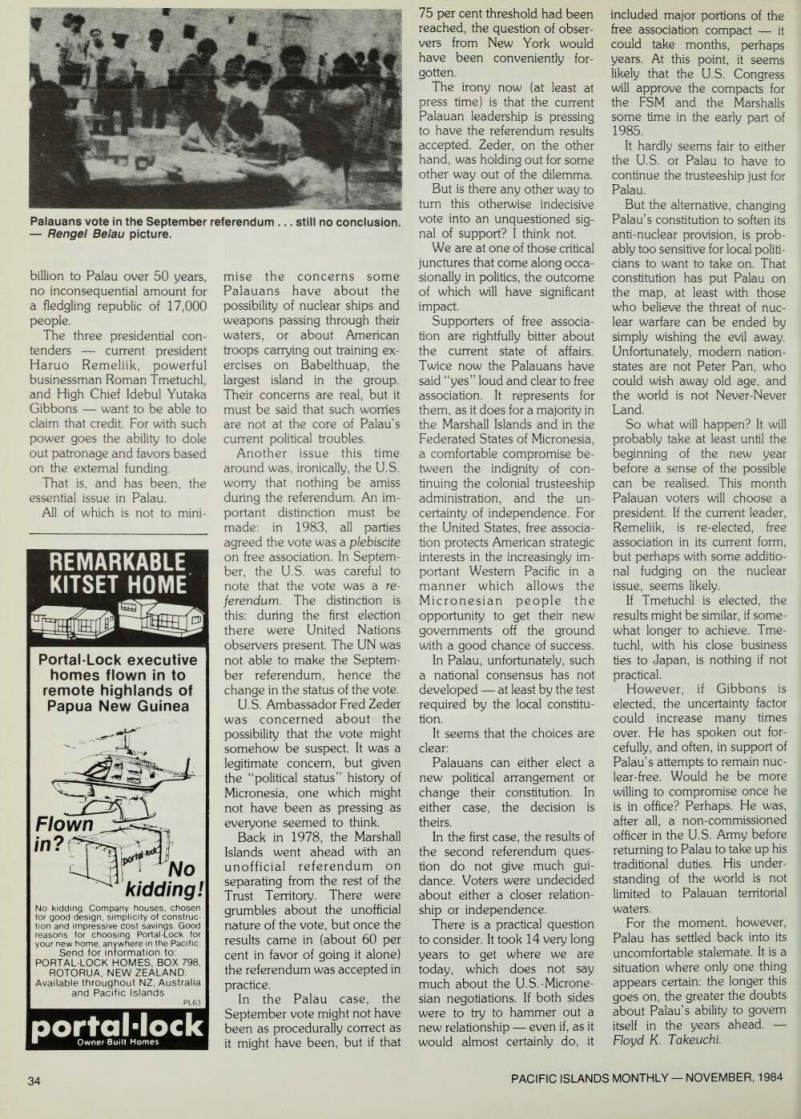
Palauan voters went to the polls again in September to try to make sense out of their con fused political status situation.
Their choice this time as compared to the vote in Febru ary, 1983 was “simple”.
Either approve or disapprove a revised Compact of Free Association, and indicate a pre ference for either a closer re lationship with the United States or independence.
But as is usually the case in Palauan politics, nothing seems either simple or clear. Voters, once again, indicated a strong preference for free association (about 66 per cent, up from 61 per cent in 1983).
But at United States insist ence, the magical 75 per cent test was not met. While there was no “nuclear” question in
volved in this latest vote that section had been removed from the compact it was under stood that for the U.S. to carry out its defence obligations it could not be restricted as Palau’s constitutional ban on nuclear materials would do.
The only way to override that ban is with a 75 per cent majority.
That was the first problem, and the most important. It is now clear that Palauans are not going to achieve a 75 per cent approval rating on the nuclear issue, or probably any other.
Local politics is too divided for such a majority to be formed out of the many factions there.
One cannot make this point too strongly: the free association question, as with the nuclear question, is primarily a local
political issue. The candidates, and their supporters, will latch on to any pressing issue to make their case, or try to do in another’s camp.
In September, the bottomline issue was not free association but which Palauan presidential candidate would be the one to turn the key to open the doors of the U.S. Treasury. Free association promises about $1
Notes from the North
Floyd K.
Takeuchi on Micronesia
billion to Palau over 50 years, no inconsequential amount for a fledgling republic of 17,000 people.
The three presidential con tenders current president Haruo Remeliik, powerful businessman Roman Tmetuchl, and High Chief Idebul Yutaka Gibbons want to be able to claim that credit. For with such power goes the ability to dole out patronage and favors based on the external funding.
That is, and has been, the essential issue in Palau.
All of which is not to mini
mise the concerns some Palauans have about the possibility of nuclear ships and weapons passing through their waters, or about American troops carrying out training ex ercises on Babelthuap, the largest island in the group.
Their concerns are real, but it must be said that such worries are not at the core of Palau’s current political troubles.
Another issue this time around was, ironically, the U.S. worry that nothing be amiss during the referendum. An im portant distinction must be made; in 1983, all parties agreed the vote was a plebiscite on free association. In Septem ber, the U.S. was careful to note that the vote was a re ferendum. The distinction is this: during the first election there were United Nations observers present. The UN was not able to make the Septem ber referendum, hence the change in the status of the vote.
U.S. Ambassador Fred Zeder was concerned about the possibility that the vote might somehow be suspect. It was a legitimate concern, but given the “political status” history of Micronesia, one which might not have been as pressing as everyone seemed to think.
Back in 1978, the Marshall Islands went ahead with an unofficial referendum on separating from the rest of the Trust Territory. There were grumbles about the unofficial nature of the vote, but once the results came in (about 60 per cent in favor of going it alone) the referendum was accepted in practice.
In the Palau case, the September vote might not have been as procedurally correct as it might have been, but if that
75 per cent threshold had been reached, the question of obser vers from New York would have been conveniently for gotten.
The irony now (at least at press time) is that the current Palauan leadership is pressing to have the referendum results accepted. Zeder, on the other hand, was holding out for some other way out of the dilemma.
But is there any other way to turn this otherwise indecisive vote into an unquestioned sig nal of support? I think not.
We are at one of those critical junctures that come along occa sionally in politics, the outcome of which will have significant impact.
Supporters of free associa tion are rightfully bitter about the current state of affairs.
Twice now the Palauans have said “yes” loud and clear to free association. It represents for them, as it does for a majority in the Marshall Islands and in the Federated States of Micronesia, a comfortable compromise be tween the indignity of con tinuing the colonial trusteeship administration, and the un certainty of independence. For the United States, free associa tion protects American strategic interests in the increasingly im portant Western Pacific in a manner which allows the Micronesian people the opportunity to get their new governments off the ground with a good chance of success.
In Palau, unfortunately, such a national consensus has not developed at least by the test required by the local constitu tion.
It seems that the choices are clear: Palauans can either elect a new political arrangement or change their constitution. In either case, the decision is theirs.
In the first case, the results of the second referendum ques tion do not give much gui dance. Voters were undecided about either a closer relation ship or independence.
There is a practical question to consider. It took 14 very long years to get where we are today, which does not say much about the U.S.-Microne sian negotiations. If both sides were to try to hammer out a new relationship even if, as it would almost certainly do, it
included major portions of the free association compact it could take months, perhaps years. At this point, it seems likely that the U.S. Congress will approve the compacts for the FSM and the Marshalls some time in the early part of 1985.
It hardly seems fair to either the U.S. or Palau to have to continue the trusteeship just for Palau.
But the alternative, changing Palau’s constitution to soften its anti-nuclear provision, is prob ably too sensitive for local politi cians to want to take on. That constitution has put Palau on the map, at least with those who believe the threat of nuc lear warfare can be ended by simply wishing the evil away.
Unfortunately, modern nation states are not Peter Pan, who could wish away old age, and the world is not Never-Never Land.
So what will happen? It will probably take at least until the beginning of the new year before a sense of the possible can be realised. This month Palauan voters will choose a president. If the current leader, Remeliik, is re-elected, free association in its current form, but perhaps with some additio nal fudging on the nuclear issue, seems likely.
If Tmetuchl is elected, the results might be similar, if some what longer to achieve. Tme tuchl, with his close business ties to Japan, is nothing if not practical.
However, if Gibbons is elected, the uncertainty factor could increase many times over. He has spoken out for cefully, and often, in support of Palau’s attempts to remain nuc lear-free. Would he be more willing to compromise once he is in office? Perhaps. He was, after all, a non-commissioned officer in the U.S. Army before returning to Palau to take up his traditional duties. His under standing of the world is not limited to Palauan territorial waters.
For the moment, however, Palau has settled back into its uncomfortable stalemate. It is a situation where only one thing appears certain: the longer this goes on, the greater the doubts about Palau’s ability to govern itself in the years ahead.
Floyd K. Takeuchi.
Palauans vote In the September referendum ... still no conclusion. -Rengel Belau picture.