The demystifying
pp. 29-32 · Read in the full issue

of Easter Island
Ever since its discovery in 1722, Easter Island has been the promised land of cranks, fools and frauds of one kind or another. Between them they have invented the craziest theories about how and why the truly stupendous stone sta tues on the island originated and were raised. Of course, the most popular of these fantasies have attributed the statues to a race of supermen from a lost continent, or to space travellers from another galaxy.
Unfortunately, the steady stream of highly imaginative books and magazine articles about the alleged mysteries of “The Navel of the World” as the island is often but erroneously called by the luna tic fringe has hidden the fact that since World War 2 a great number of scientific studies of the matter have been under taken by serious scholars. A turning point in this struggle for demystification took place in 1979 with the establishment on the island itself by the Univer sity of Chile of a research institute whose highly qualified staff immediately began a much needed inventory of all the monuments, petroglyphs and historical sites. As part of this work, islanders were also trained.
The young and dynamic director of this Centro de Estu dios Is/a de Pascua, Claudio Cristino Fernando, next had the excellent idea of organising an international congress on the island to enable archeologists and anthropologists from all over the world to pool their findings and discuss their often conflicting views of Easter Is land’s pre-history and culture. It took some time to raise the necessary funds, but in the end the institute succeeded so well that it could defray all expenses for about 30 especially invited foreign scientists, who con verged on Easter Island during the first week of September 1984.
To mention only the top names from New Zealand came the dean of Pacific prehisto
rians, Roger Green, Otago archeologist Athol Anderson, and Victoria University lecturer Nancy Pollock. From Australia came the world authority on sweet potato, Douglas Yen, and Grant McCall, the only social anthropologist to have done field work among the present day Easter Islanders. From the U.S. came the number one specialist on the cultural history of Eastern Polynesia, Yosihiko Sinoto, and the new curator of Oceanic Ethnology in the Smithsonian Institution, Adrien ne Kaeppler. From England came mild-mannered but sharp-minded palynologist John Flenley, with a fresh re port on the prehistoric flora of Easter Island. France’s delegate was Jose Garanger, whose archeological discoveries in Vanuatu in 1966-67 made big headlines. Tahiti, the nearest Polynesian country, sent only a few junior French archeologists, but this was compensated for by the impressive number of participants from the eastern shores of the Pacific, of whom most were Chilean architects and government officials, con-
cerned with the restoration of the Easter Island monuments.
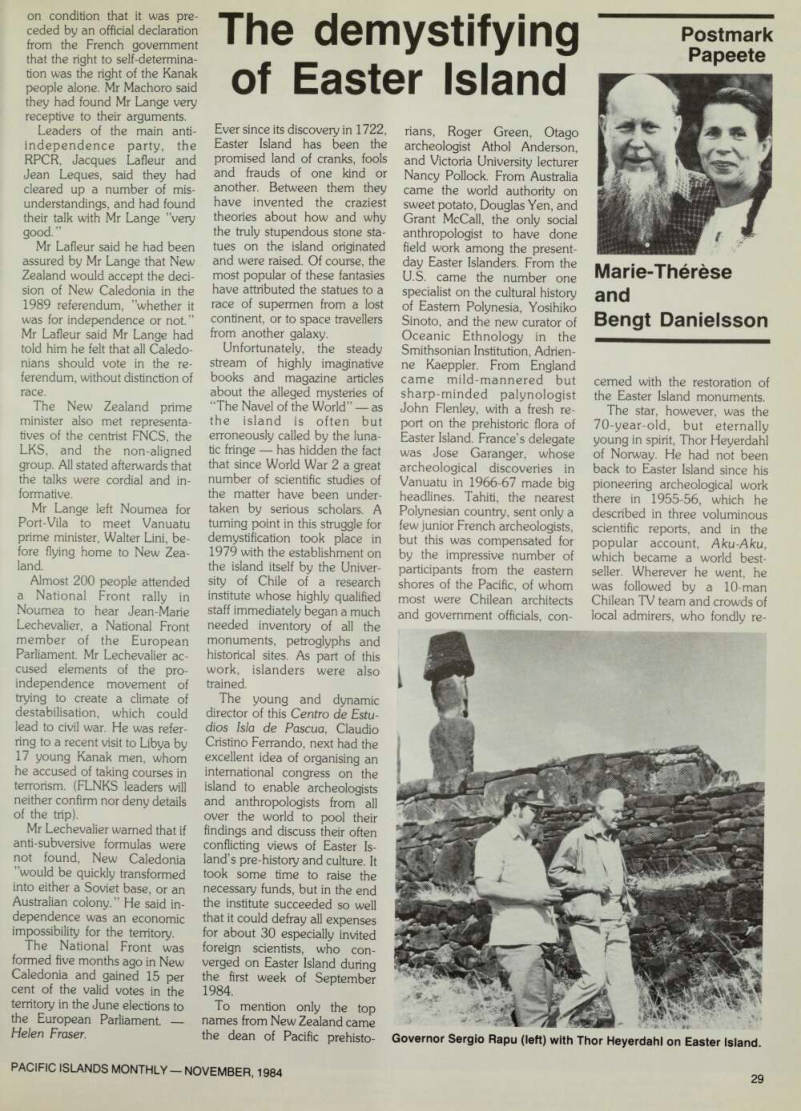
The star, however, was the 70-year-old, but eternally young in spirit, Thor Heyerdahl of Norway. He had not been back to Easter Island since his pioneering archeological work there in 1955-56, which he described in three voluminous scientific reports, and in the popular account, Aku-Aku, which became a world best seller. Wherever he went, he was followed by a 10-man Chilean TV team and crowds of local admirers, who fondly re-
Governor Sergio Rapu (left) with Thor Heyerdahl on Easter Island.
Postmark Papeete
Marie-Thèrèse and Bengt Danielsson
called his boundless generosity at a time when there were no trading stores on the island, and only one supply vessel per year.
Although the capital and only settlement on Easter Island, Hangaroa, is no more than a sprawling village inhabited by a mere 1600 Polynesians and 700 Chileans, high class accommodation was plentiful as a result of the boom in tourism in pre-Pinochet days, when a 120-room hotel and many small boarding-houses were built. Most of the meetings were held in the huge hotel even in the discotheque which once again for a brief week became a bustling place, besieged by numerous curio vendors.
The more than 50 papers presented during the six 10hour daily sessions fell into the following categories: pre-his tory, ethno-history, petro glyphs, artefacts, preservation, restoration, social anthropology and culture change.
The most interesting findings in the field of pre-history were all based on the exact, and now extensively used, methods of dating of carbon or other orga nic material, plant pollen, and obsidian spear points. They concurred in the most satisfying manner to show that the period of gigantic ahu platform buil ding and large-scale stone car ving fell between 1100 and 1700 A.D.
It was particularly interesting to leam from Professor Hen ley’s pollen studies that at the beginning of this period the island had a forest cover of Sophora toromiro trees and palms belonging to a now ex tinct species of a family repre sented otherwise only in South America. Since timber was needed not only as a fuel and a house-building material, but also and above all for the transport and erection of the giant statues, the subsequent deforestation recorded in Hen ley’s pollen samples can be understood.
The most original paper, however, came not from an earth-digger but from a sky gazer, Malcolm Clark of Califor nia. He boldly and quite con vincingly suggested that the Polynesians might have under taken most of their long sea voyages as a result of the
sudden appearance in the sky of stellar novae and supemovae of such brilliance that they were clearly visible during the day for periods varying between two months and two years. Malcolm Clark summarised his paper as follows: “The data suggest that an early migration from Samoa to the Marquesas and the initial occupations of New Zealand and Easter Island could have been stimulated by such astronomical events. There is some evidence for a similar possible influence on the migra tions to the Hawaiian Islands. A very early occupation of New Zealand from Tonga and a direct settlement of Chatham Islands from Rarotonga are also possibilities. ”
As for the sessions devoted to restoration problems, it was a great relief to discover that most participants agreed with ICCROM represenative Stan ley-Price that no such work should be done on an historical monument until it had been described and studied in the greatest detail. As he observed, there are today too many ex amples scattered across the five continents of restorations hasti ly conceived and executed, embedding terrible mistakes which can never be corrected, since nobody knows for sure the original shape of the monu ment.
The social anthropologists were agreeably surprised by the great number of islanders who from the beginning took a keen interest in their debates. Indeed they asked for and were given permission to present their own views on two burning local issues.
The first was the lack of popular political representation on the island, which they have tried to remedy by forming a council of the 35 family heads.
Unfortunately, the Chilean Government has so far refused to recognise it. On the second issue they put forward the apparently very reasonable de mand that they should become legal owners of their island, of which they were dispossessed around the turn of the century when a Scottish firm trans formed it into a sheep run, leaving only the village of Han garoa to the islanders.
Since these demands were
most definitely of a political nature, the audience of sympa thetic scientists resorted to the diplomatic device of simply re commending that the problems be studied. The Council of Easter Island Chiefs responded by throwing a Polynesian-style party with enormous quantities of umu-baked food, to which no Chilean officials were in vited.
In addition to the indoor meetings, a field trip was organ ised on Sunday, September 9, to historical Anakena Bay, where the Polynesian discover er of the island, Hotu Matu’a, landed, perhaps as early as the fifth century A.D. After another, equally substantial, umu-baked meal, the scientists gathered not without some difficulty around Ahu Naunau, exca vated and restored a few years ago by native son Sergio Rapu, a professional archeologist with a PhD. from the University of Hawaii, who, at 35, looks like a younger brother of King Taufa’ahau of Tonga disguised as an American baseball player.
Incidentally, it was during these excavations that disks of red lava and white coral frag ments were found at a depth of six metres. They constituted a most intriguing puzzle, until it suddenly occurred to Sergio that they were the components of beautifully carved eyes, which, indeed, fitted neatly into the sockets of the fallen stone statues.
Not so much on the basis of his academic record and scien tific insights as on his thorough knowledge of local affairs, his drive, and his skill as a nego tiator, the Chilean junta last year made the astute move of appointing Sergio Rapu gov ernor of Easter Island. Congress delegates greatly appreciated Sergio’s ability to guide them in their attempts to reconstruct the past as well as in helping them to understand the intricate present-day cultural, social, economic and political prob lems of the island. The ovation he received at the closing cere mony was thunderous. Partici pants approved with similar en thusiasm a resolution to hold the next international congress on Easter Island and East Polynesia in Tahiti in 1987.
Bengt Danielsson.