the month
pp. 28-29 · Read in the full issue
131 years on, the FLNKS
September 24, 1984, the 131st anniversary of French posses sion, was not officiilly com memorated in New Caledonia.
However it now marks the birth of the FLNKS - the Kanak Socialist National Liberation Front.
Following a three-day con gress attended by about 300 delegates, the FLNKS replaced the former Independence Front (IF), but without the LKS party,
which was formerly a member of the front (PIM, Sept. p 25).
The establishment of the FLNKS follows the breakdown of relations between the French govenment and the IF after France went ahead with plans for a five-year automony period for New Caledonia. The new organisation comprises the four former IF parties, the UC, the UPM, the FULK, and the PSC, as well as unions, land,
women’s and human rights groups.
The new organisation will co-ordinate the activities of all the pro-independence pressure groups in each municipality, as well as taking responsibility for their actions. It will also organ ise the boycott and disruption of the Territorial Assembly elec tions which are now expected to be held in late November.
The other work of the FLNKS was to organise the pro-independence movement into local committees in each municipality by October 7. The committees will meet in a regio nal convention on November 11. The regional convention will elect 37 deputies, who in turn will meet in a national convention on November 24- 26, and elect a provisional government with a president, prime minister, and six minis ters, who will be formally instal led on December 1.
FLNKS spokesman Eloi Machoro said the provisional government would be based in Noumea, and would ’’lead the country through its transitional phase to independence.”
The FLNKS congress adopted the name ’’Kanaky” for New Caledonia, and adopted a flag (blue, red, green, and yellow), as well as the broad outlines of a constitu tion for a decentralised, demo cratic, socialist republic.
The preamble to the constitu tion describes it as founded on the concepts of a society based on the values of Kanak civilisa tion; says that it will guarantee the rights of man, citizen and worker; that the republic will be organised without discrimina tion as to race, sex, religion, and opinion; that it will apply the progressive socialisation of the means of production and exchange, to build a self-man aged, planned economy; and that the Kanaky Republic will adhere to the Charter of the United Nations, and co-operate with other Pacific countries, notably in the anti-nuclear, anti racist, and anti-colonial strug gles.
Mr Machoro referred to the unanimous support given to the
FLNKS by the general assem bly of the World Council of Indigenous Peoples (WCIP) which met in Panama in late September (PIM, Sept p 9).
The Australian Aboriginal de legation to the WCIP sponsored the resolution, which extended admiration and appreciation to the FLNKS and their projected provisional government.
New Zealand prime minister, David Lange, visited New Cale donia on a 24-hour stopover on October 6 ”to inform himself on the ground” aboiut the terri tory’s political evolution. Mr Lange’s visit followed discus sions in New York with French Minister for External Affairs, Claude Cheysson on the New Caledonia situation.
Mr Lange met and talked with French High Commission er, Jacques Roynette, and also held talks with a six-man de legation from the FLNKS led by Roch Pidjot, one of New Cale donia’s two deputies to the French National Assembly, and Jean-Marie Tjibaou, who flew back from Australia for the encounter. (Mr Tjibaou had spent two weeks in Australia under the government’s Over seas Visitors’ Fund’s auspices).
As spokesman for the FLNKS delegation, Mr Machoro said they had told Mr Lange that a referendum in 1989 was out of the question, and that 1986 was acceptable
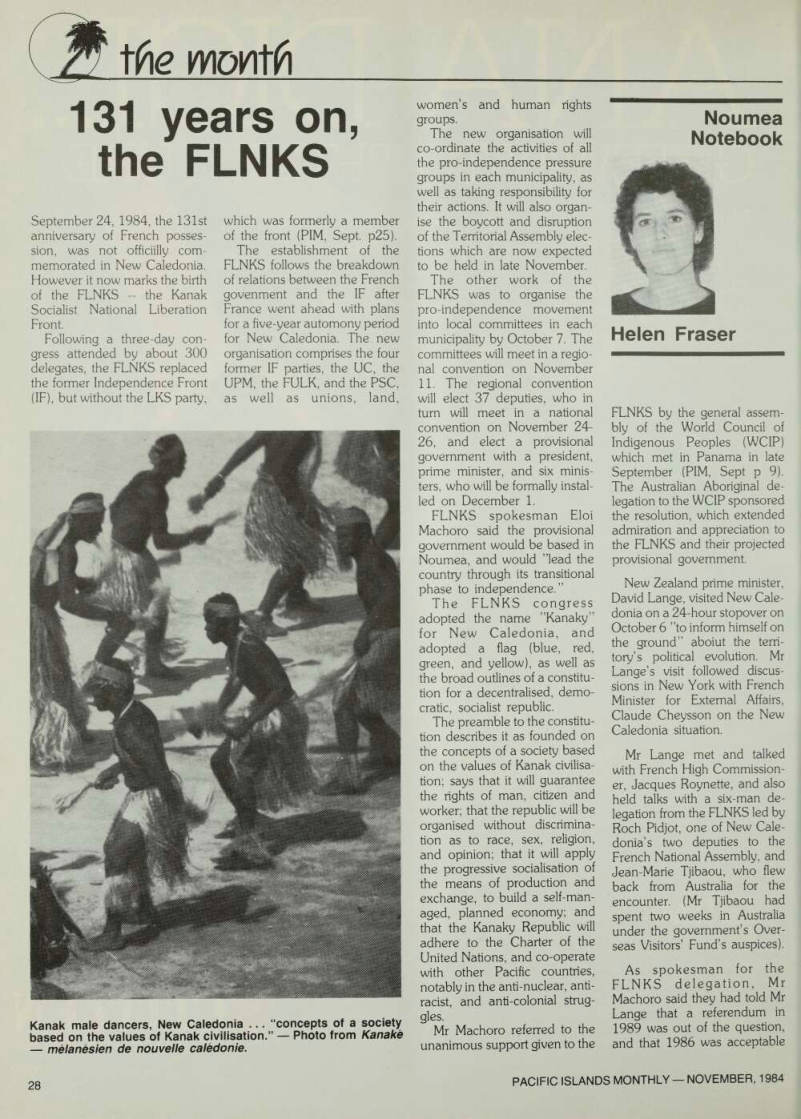
Kanak male dancers, New Caledonia ... “concepts of a society based on the values of Kanak civilisation.” - Photo from Kanaka -melanesien de nouvelle caledonie.
Noumea Notebook
Helen Fraser
on condition that it was pre ceded by an official declaration from the French government that the right to self-determina tion was the right of the Kanak people alone. Mr Machoro said they had found Mr Lange very receptive to their arguments.
Leaders of the main anti independence party, the RPCR, Jacques Lafleur and Jean Leques, said they had cleared up a number of mis understandings, and had found their talk with Mr Lange ’’very good. ”
Mr Lafleur said he had been assured by Mr Lange that New Zealand would accept the deci sion of New Caledonia in the 1989 referendum, ’’whether it was for independence or not. ”
Mr Lafleur said Mr Lange had told him he felt that all Caledo nians should vote in the re ferendum, without distinction of race.
The New Zealand prime minister also met representa tives of the centrist FNCS, the LKS, and the non-aligned group. All stated afterwards that the talks were cordial and in formative.
Mr Lange left Noumea for Port-Vila to meet Vanuatu prime minister, Walter Lini, be fore flying home to New Zea land.
Almost 200 people attended a National Front rally in Noumea to hear Jean-Marie Lechevalier, a National Front member of the European Parliament. Mr Lechevalier ac cused elements of the pro independence movement of trying to create a climate of destabilisation, which could lead to civil war. He was refer ring to a recent visit to Libya by 17 young Kanak men, whom he accused of taking courses in terrorism. (FLNKS leaders will neither confirm nor deny details of the trip).
Mr Lechevalier warned that if anti-subversive formulas were not found, New Caledonia ’’would be quickly transformed into either a Soviet base, or an Australian colony. ” He said in dependence was an economic impossibility for the territory.
The National Front was formed five months ago in New Caledonia and gained 15 per cent of the valid votes in the territory in the June elections to the European Parliament.
Helen Fraser.