political currents
p. 26 · Read in the full issue
N.F.P. factionalism flares up again at Lautoka meeting
From a Special Correspon dent in Suva Fiji’s Opposition National Federation Party held its annual convention at the beginning of September at Nausori, hoping to present to the nation the image of an alternative govern ment with strong leadership and unity. But what emerged after the two-day meeting was the image of a party divided into two factions one group backing the leader, Siddiq Koya, and the other loyalists of Jai Ram Reddy, the new party president and former par liamentary leader. The bitter in fighting and squabbling seen at the convention has taken the party back, according to obser vers, to the 1977 general elec tion days, when the Rower faction led by Mr Reddy and the Dove group with Mr Koya as its leader, fought the election with parallel candidates in most constituencies.
Over the following years, however, due to an effort large ly on Mr Reddy’s part, and also to Mr Koya’s decision to keep a low profile, the party rebuilt itself as a united force so strong indeed that the ruling Alliance Party was almost voted out of office in the last elections in 1982.
However, what happened during the election of office bearers at the 1984 Nausori convention was just what the Alliance might have been praying for.
Mr Reddy was elected presi dent of the party unopposed.
However, the divisions and factionalism, and the re-open ing of the political wounds of 1977, surfaced when the time came to choose the Party’s national secretary.
There were two candidates, Senator Mumtaz Ali, a very loyal supporter of Mr Reddy who had nominated him for the Senate, and Sharda Nand, a
After a period of relative calm, factionalism in Fiji’s opposition National Federation Party reared its head again at the party’s September annual convention in Lautoka. A PIM special correspondent tells the story.
protege of Mr Koya. Mr Nand had worked tirelessly on tactical moves in June to have Mr Koya elected leader when Mr Reddy withdrew.
To avoid open squabbles over the posts of the national secretary and other officials, it was decided to hold elections behind closed doors in which only the presidents, secretaries and treasurers of various bran ches were allowed to vote. The elected candidates were then to be endorsed by consensus at an open meeting. In the voting Senator Ali was elected by 22 votes to 18.
When Mr Koya leamt of Mr Nand’s defeat he was furious.
He had expected Mr Nand to win to have his own man in the effective position of national secretary, and Mr Reddy as president. Mr Koya refused to have the list of the secretly elected candidates endorsed.
The meeting was adjourned for two hours, and lengthy behind
the-scene negotiations ensued.
Senator Ali refused to step down in favor of Mr Nand, claiming he had been elected in a proper manner. Mr Nand also had no complaints. But Mr Koya said straight out that he was not prepared to work with Senator Ali.
Observers say if the election had been held in the open meeting, Mr Nand would have won because most delegates would not have had the cour age to defy Mr Koya.
In the two-hour-long negotia tions it was again Mr Reddy who came out the winner as the man with the magic powers of bringing about a compromise settlement. He managed to talk Senator Ali into agreeing to withdraw, and the other side also got Mr Nand to withdraw, allowing Anirudh Kuver to con tinue in office for another term.
Mr Kuver had not sought re election.
A crisis was averted, but it
clearly demonstrated the power and influence of Mr Reddy, and the key role he will have to play in keeping the fragile unity of the party intact.
In his address after the elec tion, Mr Reddy was at pains to dispel any fears that he was planning to oust Mr Koya from leadership and enter active poli tics in a hurry. Mr Reddy said he had agreed to take on the president’s position because branch delegates said he was needed to consolidate the party’s unity. He said he was not competing with Mr Koya, and would give him all his support to see that the party worked as a cohesive, united organisation. Mr Reddy said that when they operated indi vidually he and Mr Koya were weak, but united they were very strong.
Mr Reddy also made it clear that he was in no hurry to go back into parliament. But observers say Mr Reddy’s elec tion as party president is seen as a threat by the Koya camp.
Political pundits also say that if Mr Reddy, who said in May after resigning the leadership that he wanted to stay in the background in an advisory role, could in just four months come back as the party president, what is there to stop him running in the 1987 elections and seeking the leadership again?
The acid test of whether the NFP is united, or which faction has the edge over the other, is likely to come later this year when a candidate is to be selected to contest the by election for the seat Mr Reddy has vacated in Lautoka. Once again Senator Ali is seen as a strong contender, and there are a couple of hopefuls in the Koya camp a compromise candidate again what do they say about history repeating itself?
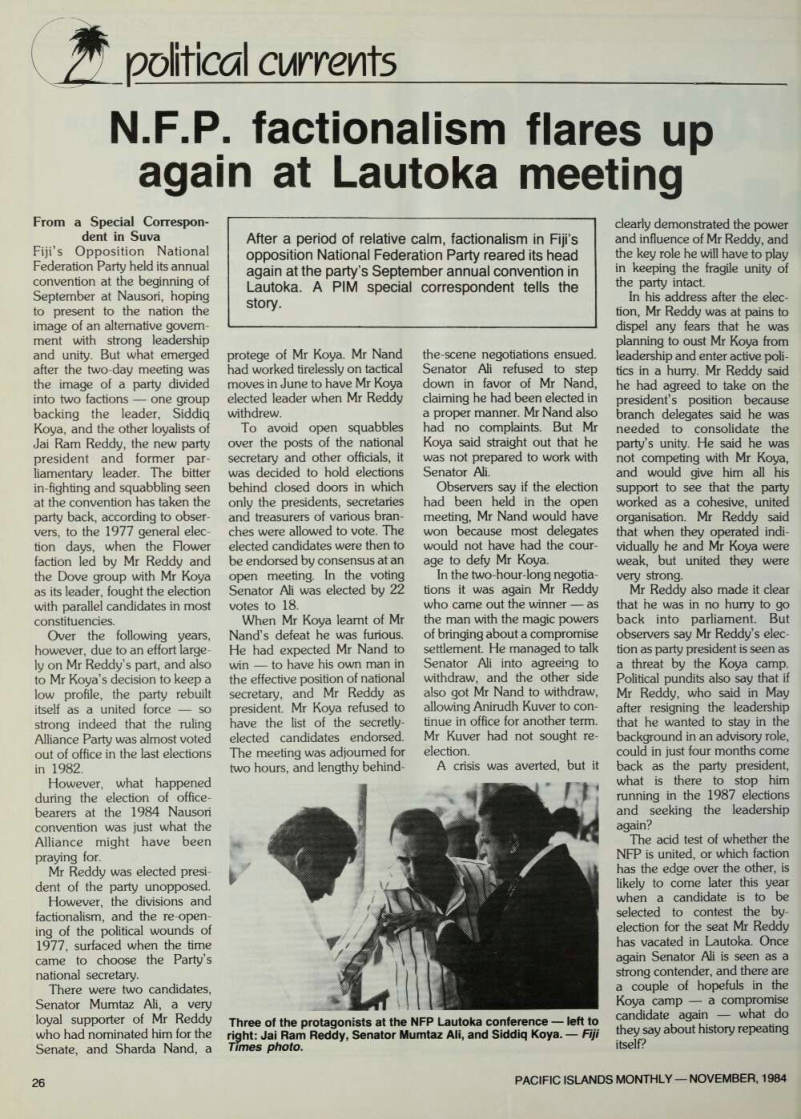
Three of the protagonists at the NFP Lautoka conference - left to right: Jai Ram Reddy, Senator Mumtaz Ali, and Siddiq Koya. - Fiji Times photo.