1830s Samoa
pp. 45-46 · Read in the full issue
A missionary-explorer in 1830s Samoa
The Samoan Journals of John Williams 1830 and 1832. Edited, with an intro duction, by Richard M. Moyle.
Published by Australian Na tional University Press, 1984. x,
302. Isbn 0 7081 1621 3.
$A29.95.
This book is number 11 in the Australian National University’s “Pacific History Series”. It will undoubtedly become a signifi cant resource for students of the Pacific region as it gives access for the first time to the original text of the 1830 and 1832 journals of John Williams, mis sionary-explorer.
Whilst the journals them selves “may be read as fascinat ing and often dramatic narra tives in their own right” (intro, p 1), the editor has added an excellent series of footnotes which often open up new ave nues of inquiry, as well as providing clarification or am plification of the text. The ex tent and variety of the editor’s research are evidenced both by the footnotes and the seven pages of bibliography at the end of the book.
The introduction briefly re views the upsurge of interest in the 18th and 19th centuries in Christian missionary enterprise, and the establishment of the various missionary societies in England, especially the London Missionary Society (LMS), the Wesleyan Methodist Missionary Society (WMMS), and the Church Missionary Society
(Cms).
John Williams’ call to mis sionary service, his marriage and his appointment to Tahiti and Raiatea under the auspices of the LMS are quickly out lined, and it is from Raiatea that he set out on his first voyage to Samoa.
In view of the later differ ences which arose between the LMS and the WMMS over spheres of missionary activity in the Pacific, some of Williams’ journal entries present a more “catholic” view of co-operation than has sometimes been credited to him, e.g. he was in Sydney in 1822 for medical
treatment, and from there wrote to the directors of the LMS: “I had nearly come to England for the purpose of proposing that Church, the London and Methodist Societies should jointly fit out a vessel to visit the various islands of the South Seas”. A late entry states: “I have frequently thought that a standard book on missions is much wanted. A work that should be admitted into all our missionary seminaries . . . ” (p 284). He went on to suggest that much could be learnt from other missionary societies the Moravians, the Baptists, the CMS and the Wesleyans, and added that plans adopted by the Jesuits in South America might be used with advantage in the South Seas. The journals themselves are much more than a record of places visited, although the number of island communities involved in the two journeys is considerable.
The entries are an invaluable “first source” for the social historian, the student of Pacific cultures and languages, and
particularly for those interested in both the pre-Christian reli gious practices in Polynesia, and the establishment of the Christian churches throughout that area.
Those who have read Wil- Hams’ published Missionary En terprises (a best-seller in 19th century England), should read the Journals as they provide a factual check against some of the exuberances of the author as he re-wrote his material for general publication, One of the remarkable aspects of the Journals is that they cover, in each case, a period of only 16 weeks, much of it spent at sea, and a total of only 30 days actually spent in Samoa, Williams’ knowledge of Tahi tian and Rarotongan customs and language enable him to make useful comparisons with other cultures, such references being picked up by the editor and enlarged upon where deemed necessary.
John Williams had remark able powers of observation and the ability to record both in-
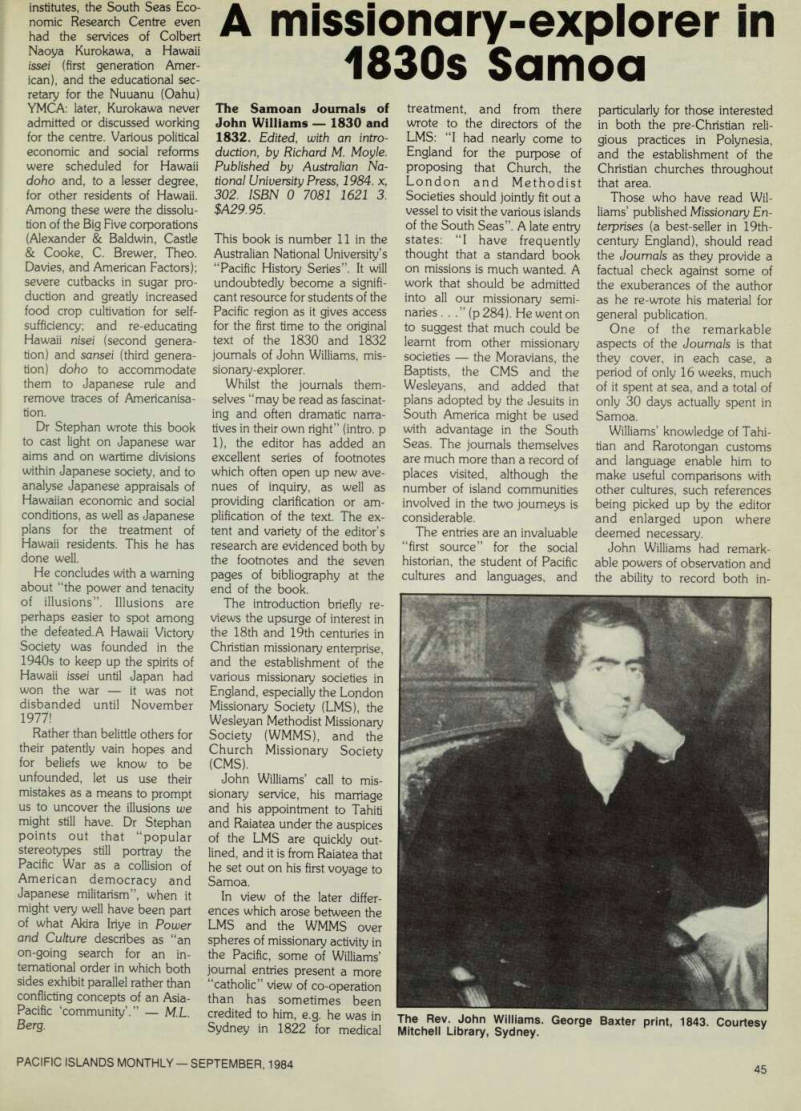
The Rev. John Williams. George Baxter print, 1843. Courtesy Mitchell Library, Sydney.
teresting and important detail.
Moyle acknowledges that the Journals provide “the earliest detailed accounts of Samoa when European influence was still in its infancy a wealth of ethnographic material”.
We are indebted to Williams for recording such matters as Samoan marriage customs, night dances, and methods of waging war all activities which were certainly obscene or cruel to the eyes of a Christian missionary. But he recorded them nevertheless, with considerable benefit to contemporary students of Polynesia.
One strange aspect of the record is that Williams advised the directors of the LMS “that the 1830 journals should be considered as coming from Mr Barff and myself jointly”. It is difficult to identify most of what may have been Mr Barff s work.
As is often the case, however, the journals reveal a great deal about the author as well as his subject. As well as recording the “sights and sounds” of Samoa we note that he had an eye for the ladies, a keen interest in the news from England, especially political and parliamentary news, and was intrigued by comparative linguistics in the Polynesian islands. He believed that missionary endeavors, whilst primarily evangelistic, had a strong secondary motiva tion to civilise in order to promote trade, commerce and Empire.
He was not always consistent in his attitude to the use of tobacco, but, 150 years later, neither are his successors in the South Seas. On the subject of tea-drinking however he was
quite clear; “Get a Polynesian into the habit of taking tea and he would go on to crave all the good things the West had to offer. ”
Whilst in Samoa, Williams spent a considerable time with the paramount chief Malietoa, forbear of the present Head of State in Western Samoa, and with the help of an expatriate Samoan, Fauea (who had been in Fiji and Tonga), he influ enced Malietoa in his decision to abandon war and accept the Christian faith.
Interspersed with comments on the culture of the various island groups visited are fre quent references to “run-away sailors”, “escaped convicts” (ex-Sydney usually), hazardous inter-island voyages by both missionaries and islanders, to gether with a host of references by name to island chiefs and orators whose successors are still found in the villages named in the journals.
The journals pay an almost indirect, but obvious, tribute to the courage, fortitude and de votion of the missionary wives, those women who adapted to strange and sometimes hostile environments as they made a home for their families against tremendous odds. Reference is made to Mrs Turner (Wes leyan), whose domestic sup plies arrived in Haapai if a canoe “happened” to be com ing the 150 miles from Tonga tapu; to Mrs Cross, drowned when the canoe in which she was travelling capsized on a reef; to the ever-patient Mary, wife of John Williams, whose health was constantly affected by filariasis, and who lost seven children while living in Polynesia.
As the journals come to us in a well-produced, carefully edited book we can only im agine the difficulties under which the originals were written usually in a cramped cabin in the ill-ventilated Olive Branch, by the light of a smoky hurri cane lamp. To John Williams and his colleagues, modern re searchers are grateful as they are to Richard Moyle, whose scholarship and concise com ments help to make the journals “living documents”.
We note that the original, quill and ink copies, are lodged in the Mitchell Library, Sydney.
Ron Allardice in Apia.