19th-century Fiji
pp. 46-47 · Read in the full issue
Sandalwooders and beachcombers in 19th-century Fiji
The Journal of William Lockcrby Sandalwood Trader in the Fccjee Is lands, 1808-1809. Samuel Patterson’s Narrative of the Wreck of the Eliza in the Fiji Islands in 1808. Pub lished in one volume by the Fiji Times & Herald, Suva, 1982. 120 pp $F4.95.
We tend to romanticise the ships which opened up the Pacific to the European world.
But books like Charles Olson’s Call Me Ishmael remind us that very often they were part of a
savage and sweated industry.
As Olson discovered: “During the 1840 s and 1850 s it cost the owners 15c to 30c a day to feed each crew member combine inefficient workers and such costs by maintaining lowest wages and miserable working conditions the result: by the 1840 s the crews were the bottom dogs of all nations and all races. Of the 18,000 men (in the Pacific whaling and sealing fleet) one half ranked as green hands and more than two-thirds deserted every voyage.”
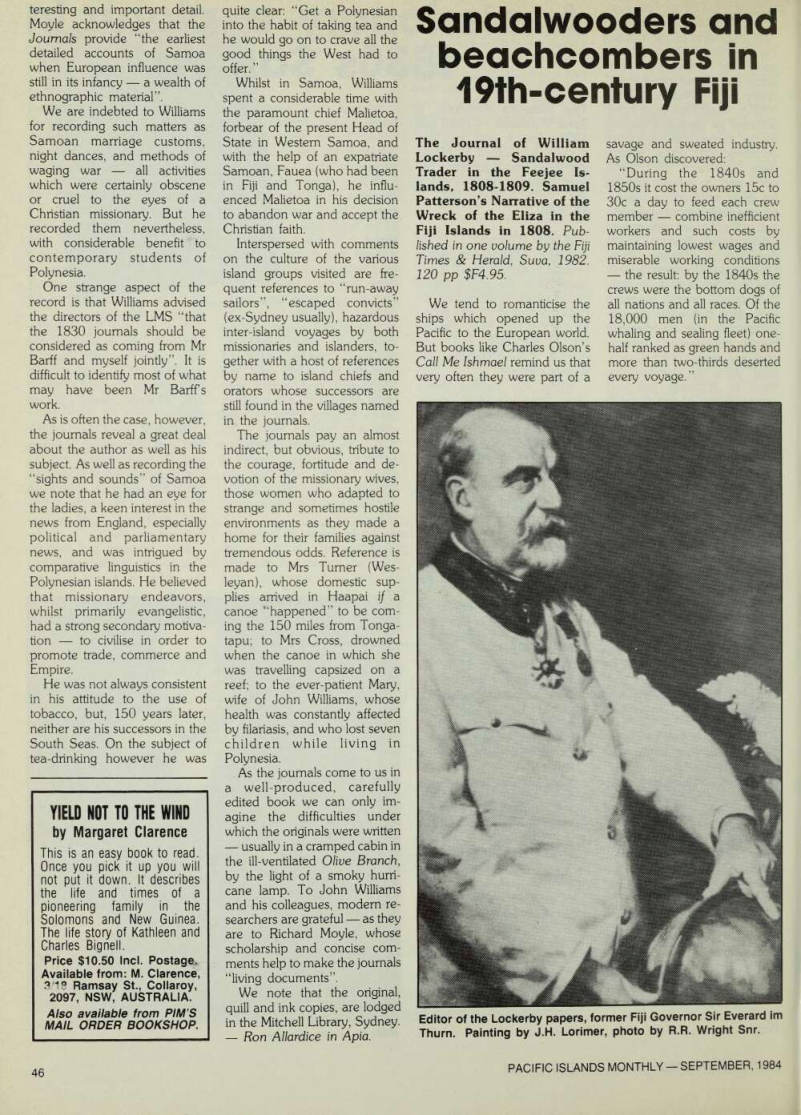
Editor of the Lockerby papers, former Fiji Governor Sir Everard im Thurn. Painting by J.H. Lorimer, photo by R.R. Wright Snr.
Lockerby and Patterson were two such “bottom dogs” who “lived to tell the tale”. Like Alexander Selkirk, Lockerby was marooned and Patterson became a “beachcomber” through shipwreck. When Sel kirk returned to London after his four years and four months on Juan Fernandez Island he drew crowds of curiosity seek ers to hear his account, includ ing, of course, the novelist Daniel Defoe, who immortal ised him as Robinson Crusoe, further firing the romantic myth.
But when Lockerby returned to Liverpool his family, under the influence of old-fashioned prudery, suppressed his narra tive. Patterson published his account in 1817 on his return to New England “with a design of enabling the subject of this Narrative to obtain some alleviation of his misfortunes from a generous publick.” He bought a wagon and a $4O horse and set out to hawk his book. The horse died in a snow drift in the Alleghenies and his narrative sank into the category of “rare book” and was almost forgotten. Around 1915, a great-grandchild of Lockerby’s eventually gave a former gov ernor of Fiji, Sir Everard im Thum, access to the Lockerby manuscript, Sir Everard subse quently edited it for the Hakluyt Society.
The Fiji Times & Herald, by reprinting these two early accounts of European contact with Fiji, is rendering a great service to a wider public who would otherwise find them almost inaccessible, for here is the reality of those early years, set down in all their grim and fascinating detail.
Samuel Patterson was born in Rhode Island in 1785. After two trips to Algiers on the United States frigate George Washington he signed on as a Guineaman engaged in the West African slave trade. In 1804 he sailed on the Boston ship Juno to collect furs in the north-west Pacific for the China market. She ran aground near Sitka the following year. By 1808 Patterson was onboard the Providence brig Eliza when she was wrecked on Mothea reef (now often called Eliza Reef) in the southern portion of the barrier reef which surrounds Nairai, Fiji.
An article in Pacific Islands
Monthly of March, 1935, recalls how Lockerby mysteriously dis appeared from Liverpool, his family thinking he had been press-ganged. Suffice it to say he went aboard the Boston ship Jenny as first officer around May 1807 and the Jenny was soon away from that port for Port Jackson and China on a sealing voyage.
Their plans changed at Port Jackson for when they arrived they found the port seething with news of the sandalwood trade. As it turned out, the period 1808-1809 was to mark the peak of the boom. The Jenny’s captain Dorr could hardly have guessed how pro fitable this change of course would prove. The Jenny de parted Fiji with 250 tons got for goods worth 50 pounds, and fetched something like 20,000
pounds for her cargo in China.
By 1840, when Wilkes’ American exploring expedition visited the Fijian Islands, his scientists had trouble even finding a specimen for their collection.
Doug Monro in Fijian Sandalwood and Beche-de-Mer (1973) called Lockerby’s journal “the major primary source for the Fijian sandalwood trade”. I would wish only that the Fiji Times & Herald had incorporated the Lockerby manuscript in the Peabody Museum in Salem. In that document Lockerby gives sailing directions for Bua Bay, information about weather and a “vocaboulary of (the Fijian) Tongue sufficient to purchase Sandle Wood and an Acct. of the Different Native Chiefs of the Fejee Isds with whom you have to do in procuring Sandle
Wood particularly those of Tokenroba (Vanua Levu)”.
While neither man was an anthropologist, Lockerby’s and Patterson’s accounts are of great value. Lockerby espedal ly had a great eye for the details of life as he found it at Bua.
Many men with more education have recorded less. He records acts of treachery and kindness on both sides and does not try to hide his own misdeeds among his numerous adven tures. His is, in fact, a reason ably honest account of the times, with little moralising to obscure the truth. We have every reason to welcome the republishing of such narratives by the “bottom dogs” of the last century. We need to set their “truths” beside the romanti cised myths which have re
placed them.
D. S. Long.