books
pp. 43-45 · Read in the full issue
The World War II plans for a Japanese Hawaii
Hawaii Under the Rising Sun: Japan’s Plans for Con quest After Pearl Harbor. By Dr John Stephan. Published by University of Hawaii Press, 1984. xii, 228 pp. ISBN 0 8248 0872. $U516.95.
Dr John Stephan of the Univer sity of Hawaii has written a book sure to be of interest to anyone concerned with the Pacific part of the fighting dur ing World War 11.
The Japanese themselves called their combat in Asian and Pacific theatres the “Greater East Asia War” (Dai Toa sen so). The “Greater East Asia Co-Prosperity Sphere” (Dai Toa kyoeiken) was a term made public on August 1, 1940, by the Japanese foreign
minister it was the geographical area considered necessary by Japan for her economic self-sufficiency.
Hawaii was to be an integral part of the sphere, along with Japanese Micronesia which Japan had taken away from the auspices of the League of Na tions in the mid-1930s and much of China, and annexed as part of the empire (pp 78-80).
This was going one better on King Kalakaua, who had made proposals during his 1881 visit to Japan for inter-marriages between Japanese and Hawaiian royal families, and the formation of an Asian federation led by Japan to which Hawaii would belong.
The Meiji emperor had politely put these requests aside (p 17).
As Dr Stephan makes clear, most plans for a Japanese Hawaii involved doho, ethnic Japanese considered by the government of Japan as nationals, regardless of their citizenship, living there. The feelings and fortunes of ethnic Japanese in prewar and wartime Hawaii are shown to be complex because these were moulded by so many different forces: racist treatment at the hands of whites in Hawaii; increasing patriotism and nationalism (for Japan) as Japanese forces swept to victory in China; the successes of the Meiji emperor; the celebration of the empire’s 2600th birthday in November, 1940; and ties to the prefectures in the homeland from which their families had
emigrated, as well as relations with others outside Japan who came from the same prefec tures. The prefectural ties seem to have mattered most over the years. Such considerations show that the wartime stereotypes of Hawaii doho as either pro-American or anti- American block our preception of their true plight. It is also salutary to reflect, as one U.S.
State Department observer did in late 1941 (p 8), on how we ourselves would have behaved if we had had to cope with a possible Japanese occupation of our homeland. ‘ Flans for an actual invasion of Hawaii were given fuel by the military conquest of China and the surprise attack on Pearl Harbor on December 7, 1941.
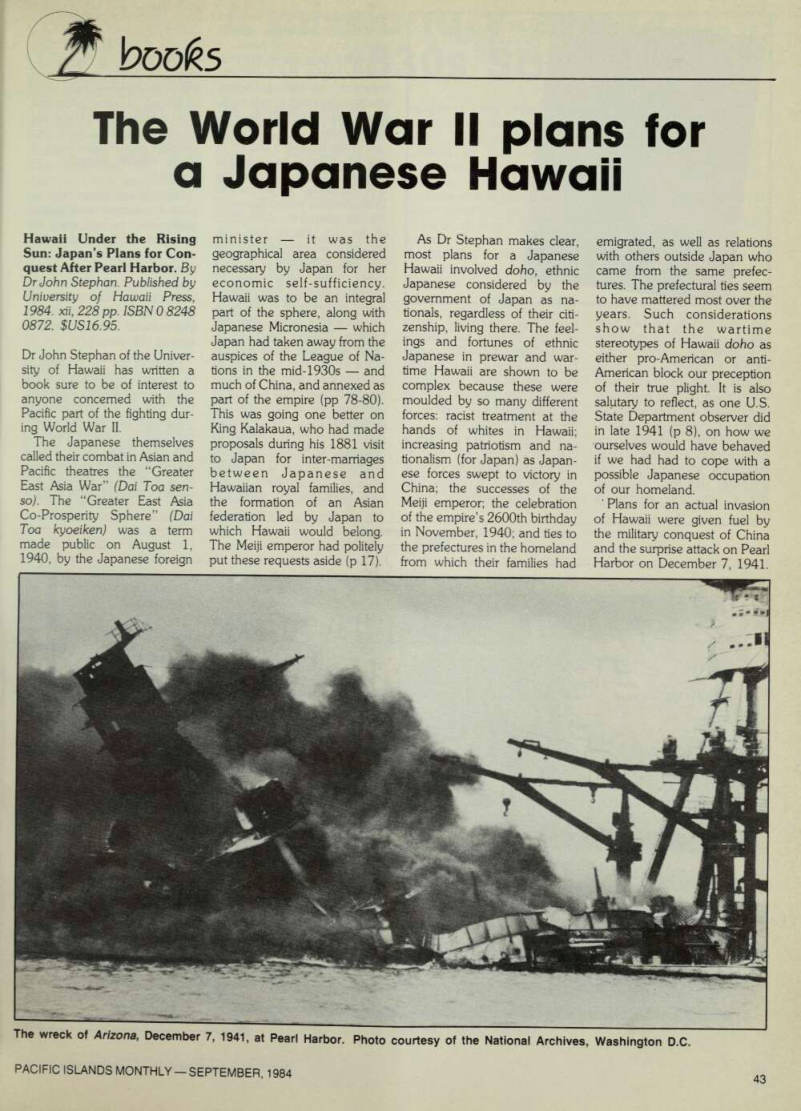
The wreck of Arizona, December 7, 1941, at Pearl Harbor. Photo courtesy of the National Archives, Washington D.C.
Yet, well before this had hap pened, a number of American and Japanese authors consi dered invasion scenarios, though most of these were uninformed by any considera tions based on reliable know ledge of military capabilities.
Some of these envisaged com bat in Montana, or the destruc tion of the Brooklyn Bridge and dirigibles landing Japanese troops atop the Woolworth
Building. Reading these accounts gives us the pleasure of studying authentic period literature, even if it is also racist in nature. All in all, four Amer ican and nine Japanese authors are presented by Dr Stephan in the chapter concerned.
Amazingly, as late as 1944, a few people were still working out invasion plans for Hawaii, although the U.S. Pacific fleet was by then taking over Japan
ese Micronesia. This was par tially due to censorship of war news, and in some cases to deliberate lying about the out come of battles. But it was also testimony to the unbridled, almost autonomous, self-confi dence called “victory disease” (senshobyo) .
In order to have a chance at invading Hawaii, the Japanese military had first to master the U.S. Pacific fleet. As far back as 1924, Admiral Seijiro Kawashi ma had advised the destruction of the U.S. Pacific fleet first, then an invasion of Hawaii. But this was something that they could never accomplish. In Miracle at Midway, which make* a nice supplement in places to Dr Stephan’s book, the late Gordon Prange examines in detail Japanese plans for the Battle of Midway, which lies in the Hawaiian chain. He reaches the conclusion in his analysis of Japanese war strategy that the Japanese navy never really made up its mind whether its objective at Midway was the destruction of the U.S. Pacific fleet, or the conquest of the atoll. Their failure to make that
basic decision resulted in poor disposition of naval forces and the loss of four aircraft carriers, which were sailing together in stead of apart, a loss from which the Japanese navy never recovered. (Prange adds that, even if Midway had been won by the Japanese, their next objective would have been to sortie against Australia, not Hawaii.) Dr Stephan shows that the Midway operation itself was an inter-service compromise be tween the Japanese army and navy, agreed upon in lieu of an invasion of Hawaii, called the “Eastern Operation”. As a rule, however, the two services did not get along well, which fur ther reduced their effectiveness against U.S. forces.
Planning for the occupation of Hawaii suffered from the same lack of agency co-opera tion and of central co-ordina tion which afflicted the Japan ese military. Overall planning was not done by a central agency, but taken up piecemeal by a number of agencies and research institutes. One of these
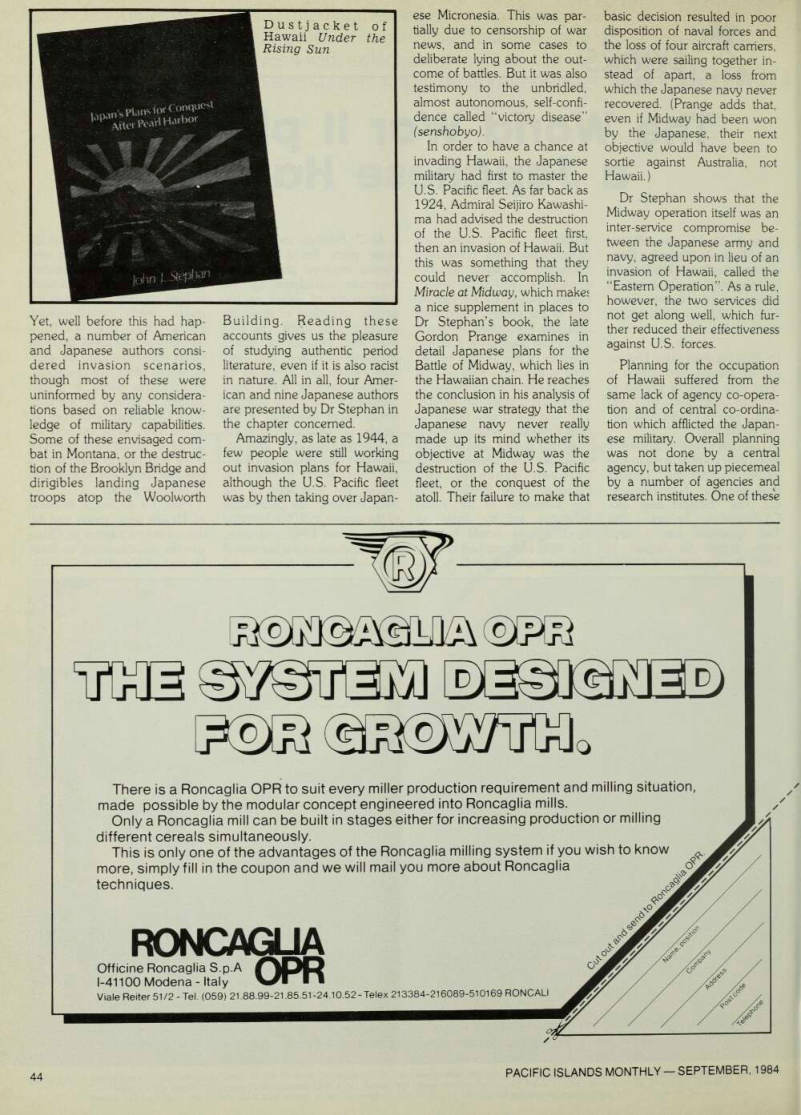
Dustjacket of Hawaii Under the Rising Sun
institutes, the South Seas Eco nomic Research Centre even had the services of Colbert Naoya Kurokawa, a Hawaii issei (first generation Amer ican), and the educational sec retary for the Nuuanu (Oahu) YMCA: later, Kurokawa never admitted or discussed working for the centre. Various political economic and social reforms were scheduled for Hawaii doho and, to a lesser degree, for other residents of Hawaii.
Among these were the dissolu tion of the Big Five corporations (Alexander & Baldwin, Castle & Cooke, C. Brewer, Theo.
Davies, and American Factors); severe cutbacks in sugar pro duction and greatly increased food crop cultivation for self sufficiency; and re-educating Hawaii nisei (second genera tion) and sansei (third genera tion) doho to accommodate them to Japanese rule and remove traces of Americanisa tion.
Dr Stephan wrote this book to cast light on Japanese war aims and on wartime divisions within Japanese society, and to analyse Japanese appraisals of Hawaiian economic and social conditions, as well as Japanese plans for the treatment of Hawaii residents. This he has done well.
He concludes with a warning about “the power and tenacity of illusions”. Illusions are perhaps easier to spot among the defeated.A Hawaii Victory Society was founded in the 1940 s to keep up the spirits of Hawaii issei until Japan had won the war it was not disbanded until November 1977!
Rather than belittle others for their patently vain hopes and for beliefs we know to be unfounded, let us use their mistakes as a means to prompt us to uncover the illusions we might still have. Dr Stephan points out that “popular stereotypes still portray the Pacific War as a collision of American democracy and Japanese militarism”, when it might very well have been part of what Akira Iriye in Power and Culture describes as “an on-going search for an in ternational order in which both sides exhibit parallel rather than conflicting concepts of an Asia-
Pacific ‘community’.”
ML
Berg.