trade winds
p. 35 · Read in the full issue
‘South Pacific skills could help Indian Ocean islands’ - Hayden
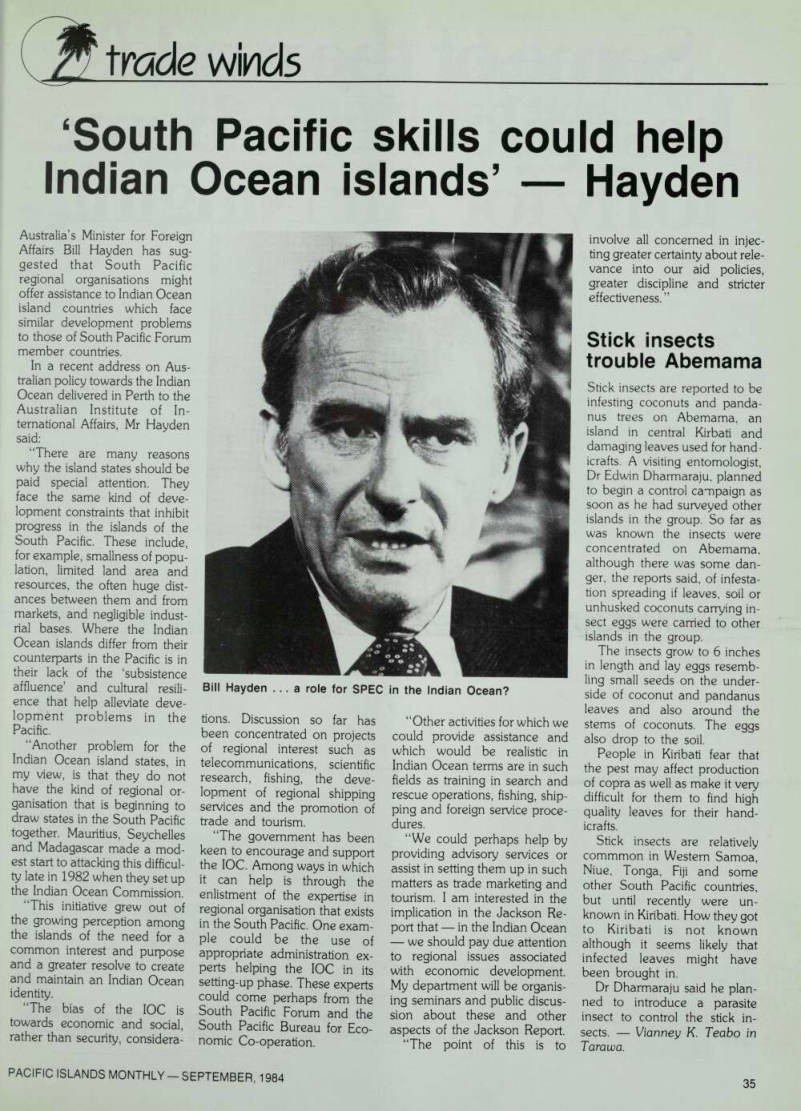
Australia’s Minister for Foreign Affairs Bill Hayden has sug gested that South Pacific regional organisations might offer assistance to Indian Ocean island countries which face similar development problems to those of South Pacific Forum member countries.
In a recent address on Aus tralian policy towards the Indian Ocean delivered in Perth to the Australian Institute of In ternational Affairs, Mr Hayden said; “There are many reasons why the island states should be paid special attention. They face the same kind of deve lopment constraints that inhibit progress in the islands of the South Pacific. These include, for example, smallness of popu lation, limited land area and resources, the often huge dist ances between them and from markets, and negligible indust rial bases. Where the Indian Ocean islands differ from their counterparts in the Pacific is in their lack of the ‘subsistence affluence’ and cultural resili ence that help alleviate deve lopment problems in the Pacific.
“Another problem for the Indian Ocean island states, in my view, is that they do not have the kind of regional or ganisation that is beginning to draw states in the South Pacific together. Mauritius, Seychelles and Madagascar made a mod est start to attacking this difficul ty late in 1982 when they set up the Indian Ocean Commission.
“This initiative grew out of the growing perception among the islands of the need for a common interest and purpose and a greater resolve to create and maintain an Indian Ocean identity.
“The bias of the lOC is towards economic and social, rather than security, considera-
tions. Discussion so far has been concentrated on projects of regional interest such as telecommunications, scientific research, fishing, the deve lopment of regional shipping services and the promotion of trade and tourism.
“The government has been keen to encourage and support the lOC. Among ways in which it can help is through the enlistment of the expertise in regional organisation that exists in the South Pacific. One exam ple could be the use of appropriate administration ex perts helping the lOC in its setting-up phase. These experts could come perhaps from the South Pacific Forum and the South Pacific Bureau for Eco nomic Co-operation.
“Other activities for which we could provide assistance and which would be realistic in Indian Ocean terms are in such fields as training in search and rescue operations, fishing, ship ping and foreign service proce dures.
“We could perhaps help by providing advisory services or assist in setting them up in such matters as trade marketing and tourism. I am interested in the implication in the Jackson Re port that in the Indian Ocean we should pay due attention to regional issues associated with economic development.
My department will be organis ing seminars and public discus sion about these and other aspects of the Jackson Report.
“The point of this is to
involve all concerned in injec ting greater certainty about rele vance into our aid policies, greater discipline and stricter effectiveness. ”
Stick insects
trouble Abemama
Stick insects are reported to be infesting coconuts and panda nus trees on Abemama, an island in central Kirbati and damaging leaves used for hand icrafts. A visiting entomologist, Dr Edwin Dharmaraju, planned to begin a control campaign as soon as he had surveyed other islands in the group. So far as was known the insects were concentrated on Abemama, although there was some dan ger, the reports said, of infesta tion spreading if leaves, soil or unhusked coconuts carrying in sect eggs were carried to other islands in the group.
The insects grow to 6 inches in length and lay eggs resemb ling small seeds on the under side of coconut and pandanus leaves and also around the stems of coconuts. The eggs also drop to the soil.
People in Kiribati fear that the pest may affect production of copra as well as make it very difficult for them to find high quality leaves for their hand icrafts.
Stick insects are relatively commmon in Western Samoa, Niue, Tonga, Fiji and some other South Pacific countries, but until recently were un known in Kiribati. How they got to Kiribati is not known although it seems likely that infected leaves might have been brought in.
Dr Dharmaraju said he plan ned to introduce a parasite insect to control the stick in
sects.
Vianney K. Teabo in
Tarawa.
Bill Hayden . . . a role for SPEC in the Indian Ocean?